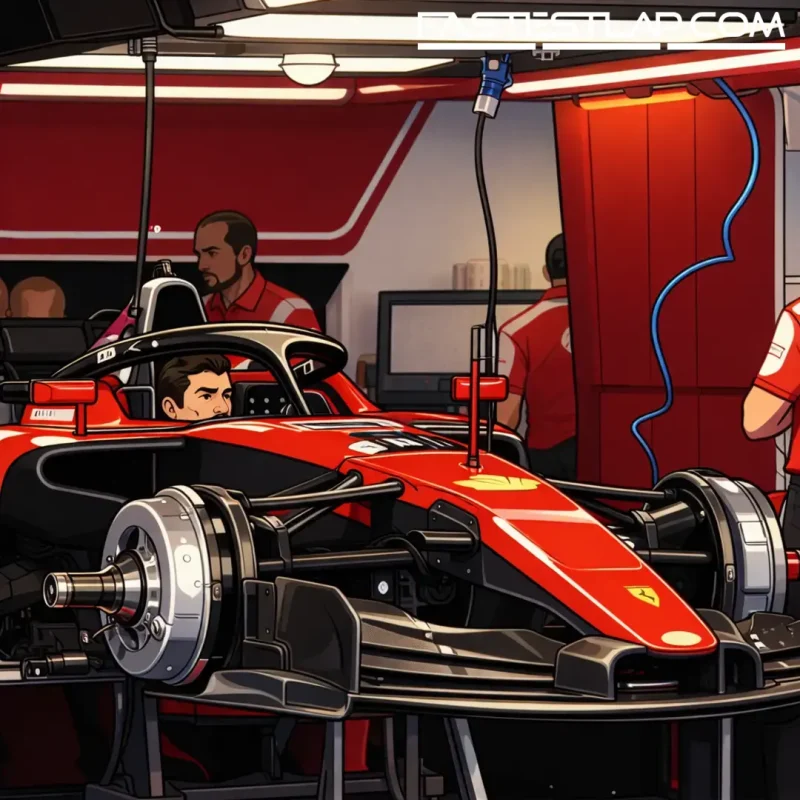
Ferrari arrived in Miami looking like a team trying to brute-force its way back into the conversation. Eleven new parts in one hit — floor, diffuser, a revised version of that “Macarena” rear wing concept aimed at better drag reduction while keeping load when it mattered — the sort of all-in development dump that either resets your season or leaves you staring at the ceiling at 3am wondering where your tools stopped telling the truth.
By Sunday night, it felt like the latter.
There was a flash at the start. Charles Leclerc topped the extended FP1 by close to three-tenths over Max Verstappen, the kind of session that gets people in the paddock peering over laptop screens and asking whether Ferrari’s finally found something. But it proved to be the high-water mark. Leclerc did salvage third in the Sprint, yet when the grand prix actually unfolded Ferrari was nowhere near dictating terms: fifth and seventh, and crucially out of the podium picture as McLaren muscled ahead. The gap to Mercedes told its own story — Leclerc went from being 15 seconds behind George Russell in Australia to finishing 40 seconds behind Kimi Antonelli in Miami, before a 20-second penalty for repeated off-track moments on the final lap added a sour postscript.
Ferrari’s line is that the upgrades were a step forward. That may be true in isolation. The problem — the one that keeps technical directors awake — is when the step isn’t big enough, and you can’t instantly say why.
Rob Smedley, who knows the Scuderia’s engineering heartbeat as well as anyone from his time there, called the aftermath “slightly soul-destroying” on the High Performance Racing podcast. He wasn’t being theatrical. In modern F1, bringing a huge package that doesn’t move the needle isn’t just “a bad weekend”; it threatens the basic confidence loop that lets you develop at pace.
If the car doesn’t do on track what the tunnel and simulation said it would, you’re forced into the most expensive activity there is: not making the car faster, but working out whether your instruments are lying. Ferrari now has to go back through every element of that Miami package and effectively reverse-engineer the weekend — which parts delivered, which didn’t, and whether the interaction between them is what killed the gain. And if even one component is off, the whole thing can become a fog.
That’s the hidden brutality of an 11-part roll-out. Scatter upgrades over a few races and, even if you’re disappointed, you can isolate cause and effect. Drop everything at once and you risk creating a correlation crime scene: too many fingerprints, too little certainty.
Otmar Szafnauer, also speaking on the podcast, underlined the organisational cost of that kind of correlation chase. Teams have finite resources, and when the development path goes murky, those resources get dragged away from outright performance and thrown at validation work — digging into why the numbers don’t match reality.
Szafnauer’s point was a practical one: even if you have a dedicated aero performance group, if it’s not large enough you end up pulling the same aerodynamicists who should be finding lap time into the business of debugging. It’s a double hit: you slow development while you investigate the very process that’s supposed to accelerate it. That’s how a “step in the right direction” can still leave you losing ground in the standings.
And the timing couldn’t be more awkward, because the wider competitive picture is shifting around Ferrari. Szafnauer revealed that Mercedes’ trackside engineering director Andrew Shovlin was wary of Ferrari heading into Miami — hardly surprising if you’d seen the scale of new parts in the garage — but Szafnauer was adamant even then that McLaren, not Ferrari, looked like the more credible long-term threat to Mercedes.
Miami did little to contradict him. McLaren’s weekend had the feel of a team whose development is landing cleanly, and whose car is giving its drivers something predictable to lean on. Ferrari, in contrast, left with an uncomfortable blend of “we improved” and “we’re still not close”.
The uncomfortable twist is that Mercedes hasn’t even played its hand yet. Szafnauer noted the Brackley team brought essentially nothing to Miami, choosing instead to hold a significant upgrade package for Canada. So while Ferrari is facing the prospect of spending valuable tunnel time and brainpower working backwards, Mercedes is preparing to move forwards — and McLaren is already operating like the natural disruptor in the fight behind (and perhaps against) the championship favourite.
None of this means Ferrari’s season is doomed. But Miami was the kind of weekend that can shape a development campaign for months, not because the parts “failed” in a simplistic sense, but because the team now has to establish whether it can trust its own map.
If correlation is intact, Ferrari can regroup, refine, and keep pushing. If it isn’t, the danger is deeper: not just that Miami didn’t deliver, but that the next update becomes a gamble. And in 2026’s early pecking order — with Mercedes setting the pace and McLaren punching hard — Ferrari can’t afford to be rolling dice with a car that needs certainties.