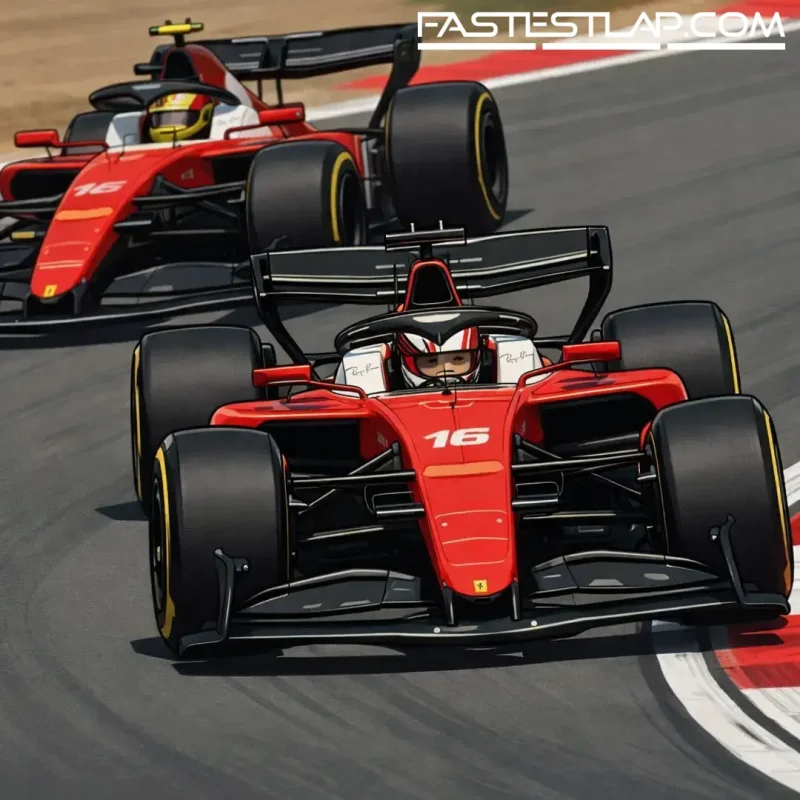
Ferrari didn’t need to say anything in Shanghai for the subtext to land. When you’ve got Charles Leclerc and Lewis Hamilton sharing a garage in the first year of a regulation reset, every clean on-track exchange doubles as a reminder of what could come later: not just points, but gravity.
That’s why Jolyon Palmer’s warning has travelled quickly through the paddock. In his view, if Ferrari really does end up with the benchmark car and both drivers are in the hunt, there isn’t a neat, grown-up way of “managing” it from the pit wall. Not because Frederic Vasseur is naive, but because history tends to do what history does when two A-listers can both win the title in the same colours. The moment it becomes championship-on-the-line, harmony stops being a policy and becomes a daily negotiation.
It’s easy to dismiss that as generic “Ferrari chaos” fearmongering — the oldest trope in the sport — but the ingredients here are unusually combustible. Leclerc isn’t a young prospect being brought along; he’s a Ferrari fixture who’s carried the expectation and the scar tissue of the last few seasons. Hamilton, meanwhile, hasn’t joined to play the wise elder. He’s there because he believes he can still win, and because Ferrari believes he can help them build a title-winning operation in a new era.
If the car is quick, the pressure will arrive early. Not necessarily as wheel-to-wheel aggression, but in the small, sharp decisions teams pretend are purely “race strategy”: whose undercut gets priority, who gets the first crack at a new front wing spec, whose Friday run plan gets protected when track time is limited. Those things are manageable when one driver is clearly ahead. They’re combustible when the margins are tenths and the stakes are a championship.
And then there’s the 2026 context. This isn’t a settled ruleset where teams can afford to play politics slowly. It’s a fresh framework, meaning momentum is currency and internal confidence matters. In that environment, even a mild perception of favouritism — real or imagined — becomes performance-altering. Drivers start protecting themselves rather than collaborating, engineers get pulled into factional noise, and the feedback loop that makes top teams brutally efficient starts to fray.
Leclerc, for his part, has been doing something else that’s notable: pushing back against the sweeping criticism of the 2026 regulations. Plenty around the grid and fanbase haven’t warmed to the new direction, but Leclerc’s take has been more pragmatic than romantic. He’s described the racing element as “really good,” pointing to the strategic layer introduced by the reliance on energy recovery systems.
That matters because it hints at where the friction might actually come from in 2026: not just “who’s faster”, but who understands the new game quickest. When strategy is more tightly entwined with energy deployment and recovery, the driver isn’t simply executing; he’s shaping the race in real time. If Leclerc genuinely feels comfortable in that environment — and if Hamilton finds his own edge there too — Ferrari could end up with two drivers capable of winning the same race in two different ways. That’s great for trophies, but it’s rarely calm inside the garage.
Elsewhere in the wider motorsport world, the Nürburgring 24 Hours served up an early reminder of how quickly a weekend can turn. A fiery crash in the opening minutes of the first qualifying session has triggered a stewards’ investigation after Alexander Hardt was left stranded and standing trackside to warn oncoming traffic, only for Janina Schall’s #146 Porsche to run into the back of his car. Both drivers appeared unscathed, and officials confirmed the incident will be investigated — but it was the kind of moment that freezes the room, even for those who’ve seen plenty.
Back in F1’s orbit, Mohammed Ben Sulayem has offered a pointed assessment of former Red Bull team boss Christian Horner, saying he’s “regularly” in contact with him and adding that Horner “talks too much” as part of his verdict on a potential return to the paddock. It’s a line with the unmistakable tang of politics: half throwaway jab, half reminder that in Formula 1, even people who are “out” are rarely ever truly out — and the FIA’s relationship with team powerbrokers remains its own ecosystem of leverage.
For Ferrari, though, the immediate storyline is simpler and more dangerous: what happens if the car’s good enough to make all of this real. Because if Leclerc is right and 2026 racing is going to be more strategically elastic — more shaped by energy management, timing, and judgement — then the old idea of controlling a title fight with “team harmony” becomes even harder. The margins will swing more often, the opportunities for one driver to feel short-changed will multiply, and the points will change hands faster.
The best teams don’t avoid these situations; they survive them. Ferrari’s challenge in 2026 may not be to prevent Hamilton versus Leclerc. It may be to accept it’s coming, and build an operation robust enough that the fight stays on Sundays — not in the briefings, not on the radio, and not in the storylines that start writing themselves the moment the red car looks like the one to beat.