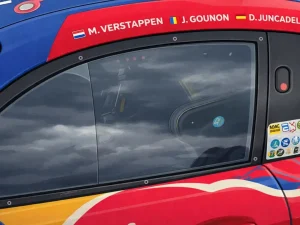
Max Verstappen’s Nürburgring 24 Hours project ticked off the kind of box endurance teams care about most: the car ran, the systems behaved, and nothing unexpected bit back in the final warm-up before the main event.
In the one-hour session around the Nordschleife — less a qualifying shootout than a last-minute sense check — Jules Gounon took the #3 Verstappen Racing Mercedes through its paces and brought it home ninth. On a weekend where the conversation has been as much about surviving the place as it is about raw pace, P9 in warm-up is exactly as informative as the team wanted it to be: not much, by design, except that it’s ready to go racing.
There were hints of the conditions everyone’s bracing for once the 24 hours begins. Light rain was falling in patches, giving drivers a quick reminder that Nürburgring weather rarely signs contracts and always keeps its options open. Warm-up laps in that sort of half-wet, half-drying uncertainty are valuable not because they produce headline times, but because they expose gremlins — sensors that don’t like spray, traction settings that need a tweak, brake feel that changes when the track goes greasy.
The early timing screens reflected that caution. Kévin Estre put the #911 Porsche at the top at the halfway mark with an 8:42.238, which said more about who happened to be on a lap at the right moment than any true pecking order. The #3 Mercedes sat fourth at that stage, with the usual Nürburgring caveat attached: traffic, flags and microclimates can make a mockery of comparisons even in a flat-out session, never mind one where the priority is checking boxes.
Things sharpened up in the final minutes as a few crews finally leaned on the throttle. The repaired #80 Mercedes — back in action after Maro Engel’s off on Friday forced work overnight — emerged as the late-session reference, first grabbing P1 as the clock ran down and then holding it to the flag.
With Maxime Martin at the wheel, the #80 stopped the clocks at 8:32.206, ending the hour 4.5 seconds clear of the #26 Mercedes. It was a neat statement for a car that had every right to spend warm-up simply ensuring the fixes were sound. Instead, it looked comfortable enough to show some speed when it mattered.
For Verstappen’s entry, the takeaway was more subtle but arguably more important. Warm-up at the Nürburgring is where teams find out whether a weekend’s work has actually joined up — whether the setup changes make sense in real conditions, whether the car behaves predictably over bumps and kerbs, whether the electronics and pit-to-car communication are clean. Gounon’s “smooth session” and the absence of drama is the kind of progress you only really notice when it’s missing.
And at a race like this, that calm is a currency. The Nordschleife doesn’t need an invitation to create chaos; you can arrive with the fastest car and still be one slow zone, one mistimed pass in traffic, one patch of rain on the wrong crest away from spending the night repairing bodywork. So a warm-up that looks almost uneventful on paper can be the best possible prelude.
Race day now becomes the real exam — not a sprint for a headline lap time, but the long grind of decision-making in mixed conditions, managing risk, and keeping the Mercedes in one piece while the track and the weather try to pry it apart. The #3 is up and running. At the Nürburgring, that’s a meaningful start.