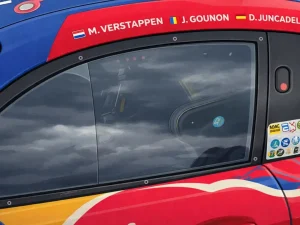
Max Verstappen doesn’t often sound like a rookie, but that’s effectively what he was at the Nürburgring this week: a four-time Formula 1 world champion discovering, in real time, that night racing in the Eifel mountains has its own rules — and that bad weather turns the lesson into something closer to survival training.
Verstappen is making his first start in the 24 Hours of Nürburgring, sharing the #3 Mercedes under the Verstappen Racing banner with Lucas Auer, Jules Gounon and Daniel Juncadella. The build-up has already been messy. Rain and hail have swept across the circuit on and off throughout the week, and when Verstappen finally got his first proper taste of the place in darkness, the conditions weren’t just awkward — they were borderline unreadable.
“The conditions were quite tricky,” Verstappen said, describing a night run in the wet that left him “barely” able to see. That wasn’t theatrics. With fog hanging, spray rising and vapour coming off the surface, the usual cues evaporated. In an environment where you’re hunting grip on a strip of tarmac that’s constantly changing elevation and camber, not being able to spot standing water early is a problem that compounds quickly.
His summary was blunt: you slow down because you have to. Not because you want to.
What’s interesting is not that Verstappen found it difficult — everyone does in those conditions — but that he framed it as necessary homework. He wanted time in the dark simply to adjust his eyes and calibrate his references. That’s the endurance racing bit F1 doesn’t really teach: you can have the outright speed and still need the acclimatisation, because the task isn’t just about extracting lap time. It’s about doing it with imperfect information and staying out of the barriers for stint after stint.
Verstappen also pointed to another Nürburgring quirk that tends to catch first-timers out: the crowd. The place is famously alive at night, and the trackside colours can play tricks on you when visibility drops. Verstappen admitted the fans can create confusion because, in the periphery, they can resemble “a yellow or green flag” — the sort of split-second misread that can either cost you time or cause you real trouble, depending on what you do next.
For a driver used to reading highly controlled signals in brightly lit F1 arenas, it’s a reminder that the Nordschleife isn’t interested in your CV. It’s busy, it’s dark, it’s wet, and it has a way of flattening reputations if you arrive assuming talent alone will cover the gaps in experience.
Yet within the #3 crew there’s a quiet confidence that Verstappen will adjust quickly, because that’s what he tends to do. Gounon, one of endurance racing’s proven operators, sounded more amused than concerned when asked about Verstappen’s rough first taste of the night.
“I don’t think many things have an effect on Max, to be honest!” he laughed. Gounon pointed out that Verstappen’s first experience was essentially the worst-case introduction — heavy rain, fog and steam — and suggested the Dutchman will “get to it” once the race settles into a rhythm. He even joked about the novelty of it all: a driver with Verstappen’s F1 status arriving somewhere and genuinely being “a rookie”, while the endurance specialists around him are the ones offering advice.
That dynamic is part of what makes this entry so compelling. In Formula 1, Verstappen is usually the reference point. At the Nürburgring 24, he’s one part of a four-driver unit, learning the subtleties of traffic management, stint discipline, and the particular kind of patience required when the fastest thing you can do is sometimes simply stay on the island and bring the car back intact.
If the weather stays volatile — and this week suggests it might — the race could become less about headline lap times and more about judgement. That’s where night driving at the Nordschleife really bites: you’re never just racing the stopwatch, you’re racing your own willingness to take risks when the track is giving you every reason not to.
Verstappen’s early takeaway sounded like a man ticking boxes with purpose rather than ego. He didn’t dress it up; he didn’t pretend it was comfortable. He went out, realised he could barely see, and filed it as experience he needed to bank. In a race that rewards humility as much as speed, that might be the most important stint he does all weekend.