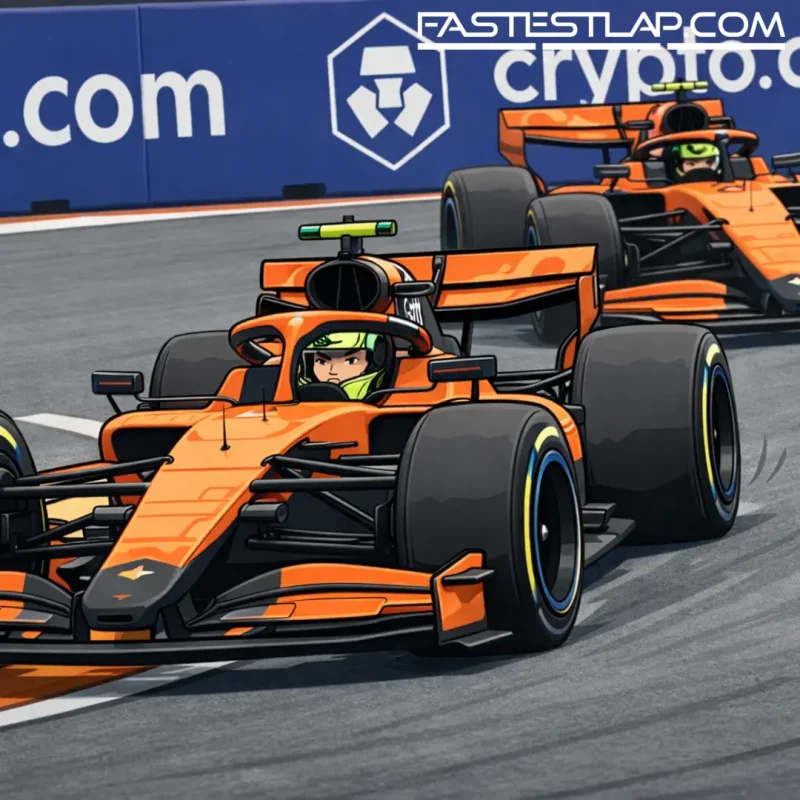
McLaren has quietly done something it probably should’ve done the moment “papaya rules” escaped the confines of a radio message and became a slogan: it’s stopped saying it.
The phrase was born in a fairly harmless moment back at Monza in 2024, when Lando Norris’ engineer Will Joseph told him he was free to race Oscar Piastri — but only “within papaya rules”. Andrea Stella later tried to frame it as nothing more than a reminder to leave extra margin when the car ahead is the same colour as yours. Zak Brown boiled it down even further: race hard, race fair, don’t touch.
In any other team, that might’ve been the end of it. At McLaren, it turned into a tag line that started doing the opposite of what it was meant to do.
Once last year’s title fight heated up, “papaya rules” stopped sounding like common-sense etiquette and started sounding like a policy that could be bent depending on which side of the garage was shouting loudest. Piastri being told to yield at Monza, then Norris tagging his team-mate in Singapore without any in-race consequences, were the kind of flashpoints that gave the phrase a life of its own. The noise got so loud it even spilled outside the paddock — to the point Australia’s parliament felt compelled to ask whether Piastri was being treated fairly.
That’s the risk with branding something that’s supposed to be unglamorous. A “rule of engagement” is meant to be boring. It’s meant to be internal. It’s meant to be the thing you don’t notice until the day it isn’t followed. Give it a catchy name, and you’re inviting the world to keep score.
Former Ferrari engineer Rob Smedley made that point bluntly on the High Performance Racing podcast, joking that “papaya rules” is exactly why you shouldn’t let the marketing department anywhere near the serious stuff. And he wasn’t just taking a swipe for the sake of it — he was describing a dynamic every team knows too well.
Every organisation has its own version of these rules. Some are written down, some are understood, some change depending on the stakes. What matters isn’t the label; it’s whether everyone — drivers, engineers, strategy group, team leadership — is operating off the same page when the pressure spikes.
Smedley’s broader criticism was that McLaren appeared to lose that clarity at times last season. Not necessarily because the intentions were wrong, but because the messaging didn’t land consistently across the team. That’s how you end up with half the garage believing one thing, half believing another, and the outside world spotting the seams. Once that happens, even the fairest call looks political.
Piastri, for his part, has already hinted that the internal operating model is being reshaped. He’s said the “papaya rules” will “look different” this year, and admitted McLaren “probably caused some headaches for ourselves that we didn’t need to at points last year.” The simplest painkiller is obvious: stop giving critics a handy phrase to weaponise.
The irony is that McLaren doesn’t actually need a slogan to manage two front-line drivers. It needs something less glamorous and more difficult: consistency. Consistency in how the pair are allowed to race when they’re fighting for podiums, and consistency in how the team reacts when it goes wrong — because sooner or later, with two aggressive racers in similar machinery, it will.
So far in 2026, the competitive picture inside McLaren has been close enough to keep the same questions bubbling. Norris has edged the intra-team points battle 51–43, with the pair sitting fourth and sixth in the Drivers’ Championship. That’s not an unbridgeable gap, but it’s enough to keep perceptions sensitive — particularly given how last season ended, with Piastri ultimately losing the title by 13 points to Norris and also being overtaken by Max Verstappen in the standings.
The bigger point is this: McLaren is trying to remove the theatre from its decision-making. When a team finds itself explaining its own vocabulary more than its racing, it’s already lost control of the narrative. Dropping “papaya rules” isn’t a revolutionary change in how McLaren will operate — Brown has made it clear they’ll still race “the way we go racing” — but it is an acknowledgement that the words mattered as much as the calls.
In the paddock, the smartest teams are usually the ones that leave as little as possible open to interpretation. McLaren learned, the hard way, that you can’t trademark trust. You can only earn it — and you can definitely lose it if your internal guidelines start sounding like a marketing campaign.