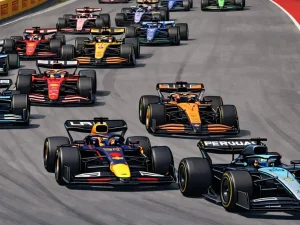
McLaren arrived in Miami needing a reset. It left with something more useful: proof that its upgrade programme is finally landing in the window often enough to turn promise into points.
Lando Norris and Oscar Piastri finishing second and third delivered the reigning constructors’ champions their first double podium of the 2026 season, and Andrea Stella didn’t try to hide what mattered most to him. It wasn’t just the trophy room optics — it was the direction of travel.
“With four teams separated by very little lap time,” Stella said after the weekend, the pecking order is now so tight that it’s increasingly “about execution and optimization and adaptations to the conditions, rather than one team being dominant.” In other words: welcome back to the part of the cycle where weekends are won by the teams that can nail the details, not simply bolt on the biggest performance step.
Stella’s read is that Mercedes still holds a slight underlying edge, but the more telling point was how open the sharp end looked across sprint qualifying. In his view, there wasn’t a single obvious “should’ve” on sprint pole — Kimi Antonelli, Charles Leclerc, Norris, Piastri, Max Verstappen all felt plausible candidates depending on who stitched the lap together and who didn’t. That’s the kind of competitive compression that turns incremental updates into real weapons.
And McLaren’s updates, Stella insisted, did exactly what they were supposed to do.
He noted Ferrari appeared to have brought a more substantial package to Miami than Red Bull or McLaren in pure volume, yet McLaren still managed to extract the performance it was chasing. That’s a quiet but significant subtext: when you’re not necessarily bringing the biggest bundle of new parts, your correlation and integration have to be sharp. Miami, in Stella’s telling, was a validation of process as much as product.
The timing has been handy, too. The unusual gap in the calendar caused by the cancelled Bahrain and Saudi Arabian grands prix offered everyone extra factory time, but Stella’s tone suggested McLaren feels it converted that opportunity more effectively than most. With the competitive order now so sensitive, “more effectively” might just mean arriving with parts that do what the wind tunnel and tools promised — and knowing how to set them up quickly enough to cash in on a given weekend.
McLaren, crucially, isn’t stopping there. Stella confirmed more updates are due for this weekend’s Canadian Grand Prix, framing Miami as an encouraging step in an ongoing sequence rather than a one-off hit.
That matters because Montreal is the sort of track that can make a fool of any narrative built on a single result. Norris himself was quick to strike that note, even as he admitted it would be “silly” not to take confidence from the progress.
“I think you’d have to feel silly if you don’t feel confident about the future when we improved so much this weekend,” Norris said, before immediately putting a pin in the optimism. He pointed out that while Montreal has tended to suit McLaren, it’s also a venue that historically flatters Mercedes — and, as he noted, a Silver Arrows driver has been on the Canadian GP podium every year since 2013.
Norris’ caution isn’t false modesty; it’s an accurate description of modern F1 reality. The field is close enough that each circuit type can reshuffle the deck, and the difference between fighting for pole and fighting for fifth can be as small as a tyre preparation trend, a Friday compromise that doesn’t quite work, or a gusty track evolution you misread by half a step.
That’s why Norris framed Miami as a data point, not a conclusion. He talked about needing to measure form across “a number of races and different styles of track: street circuits, hot tracks, cold tracks, tight and twisty, fast circuits.” It’s the calendar’s variety that exposes whether your upgrade path has genuinely broadened the car’s operating window — or simply boosted it in one set of conditions.
For McLaren, Canada is therefore less about repeating a podium and more about stress-testing the upgrade story Stella is trying to tell. If the additional parts arriving in Montreal behave, and if the team can execute cleanly in a weekend where margins are expected to be microscopic, Miami starts to look like the first page of a longer run rather than an isolated headline.
The encouraging thing for McLaren is that, in this kind of four-way knife fight, momentum doesn’t always need to be dramatic. Sometimes it’s enough to keep turning up with a car that’s a touch easier to optimise than your rivals’ — and a team that understands exactly where the lap time is hiding when the stopwatch says everyone is effectively tied.