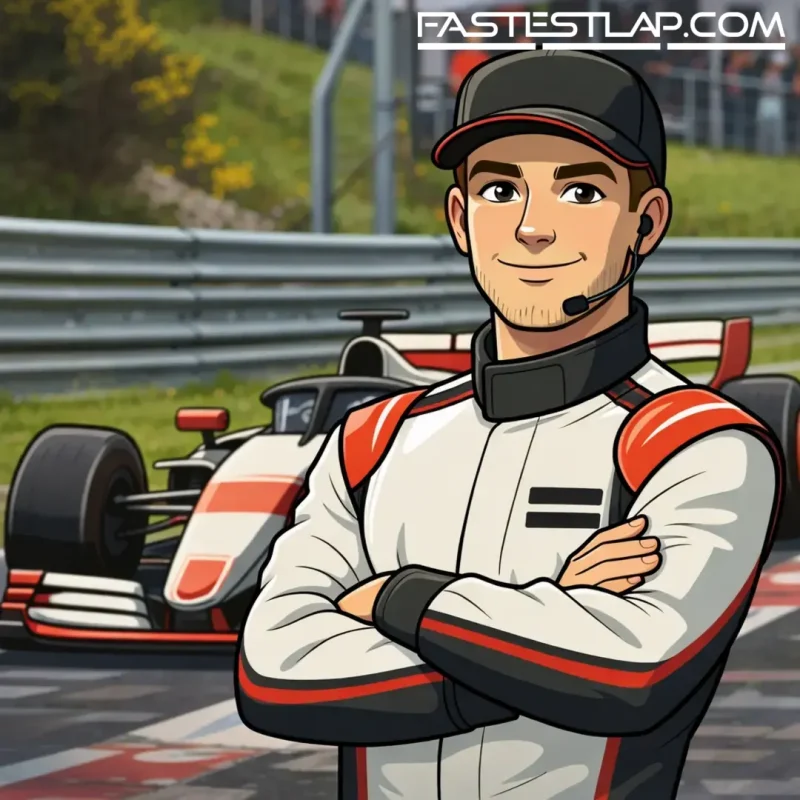
Max Verstappen didn’t go to the Nürburgring 24 Hours for a jolly. He went there because it scratches an itch Formula 1 hasn’t quite been able to reach lately — and because, in his own words, it’s now “unfinished business”.
A free weekend in the F1 calendar gave the four-time world champion the chance to throw himself into his first major endurance race, joining a four-driver crew in a Mercedes-AMG GT3. On paper it looked like a fun side quest. In reality, it turned into the sort of bruising, absorbing, properly old-school racing Verstappen has been hinting he craves when he talks about what modern grand prix driving is — and isn’t.
For most of the night it was going his way, too. The #3 Mercedes shared by Verstappen, Lucas Auer, Dani Juncadella and Jules Gounon had emerged as the sharper of Winward Racing’s two cars, and by the time the race neared the 21-hour mark the Verstappen-linked entry was leading with close to a 30-second cushion.
The key moment came in the intra-Mercedes duel. Verstappen found himself fighting Maro Engel in the #80, and in the kind of wheel-to-wheel exchange that endurance racing serves up when the track, traffic and tyre life all collide, he forced the issue and turned a fight into clear air. By the time he handed the car over to Juncadella with just over three hours remaining, the job looked neatly under control.
Then endurance racing did what endurance racing does: it reached for the trapdoor.
Minutes after Verstappen climbed out, a driveshaft failure ended the car’s fight for the win. Juncadella limped back to the pits, but there was no quick fix. After all the preparation — including months spent building up to the event via qualifying races to secure the required DMSB permit — the challenge was effectively over on the spot. The #3 eventually returned to circulate near the end and was classified 38th, a result that tells you nothing about how close it had been to a statement victory.
Verstappen kept his Nürburgring media obligations to a minimum at the time, speaking only briefly in the pitbox. But back in Montreal on Thursday ahead of the Canadian Grand Prix, he was unusually open about just how much the experience landed with him.
“Overall, it was just a great week. Yeah, I enjoyed it a lot,” Verstappen said. “It was my first big endurance race, and everything went really well. Yeah, we had the car in good shape. I think we executed it very well.
“Unfortunately, it’s still a mechanical sport at the end of the day, and yeah, we had that failure, which, of course, cost us the win, because we had everything under control up until that point.
“But the whole experience of also driving in the wet, changing conditions, and the whole experience like sharing it with my teammates was something that I really enjoyed.”
That line about “wet, changing conditions” is doing some heavy lifting. Verstappen’s Nürburgring fix wasn’t simply about driving a GT3 car; it was about the type of driving. The Nordschleife in a 24-hour format forces commitment and adaptability — not just to weather and track evolution, but to traffic management and rhythm, lap after lap after lap. It’s “flat-out” in the way he’s argued F1 has moved away from with the latest power unit era and its accompanying driving techniques.
Asked in Montreal about how satisfying endurance racing feels compared to F1, Verstappen didn’t dress it up as a substitute. But he didn’t hide the appeal either.
“It’s a different discipline,” he said. “I enjoy it a lot, and it’s something that I always wanted to do outside of Formula 1. There are a lot of other kinds of racing that you can do, and that one was definitely on my list.
“I think if you look at the onboards, I think you can understand why; it’s brutal and just very exciting… and of course, also something that I would like to keep going.”
And he’s already positioning himself for a return — with a caveat that doubles as a subtle message to anyone trying to read his long-term intent.
“I do feel that it’s a bit like unfinished business,” Verstappen said. “I want to win it, so I want to go back, but of course, the calendar needs to allow it.
“But it’s definitely a race that I want to do more often.”
That’s the interesting part. Verstappen has left the door open earlier this year when asked about how long he wants to remain in F1, especially as the early realities of the new regulations became clearer. Now he’s talking about making sure the F1 calendar doesn’t clash with the Nürburgring 24 Hours — which is about as close as you get, in Verstappen language, to confirming you’re still planning around grand prix racing.
He stopped well short of any neat declaration, though, and kept his answer in the grey zone he prefers.
“I’m not yes or no, it doesn’t matter,” Verstappen said. “For me, I’m happy where I’m at. I see the team really progressing, and that’s also very exciting to see. For me, I always wanted to continue anyway, but I always wanted to see change, and I think the change that’s coming now is definitely very, very positive, or at least I would say almost back to normal, so that’s good.”
So, no grand announcement. Just Verstappen doing what Verstappen does: racing anything he can, as hard as he can, and letting the rest of the sport work out how to keep up — on track, and off it. The Nürburgring didn’t give him the trophy this time. It did give him a reason to come back.