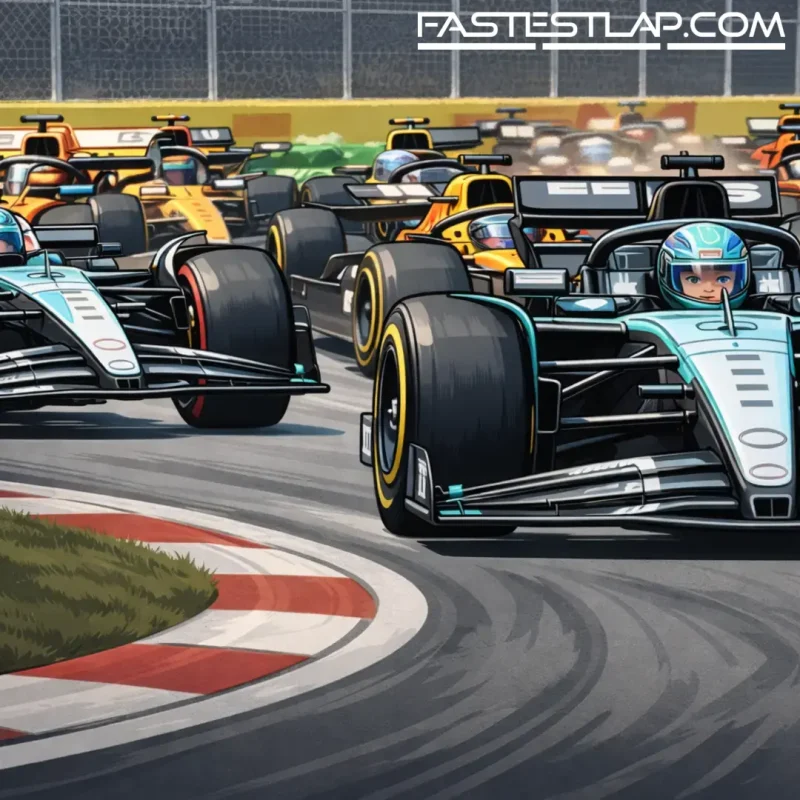
Montreal tends to arrive right when the 2026 season starts feeling real.
Up to this point, the story has largely been Mercedes dictating the pace and everyone else trying to work out whether they’re chasing a mirage or a genuine benchmark. But Circuit Gilles Villeneuve has a habit of stripping away assumptions. It’s a track that punishes hesitation, rewards decisive set-up calls, and—when the weather turns—exposes any weakness in preparation. Add a Sprint weekend to that mix and you’ve got an event that can swing from “routine points haul” to “damage limitation” in the space of a couple of sessions.
That’s why this Canadian Grand Prix feels less like just another stop on the calendar and more like an early-summer audit. The margins are tight enough already; with the Sprint format compressing the schedule, there’s barely time to breathe, let alone to methodically tune a car into its window. One practice hour on Friday and then you’re straight into Sprint Qualifying—meaning the first truly meaningful laps of the weekend arrive before teams have even completed the sort of basic long-run work they’d normally use to calm nerves and confirm tyre behaviour.
For Mercedes, that time pressure cuts both ways. If the car’s underlying balance is solid, the shortened weekend becomes an ally: fewer opportunities for rivals to iterate towards them. If the car needs coaxing, or if the conditions change quickly, the Sprint format turns into a stress test. And Montreal is absolutely the sort of venue where a tiny misjudgement—brake stability into the chicane, rear traction out of slow corners, kerb use that’s just a touch too ambitious—can spill into lost track position or something worse.
The paddock chatter ahead of this one has a familiar edge: Mercedes has started the year strongest, but the gap has already looked less comfortable in Japan and Miami. This weekend is framed as a moment where a major upgrade package could either restore daylight at the front or, at the very least, settle the argument about whether the chasing pack has truly closed up. Montreal is a clean place to read performance because it demands efficiency and confidence under braking; if the upgrade adds what Mercedes believes it adds, it should show.
The more intriguing tension, though, sits inside the garage.
George Russell arrives in Canada with an uncomfortably simple line in the sand: he’s 20 points behind Kimi Antonelli. Nobody in that team will dress it up as panic—there’s too much season left for that—but in modern F1, momentum becomes narrative far quicker than teams would like. Antonelli has put himself in the position every rookie dreams of: fast enough to score hard points early, calm enough to make it look repeatable, and now leading the intra-team fight with enough margin that Russell can’t wave it away as noise.
Russell’s situation isn’t dramatic so much as sharp. If Mercedes really does have a step to unleash this weekend, the natural assumption is that he’ll be one of the drivers best placed to exploit it: experienced, aggressive when it matters, and usually strong when grip is inconsistent. But the flip side is obvious too—if Antonelli continues to look comfortable and Russell has another messy weekend, the “who’s the reference point?” conversation becomes harder to avoid.
That’s where Montreal’s particular brand of pressure comes in. It’s not a circuit where you can dial it back and wait for Sunday. Traffic can ruin your day in a heartbeat, the walls are close enough to punish half-commitment, and track evolution can make yesterday’s conclusions feel irrelevant. With Sprint points available, there’s an extra layer of incentive to lean into risk earlier than teams might like. Mercedes can’t afford to be casual with execution; neither can either driver in a garage battle that’s already live.
And then there’s the weather.
Canada has long been the race where forecasts are treated like rumours until the first drops actually hit the visor, and 2026 looks set to continue that tradition. A mixed outlook across the weekend opens up the kind of strategic mess that teams both fear and secretly enjoy: the wrong tyre call at the wrong minute, a Safety Car at the wrong moment, or a timing swing that flips the competitive order without warning. On a Sprint weekend, the complexity multiplies because parc fermé constraints and limited practice reduce the opportunity to “learn” the track in evolving conditions before the points-paying sessions begin.
If we do get wet running—especially if Sunday is the first properly wet race of the season—the weekend becomes as much about clarity of decision-making as outright speed. Drivers will need to be precise in the braking zones and brave over the kerbs, but the bigger wins may come from teams that stay calm when the radar turns ugly and the crossover moment arrives faster than expected.
All of which makes this Canadian Grand Prix a deceptively important marker. Mercedes has the chance to answer the questions that have been creeping in since Japan and Miami. Russell has a chance to halt a points deficit that already has bite. Antonelli has the chance to prove his early-season advantage isn’t just a good run—it’s a real shift in the team’s internal pecking order. And Montreal, being Montreal, will do its best to make sure none of it plays out neatly.
By the time the 70-lap race is done on Sunday, we should know whether this season remains Mercedes-led with occasional scares—or whether the championship fight is about to get properly uncomfortable for the team that started it on top.