
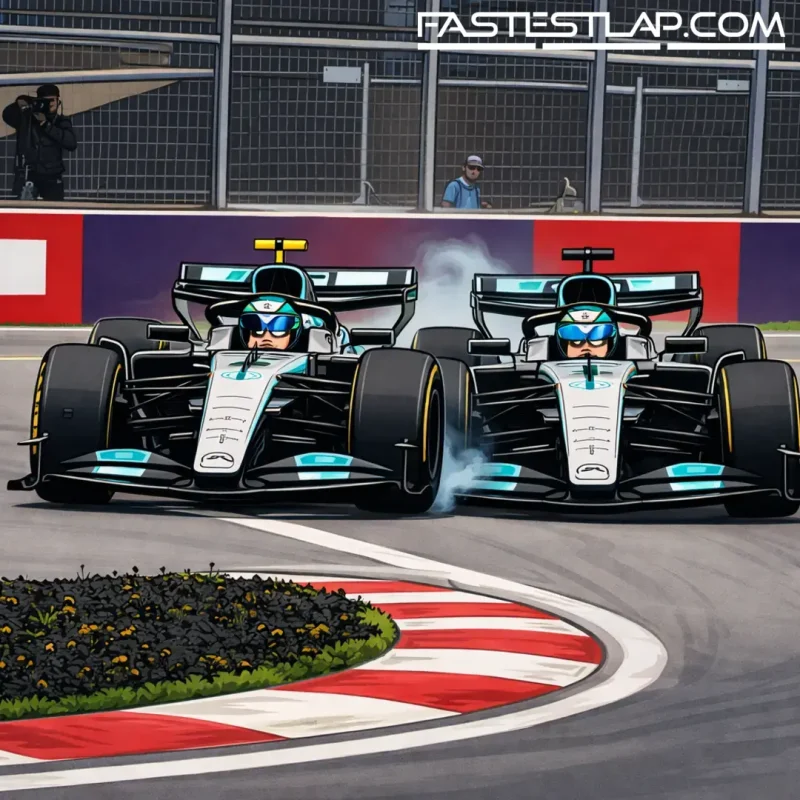
Mercedes arrived in Montreal with the kind of intra-team harmony that looks great on the timing screens and feels a lot messier in the cockpit. By the time the Canadian Grand Prix Sprint had settled down, Kimi Antonelli and George Russell had made it clear that whatever’s been agreed in the pre-race briefings isn’t being interpreted the same way once the visors go down.
The flashpoint came immediately. Antonelli launched alongside Russell through the opening sequence and tried to make the long way round at Turn 1 work, with an eye on cutting back for the inside at Turn 2. Instead, he found grass and consequence — momentum gone, position lost to Lando Norris, and a rapid spike in temperature on the radio.
Antonelli’s verdict in the moment was blunt: Russell’s defence was “very naughty”. Toto Wolff’s response was even blunter, stepping in on team radio to tell his rookie to “concentrate on the driving please, and not on the radio moaning”. It was a very Mercedes exchange: the boss policing the tone as much as the tactics.
Afterwards, Antonelli didn’t try to hide how much it bothered him, but he also didn’t turn it into a public feud. The theme of his comments was clarity — not payback. Mercedes, he said, holds meetings before races to lay out how the drivers should go racing, and he felt the Turn 1-2 sequence didn’t match what he believed had been discussed.
“We do meetings before races, and that’s what we say in the room,” Antonelli explained. “Then, of course, we race to win, and we try to do our best to defend our position. So, probably I understood the significance of that meeting a bit differently, but just obviously I need to recheck.
“My emotions were very high in the moment, and obviously I was very annoyed, but I just need to recheck, and for sure we’re going to talk about it, and we’re going to clarify on that.”
That’s the key phrase: *understood… differently*. This isn’t a driver demanding his teammate be put on a leash; it’s a driver realising that “race hard, be sensible” is a slogan until the first time both cars arrive at a braking zone with a realistic shot at winning. Antonelli’s not asking for Russell to be told to move aside — he’s asking for the line in the sand to be drawn in ink rather than pencil.
Pressed on whether he’d change his own approach if Russell’s defence is deemed within the agreed boundaries, Antonelli again went back to the same idea. He wants the rules of engagement restated so both drivers know exactly what’s acceptable — and what isn’t — before the next high-speed disagreement.
“For sure, I think probably we just need a bit of clarity, and then once it’s clear, then it’s all going to be fine,” he said. “I think definitely I need to probably ask again, but the main thing for the team is that there’s no contact, that we don’t crash into each other, which today at the end was very close.
“I think that’s the most important thing for the team. Also, as a driver, you don’t want to crash into your own teammate. We all want the best for, first of all, each other, but also for the team, so for sure we will clarify, and everything’s going to be fine.”
Russell, for his part, sounded almost amused by the whole episode — the tone of a driver who’s just won a Sprint and enjoyed having to actually fight for it. He insisted he hadn’t crossed any line and pointed to the stewards’ silence as the simplest defence: no investigation, no problem.
“I mean, truthfully, I need to check it as well,” Russell said. “From my side, I didn’t think I did anything wrong, and it wasn’t investigated, so I guess the race directors and stewards thought the same, but I need to check it.
“It is clear that between teammates we race hard and fair and no contact, and that’s always the objective. I wasn’t racing Kimi any harder than I would have raced Lando [Norris] in the same position.”
That last point is doing a lot of work. Russell’s essentially arguing that Antonelli is asking for teammate treatment, while Russell believes the “teammate treatment” is simply leaving that extra sliver of margin to avoid contact — not softening a defence. He even noted that in previous fights he’s tended to give Antonelli more room than he would a rival, precisely because the consequences of misjudgement are so much higher when both cars wear the same badge.
“We’re both here fighting to win, and always in the past, even last year when we battled, I always gave Kimi a bit more room compared to anyone else,” he said. “There was nothing untoward with the driving, and as I said, I don’t think it wasn’t even investigated, so that’s I think that says enough.”
The bigger picture is hard to ignore: this wasn’t a midfield squabble over eighth. Russell’s Sprint win mattered. It cut into what had been an early championship gap, trimming Antonelli’s advantage to 18 points. In other words, the tension isn’t manufactured; it’s structural. When the stakes rise, “don’t hit each other” stops being a principle and becomes a negotiation — one braking zone at a time.
Mercedes now has the familiar job of managing two drivers who both believe they’re entitled to the same piece of track. Wolff can shut down radio tone all he likes, but the more important conversation will happen behind closed doors: not whether Antonelli should complain, but whether both drivers are genuinely aligned on what “hard but fair” looks like when the win is on the table.









