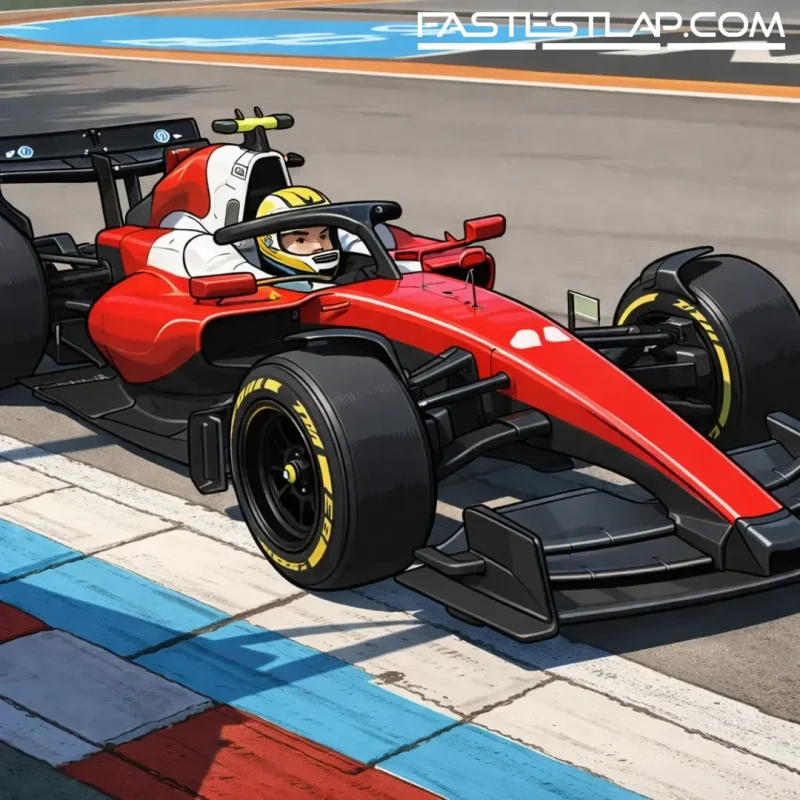
Lewis Hamilton escaped a late-Sprint sting from the stewards in Montreal after the FIA decided not to take action over his trip across the final chicane in a three-car scrap that had already turned messy enough on track.
The Ferrari driver was placed under investigation following a last-lap fight with McLaren’s Oscar Piastri — with Charles Leclerc also hovering — when Hamilton cut Turn 13 and rejoined still ahead of Piastri. Given the way leaving-the-track calls have gone in recent seasons, the sight of “under investigation” next to Hamilton’s name felt like it could easily become one of those routine, quietly painful post-Sprint penalties that reshuffle the order long after the chequered flag.
Instead, Hamilton was cleared.
The stewards’ explanation hinged on a point that’s become increasingly central to how these incidents are policed: whether the car behind is actually in a position to overtake, and whether the driver ahead is therefore “defending” in a way that creates a lasting advantage by shortcutting the track.
In their written decision, the stewards confirmed Hamilton (Car 44) was already in front of Piastri (Car 81) on the approach to Turn 13, left the circuit through the chicane, and rejoined still ahead. But crucially, they did not consider Piastri to be “in an overtaking position” at the moment Hamilton went off. That distinction meant Hamilton was not deemed to be defending, and therefore not judged to have gained a lasting advantage — a call the FIA said was consistent with its Driving Standards Guidelines.
It’s a nuanced ruling, and one that will do little to calm the broader paddock frustration about grey areas around track limits. But the stewards were clearly conscious of the optics here, because the decision also directly addressed why Hamilton’s case wasn’t treated the same as an earlier one in the same Sprint.
Audi’s Nico Hülkenberg had been handed a 10-second penalty for leaving the track and gaining an advantage in a clash with Liam Lawson — and the contrast was the first thing most teams and fans latched onto once Hamilton’s investigation emerged. The FIA’s answer was essentially that Hülkenberg’s incident featured a car properly placed to attack; Hamilton’s did not.
For Hamilton, it brought an immediate sense of relief on a day that had already swung from promising to frustrating. He’d launched well and got the better of Piastri early in the 100km race, then spent much of the Sprint clinging on to fourth as the McLaren came back at him late. There was even a brush with the Wall of Champions as the pressure ramped up — a reminder that in Montreal you can do everything “right” and still pay for being a centimetre off line.
But the final lap was where it unravelled. Piastri forced the issue at the last corner to get through, and Hamilton’s compromised exit left him vulnerable to his own teammate. Leclerc had the momentum to drag past and snatch the place at the line, leaving Hamilton sixth on the road and suddenly facing the possibility of being shoved even further back by the stewards.
That sting never arrived, but the bigger takeaway is what this decision says about the current threshold for intervention. The stewards are not simply asking whether a driver left the circuit and rejoined ahead; they’re interrogating the context of the battle at the moment it happens — who’s actually alongside, who has earned the right to the corner, and whether the action changes the competitive situation in a “lasting” way.
That’s logical in theory, yet it’s also exactly the sort of subjective interpretation that guarantees another team will feel hard done by the next time a similar-looking incident gets a different outcome. Montreal’s final chicane is especially good at producing those “it depends” moments, because cars arrive there on the limit, in the wake of DRS runs, and any slight misjudgement looks indistinguishable from gamesmanship on the replay.
Up front, the Sprint win went to Mercedes’ George Russell, who finished ahead of McLaren’s Lando Norris, with Mercedes team-mate Kimi Antonelli third. Their on-track elbows-out moment added another layer of spice to a weekend already thick with incident — and it underlined how quickly a Sprint can become less about banking points and more about sending messages, even within the same garage.
For Hamilton, though, Saturday’s headline is simpler: he survives the stewards and lives to fight the rest of the Canadian Grand Prix weekend without a penalty hanging over him. In a season where margins and momentum swings are brutal, sometimes the biggest win is simply avoiding the one you don’t deserve to be fighting in the first place.