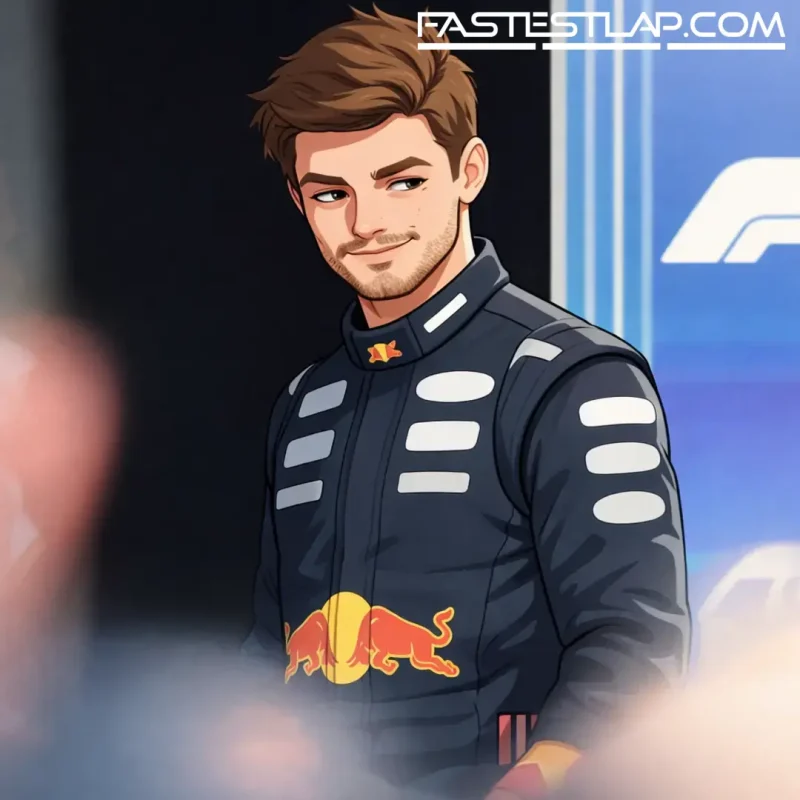
Esteban Ocon doesn’t sound remotely convinced by the idea that Max Verstappen is plotting an exit route.
With the grid still adjusting to 2026’s power-unit reset — the much-debated 50/50 split between internal combustion and electrical power — Verstappen has been the loudest voice arguing that F1 has wandered into a cul-de-sac. He’s labelled the new direction “anti-racing” and, in typically unvarnished fashion, compared it to “Formula E on steroids”. More than once, he’s warned that if the sport stops being fun, he’s got no problem walking away.
But Ocon, now at Haas, thinks the temperature has changed — not because Verstappen has softened, but because the rule-makers have.
“He will not go away,” Ocon insisted in an interview with Automoto.it, pushing back on the notion that the four-time world champion might actually act on his frustration. “Clearly, if we were to lose such a winning driver for the technical regulations, it would be a problem. But it will not happen.
“They are listening to us, and we are moving in the right direction.”
That “direction” is the FIA and manufacturers agreeing to tilt the balance back toward combustion power over the next two seasons. The plan is for 2027 to move to a 58/42 split in favour of the ICE, before 2028 pushes it further to 60 per cent combustion.
It’s an unusually explicit admission that the initial concept, while politically and commercially attractive on paper, hasn’t landed cleanly in the cockpit. The drivers have spent the early months of this era talking less about racecraft and more about energy deployment, harvesting targets, and the peculiar compromises that come with “super clipping” — the sensation of the car running out of electrical assistance at awkward moments, forcing a lift even when instinct says flat.
Verstappen, speaking in Spain, welcomed the shift as “a nice change”, but his comment came with a barb that told you everything about why this conversation won’t go away overnight.
“I would have hoped next year would be what we get already in 2028,” he said. “But I also understand that there are politics involved in that.”
That’s the subtext that keeps the rumours alive: it isn’t only about what’s written in the regulations, but how quickly F1 is willing to react when the racing product — and the drivers’ relationship with it — starts to fray. Verstappen has never hidden that he’s motivated by the purity of competing rather than the idea of simply occupying a seat, and the new energy management demands have clearly grated.
Ocon’s read is that the sport has blinked early enough to keep a generational talent engaged. He also suggested there’s now a broad paddock agreement that the current cars became “too complicated” at the beginning of the year, and that interventions already made are a positive sign.
Still, Ocon couldn’t resist a broader point: if F1 wants to avoid this cycle repeating, it may need to look further back than a tweak to percentages.
Asked what he’d choose in an ideal world, Ocon didn’t go for a fashionable compromise. He went straight to nostalgia — but with a modern add-on.
“A non-turbo, naturally aspirated engine, a V8 or V10,” he said. “I think the V8s were the best engines in F1. Probably with a larger displacement, not 2.4, but 3.5 or 4 litres to reach 900 hp.
“And then I would add 100-150 hp with the hybrid. It would be an engine with more character.”
It’s a revealing answer not just for the obvious “make it loud again” appeal, but because it frames hybrid as an accessory rather than the centrepiece — a performance enhancer rather than the governing constraint. Ocon’s argument is that character matters: not only the sound, but the way power arrives, the way the rear moves, the way a driver can lean on the car without feeling like he’s managing a spreadsheet.
“If the regulations were like this, everyone would go crazy,” he added. “It would be fantastic, even for us drivers. Not only for the sound, but also for the driving dynamics. I am convinced that F1 will go in that direction in the future.”
The political wind may already be blowing that way. FIA president Mohammed Ben Sulayem has publicly pushed for V8s to return on sustainable fuels with minimal electrical power, describing such an engine concept as “simpler, lighter, safer, louder”. He’s even put a timeline on it: ideally 2030, at the latest 2031, tied to the next regulations cycle.
That doesn’t make it inevitable — F1’s engine rules are never just about what’s best on track — but it does mean Verstappen’s complaints are landing in a moment when the sport is unusually sensitive to the risk of misreading its own identity.
For now, the immediate story is more modest: the FIA has moved to rebalance the formula, Verstappen has acknowledged it’s an improvement, and at least one rival driver is willing to say out loud what plenty are thinking privately — that losing Verstappen because the sport got too clever with its own technology would be self-inflicted damage.
Ocon’s certainty may prove optimistic, but the deeper point is hard to argue with. F1 can sell the future as hard as it likes; it still needs its best racers to want to be there when it arrives.