Lewis Hamilton and Max Verstappen didn’t need a championship decider to remind everyone what their rivalry looks like at full volume. Give them clean air, a patch of tarmac wide enough for two cars, and a braking zone that invites optimism, and the old instincts kick in.
Austria delivered exactly that. Twice.
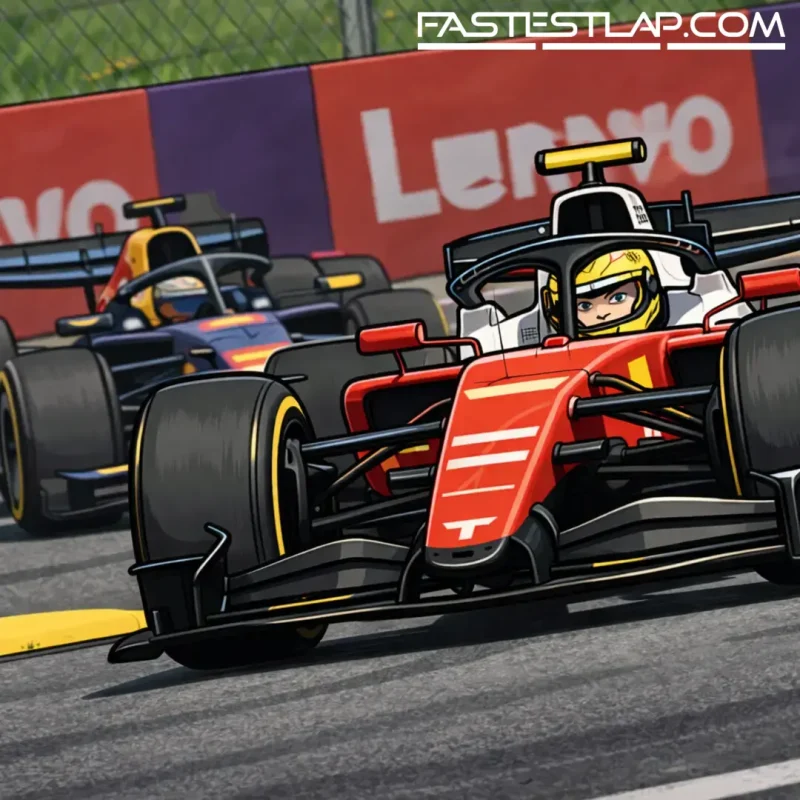
Their first proper flashpoint came early, with Verstappen launching a move on Lap 11 into Turn 3 for what was, at the time, a realistic podium fight. He got the Ferrari ahead into the corner, but Hamilton’s response was pure Hamilton: no drama on the radio, no theatrics, just a refusal to yield an inch of track he believed he’d earned. Side-by-side on exit, Verstappen ran out of asphalt and ended up skating across the gravel.
“Clear penalty!” Verstappen fired off over the radio. Race Control noted it and moved on. No further action.
Hamilton, when told Verstappen had been calling for punishment, sounded more amused than bothered.
“He went off the outside. You don’t expect to go around the outside of a champion,” Hamilton said afterwards. “I wouldn’t expect to go around the outside of him there and hold the line. So he was behind at the apex, and therefore he should have backed out.”
It was the sort of quote that lands differently depending on which side of the 2021 divide you’re on — half a reminder of status, half a statement of principle. But it also captured the reality of that moment: Verstappen tried the outside in a corner where being half a car behind at the apex usually means you’re about to discover the edge of the circuit. Hamilton knew it. Verstappen knew it too, even if he didn’t like the outcome.
Juan Pablo Montoya certainly enjoyed it. Watching for F1 TV, he put it in the blunt, driver-to-driver terms the paddock rarely uses anymore.
“I think the racing was really good,” Montoya said. “I think sometimes people forget what happened between Max and Lewis before, and Lewis doesn’t forget.
“When you’re a driver, and they run you over before, you don’t forget, and if you can give it to them, you will all the way. And that’s what we saw. It was unbelievable. I was giggling watching that.”
The second act arrived after the first round of pit stops, and if the first fight was about Hamilton’s defiance, the next was about Verstappen’s adaptation. Again, it started at Turn 3: Verstappen forcing the issue, Hamilton countering, the pair leaning on each other through the fast sweep that follows. But this time Verstappen changed the geometry of the argument. Instead of accepting an uncomfortable line and hoping Hamilton would blink, he committed hard at Turn 6 — aggressive on the inside, decisive enough that Hamilton couldn’t realistically hang it around the outside without inviting contact.
Verstappen made it stick.
There was something telling in that progression. It wasn’t a driver “getting his elbows out” for the cameras; it was a champion reading the situation and finding the version of the move that couldn’t be debated afterwards. If Hamilton was making a point about track position and consequence, Verstappen responded by ensuring he controlled the next corner, not the last one.
In the end, the scoreboard flattered Verstappen more than Hamilton. Verstappen finished second — his best result of the season — while Hamilton slipped back to fifth, Ferrari unable to generate the straight-line speed it needed around the Red Bull Ring to turn attitude into outcome. In a weekend where marginal gains were being traded at 300km/h, that deficit mattered. Hamilton could go toe-to-toe in the braking zones, but he couldn’t always finish the job on the straights that followed.
Still, for all the talk of points and pace, Austria was a reminder that certain match-ups in Formula 1 don’t really need a narrative push. Put Hamilton and Verstappen in the same piece of track with something tangible on the line — even if it’s “only” a podium place rather than a title — and the temperature rises immediately.
Montoya’s warning carried an edge of truth that tends to get lost in the polite language of modern F1: Hamilton doesn’t do grudges in public, but he does remember the moments that mattered, and he certainly doesn’t roll over for anyone. If Verstappen was hoping time had softened that, Austria suggested the opposite.
The paddock has moved on in a lot of ways since their 2021 collision course, but the on-track shorthand between them is still instantly recognisable. Hamilton will hold his ground because he believes he’s entitled to it. Verstappen will keep coming because he believes it’s his job to take it.
Austria just happened to give them two chances to prove it.