Sergio Perez managed to tick off one of the more unusual boxes on an F1 weekend in Austria: he committed a start infringement, was investigated, and then effectively walked away without a sporting penalty — not because the stewards cleared him, but because Cadillac’s afternoon had already collapsed.
Perez was placed under investigation after the Red Bull Ring start for moving on the grid before the signal. In most circumstances that’s a straightforward five-second time penalty. The catch this time was timing. By the point the matter landed on the stewards’ desk, Perez had already retired, and a five-second sanction can’t be applied to a car that’s no longer circulating. Crucially, the stewards noted that this type of unserved time penalty doesn’t convert into a grid drop for the next race, so there was nothing practical left to impose.
“The car moved before the start signal was given. This normally warrants a 5 second penalty (which would not convert into a grid drop for the next race),” the stewards wrote after reviewing positioning/marshalling system data and in-car video. “However, as the car had already retired from the race at the time the incident was brought to the attention of the Stewards, it does not seem appropriate to apply any time penalty… therefore the Stewards decide not to impose any penalty.”
It’s the sort of procedural quirk that will irritate some and amuse others, but it also speaks to the day Cadillac were having: the penalty discussion was academic because the race was already over for both of its cars almost as soon as it began.
Valtteri Bottas was the first to park it. Two laps into Sunday’s race he retired with a brake fire, ending his Austrian Grand Prix before it had really started. Perez followed him out two laps later, also with brake problems, turning what was supposed to be a key data-gathering exercise into a four-lap footnote.
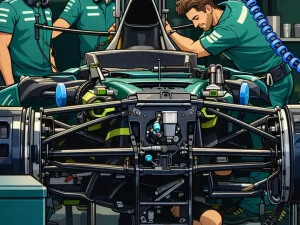
That’s the context that makes this weekend sting. Cadillac arrived with what was described as a sizeable upgrade package, the sort of step that — even if it doesn’t instantly shift lap time in a straight line — is meant to give a young operation clarity. Instead, Austria gave them none of it.
Perez didn’t hide his frustration afterwards, describing a weekend that seemed to go backwards rather than edge forward.
“It’s a bit unfortunate what happened today,” he said. “I think we underestimated the effect of traffic and we’ve been having issues all weekend.
“I think it’s been the worst weekend. It feels like we took four or five steps backwards, so there needs to be a massive process thinking on how we’re doing things, especially when it comes to upgrades, because today what happened was totally unacceptable and very unfortunate as well for the team.
“I’m sure that we will be able to sort it out for coming races.”
The traffic point is an interesting one because it hints at the kind of second-order problem that can blindside teams: not a fundamental design flaw you can spot in a tidy Friday run plan, but an operational reality that bites when the cars are in dirty air and the braking system is asked to do repeated heavy work in compromised conditions. Perez insisted the team hadn’t been consciously managing brakes across the weekend.
“No, not really. I think it was just a traffic thing that overexaggerated this,” he said. “Obviously it’s frustrating because we wanted to see how was the performance in the race, what we were able to do, how were things [with the upgrades], but unfortunately we didn’t get the chance.”
What makes it all feel particularly raw for Perez is that it’s not an isolated hit. Cadillac have already had brake trouble cost them in Monaco, where Perez lost what would have been the team’s first point after a penalty for a start infringement. And he referenced other recent setbacks too, including a suspension failure in Canada. A new team can accept a certain level of pain — but not stagnation.
“Of course it is frustrating,” Perez said. “But the most frustrating thing is not to see progress. I think we always expected these things to occur to a new team, obviously, but I think the frustration comes from the lack of progress.
“So I’m sure that this upgrade will help us to understand a lot of those deficiencies and I do expect a massive step forward in reliability going to Silverstone.”
That last line is doing a lot of heavy lifting. Silverstone now becomes more than just the next round on the calendar; it’s the next credibility check. Cadillac didn’t come to Austria simply to bolt on new parts — they came to learn, to confirm correlation, to turn a development direction into something that can be trusted. Losing both cars to brake issues inside four laps robs them of that, and dumps extra pressure on the factory to deliver answers quickly.
As for Perez “escaping” punishment, it’s less a get-out-of-jail card than an illustration of how F1’s penalty framework sometimes struggles to fit real-world messiness. The stewards didn’t dispute what happened. They simply judged that there was no meaningful penalty left to apply once the car was already in the garage.
In a functioning weekend, five seconds might have mattered. In Cadillac’s Austrian Grand Prix, it barely registered against the bigger problem: they never got to race at all.