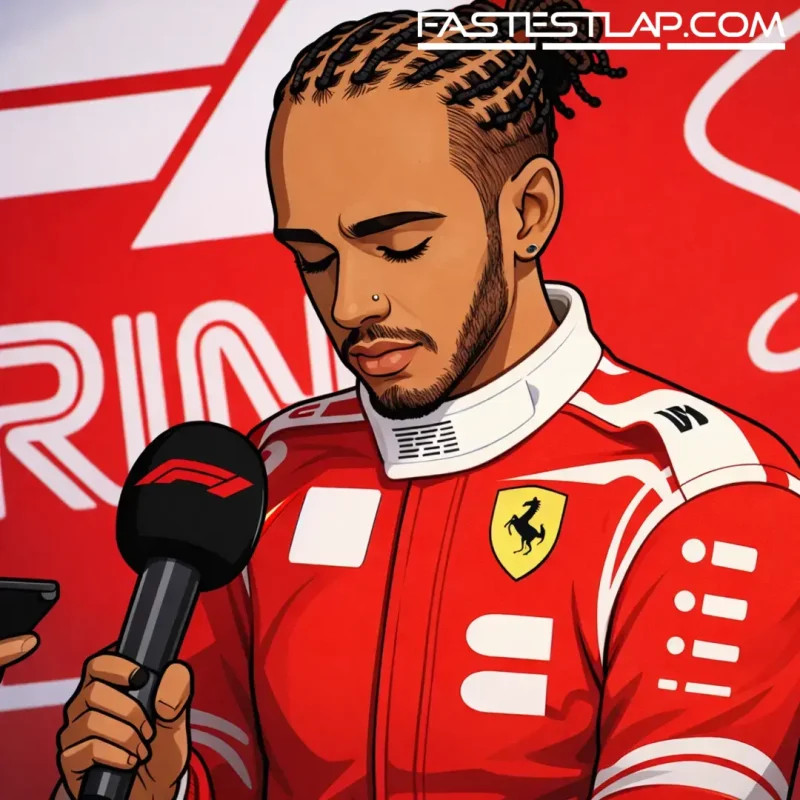
Lewis Hamilton didn’t need much prompting after Spielberg to point at something Ferrari has to get on top of — and quickly. The seven-time champion wants an internal deep-dive into how the Scuderia is deploying its power, after a weekend in Austria that left them scrapping rather than threatening.
The trigger was a remark from Mercedes’ Kimi Antonelli, who said the Ferraris were “deploying so weirdly” that he “almost crashed” into Charles Leclerc’s team-mate. When a rival is close enough to notice — and alarmed enough to say it out loud — it’s rarely just noise.
Ferrari’s Sunday underlined the broader issue. Hamilton brought the car home fifth, Leclerc eighth, and neither result felt like it came from a clean, maximised race. The sense around the paddock is that Ferrari’s performance swing isn’t just about aero load or tyre behaviour; it’s also about how the car delivers its lap time, and how predictable that delivery is in traffic. If the power deployment isn’t consistent corner-to-corner, it doesn’t only cost you on the straights — it forces drivers into compromised positioning, awkward closing speeds, and those half-committed moments under braking that make everyone’s life harder.
Hamilton’s call for an “investigation” isn’t the language of a driver throwing toys out of the pram. It’s closer to a veteran identifying a systems problem that can’t be patched with set-up tweaks and optimism. In this era, the margins are too tight: if your car behaves differently depending on where it is in its energy cycle, you don’t just lose tenths — you lose confidence, and confidence is what keeps you daring in the places you need to be daring.
There’s an irony, too, in the timing. Mercedes “returned to winning ways” in Austria, and part of the story of 2026 so far has been which teams are learning fastest how to make their new packages work in the real world, not just in simulations. Ferrari’s frustration is that its ceiling still looks competitive, but its execution — the repeatable, boring part of being quick — is proving harder to nail down.
While Ferrari tries to iron out those inconsistencies, Aston Martin is taking a different kind of gamble: fewer swings, but a bigger one.
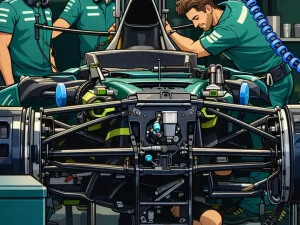
Adrian Newey has confirmed the team’s long-awaited upgrade will land at the Hungarian Grand Prix next month, and he’s framed it as a deliberate shift in philosophy after what he’s described as a poor start to F1 2026. Instead of peppering the car with incremental updates, Aston Martin has put its chips on a single major package — a new nose, “substantially revised aerodynamic surfaces”, and a “significant weight reduction” for the AMR26.
That’s the sort of language that makes rival engineers sit up. Weight reduction alone is often the unglamorous differentiator that unlocks everything else — set-up freedom, tyre life, flexibility across track types — but it also hints Aston Martin hasn’t been where it wanted to be on the fundamentals. A big bang upgrade can move you forward quickly, but it can also expose how well your correlation tools are behaving. If it works, it’s a statement. If it doesn’t, you’ve lost time you don’t get back.
Newey, meanwhile, has also spoken about a “difficult period” with health problems, insisting he’s “OK now” after returning to the paddock in Monaco. For a team that’s hitched a lot of its identity — and expectation — to his presence, simply having him back in the mix is meaningful. Formula 1 teams are relentless machines, but they still run on human bandwidth, and that’s especially true when you’re trying to change direction midstream.
Elsewhere from Austria, Sergio Perez has quietly avoided any knock-on pain for this weekend despite being investigated for a start infringement. The Cadillac driver retired after four laps, and the FIA opted not to apply the standard five-second penalty. Crucially, that also means nothing converts into a grid penalty for the British Grand Prix — a small administrative outcome, perhaps, but in a packed midfield, the difference between starting where you qualify and starting five places back can be the whole race.
And then there’s the rumour mill, which has been circling Max Verstappen like it always does when Red Bull looks even slightly vulnerable. This time, McLaren has been dragged into the conversation, with speculation about a 2027 move. Zak Brown’s response was to laugh it off — not aggressively, more like someone who’s heard enough paddock whispers over the years to know which ones deserve oxygen and which don’t.
The interesting part isn’t Brown’s dismissal; it’s the context that keeps fuelling the talk. Verstappen is understood to have an exit clause if he’s lower than second in the championship at the summer break. He currently sits seventh with three races remaining before the shutdown. That detail alone ensures every passing comment gets treated like a breadcrumb.
For now, though, the more immediate story is the one playing out in garages rather than on gossip boards. Ferrari has a world-famous driver asking for a forensic look at how its car deploys its performance. Aston Martin is betting that one heavy swing in Hungary can change the feel of its season. Cadillac is learning how quickly small procedural calls can affect a weekend. And McLaren — publicly at least — is telling everyone to stop slipping on banana peels.
Silverstone will bring its own answers, but the undercurrent is already clear: 2026 is becoming a season where “potential” is cheap, and the teams that can make their speed predictable are the ones that will actually get paid.