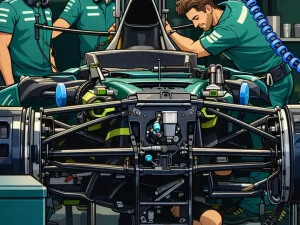
Lance Stroll’s Silverstone weekend ended in a familiar place on the timing screens — last of the classified runners — but it was the way he got there that left a sharper impression inside the Aston Martin camp.
Three separate five-second penalties for track limits, picked up in a nine-lap burst between Laps 33 and 42, effectively turned a difficult afternoon into a formality. By the flag, Stroll had racked up six track-limits strikes across the 52-lap British Grand Prix and paid for the final three in time penalties, a neat illustration of how quickly the FIA’s system snowballs when you’re living on the edge of the white lines.
Stroll didn’t exactly launch a courtroom appeal in the mixed zone, but he did point the finger at what he called the AMR26’s “behaviour” — and he wasn’t talking about a broken endplate or a damaged floor.
“Maybe, I guess,” he said when asked if he agreed with the penalties. “We had a lot of understeer in the race and the car’s very broken, so it’s even hard to stay within the track limits. A lot of different behaviour every lap, every corner. Just a challenging race. The whole year has been so far.”
Pressed on whether he meant physically broken, Stroll clarified: “No, just aerodynamically very broken.”
That choice of words is telling. Drivers will often default to the vague “balance” complaints when they don’t want to inflame a situation, but “aerodynamically very broken” is a fairly direct way of describing a car that isn’t doing what the simulator promised — and, more importantly, isn’t doing the same thing twice. At Silverstone, that can become toxic very quickly. When high-speed sections punish hesitation and the margins at corner exit are measured in centimetres, any inconsistency in platform or load can turn “using the track” into “leaving the track” before the driver has even processed what’s changed.
Footage from Stroll’s onboard during the race backed up the feel he described: plenty of steering input through Copse and especially in the Maggotts/Becketts sequence, the kind of mid-corner correction you associate with a car that won’t settle where it should. And while the penalties suggest a driver making repeated misjudgements, Stroll’s view was that it was a car forcing him to guess more than he could afford.
Yet he also admitted there was no backing off.
“Yeah, for sure!” Stroll said when it was put to him that he was still pushing hard despite the limitations. “Out there racing and pushing, so I’m always trying to give it everything I can.”
That’s the bind for a driver in the midfield when the car is awkward: if you dial it back to guarantee you stay within the lines, you’re giving away lap time you probably can’t spare. If you keep leaning on it, the rulebook is waiting — and at Silverstone, where lap after lap builds rhythm, one small loss of confidence in what the car will do can quickly lead to a repeat pattern of “just a bit too wide”.
Stroll’s frustrations land at a moment when Aston Martin is already committed to a very different development philosophy this season. Rather than drip-feed updates like many of its rivals, the team has been working towards a larger, more fundamental package due to arrive at the Hungarian Grand Prix later this month.
Adrian Newey, now leading the outfit as team principal, has already indicated the Budapest specification should be a “large step” — and the first details paint a picture of a reset rather than a tweak. Aston Martin is targeting a significant weight reduction with its so-called B-spec car, including a lighter chassis and gearbox architecture. There are also revisions planned to the rear suspension, the nose and aerodynamic surfaces.
In other words, the team isn’t just trying to sand down rough edges; it’s attempting to change the underlying behaviour Stroll is complaining about. Weight reduction and structural changes are expensive, time-consuming moves to make mid-season — the kind you only do if you believe the original concept has left performance on the table and, crucially, isn’t giving the drivers a consistent platform to extract what’s there.
The Hungaroring is an interesting venue for a debut, too. It’s lower-speed, higher-downforce, more about rotation and traction than holding your breath through fast, aero-loaded direction changes. If Aston Martin’s primary issue is an aero platform that isn’t robust, Budapest will offer a different type of interrogation — but it may also give the team a cleaner read, away from Silverstone’s brutal high-speed telltales.
And there’s more to come: Aston Martin is scheduled to follow the Hungary package with a Honda power unit update at the Dutch Grand Prix, the first race after the summer break. So Silverstone, messy as it was, might end up being the low point before the next phase of the season begins.
For Stroll, the penalties will stick on the record, and the optics are never great when you collect three in nine laps. But the more consequential part of his Silverstone debrief wasn’t about the FIA at all — it was the bluntness with which he described his own car. In a year already defined by Aston Martin’s poor start, “aerodynamically very broken” sounds less like a complaint in the heat of battle and more like a diagnosis the team can’t ignore.