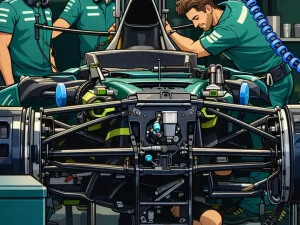
Aston Martin’s decision to sit on its hands through the opening stretch of 2026 hasn’t been popular in the paddock, least of all because Ferrari has been rolling into almost every weekend with something new bolted to the car. But inside Silverstone, the message from the team was clear: the “big bang” upgrade plan isn’t some romantic contrarian streak — it’s simply a different way of surviving the same cost-cap maths.
While Ferrari has adopted an almost constant cadence of updates, including two larger packages in Miami and Barcelona, Aston Martin has deliberately resisted the temptation to drip-feed developments. The team’s B-spec concept is expected to appear at the Hungarian Grand Prix, with Adrian Newey backing it as a sizeable performance step.
That’s an eyebrow-raiser given how bleak Aston Martin’s start has been. Nine race weekends in, it has a solitary point and sits 10th in the constructors’ championship, ahead of only newcomer Cadillac. The winter talk that a rules reset — plus the new partnership with Honda — could push Aston into contention has, so far, aged badly.
The early storyline centred on vibration issues with the Honda power unit, but Aston Martin’s own list has been longer than anyone expected: gearbox problems, an overall downforce deficit, and a chassis that’s carrying too much weight. None of those are the sort of flaws you polish away with a couple of new winglets.
Mike Krack, Aston Martin’s chief trackside officer, insisted the team’s approach isn’t any more suspicious or reckless than the weekly upgrade culture elsewhere — it’s just premeditated.
“It depends on the plan,” Krack said. “At the end of the day, a decision was made… that we will not bring race on race and race, and if their plan was different, then it was different.
“You must just not forget one thing; if you bring an upgrade every week, you have to plan this long in advance. You cannot say I was poor in Austria, and I have an upgrade in Silverstone the week after. So this is all following a plan that has taken a long time to do, where you factor everything in – logistics, production, technicalities of the circuit, and all that.”
Krack’s point is one most teams quietly agree with: “constant updates” doesn’t mean reactive updates. The lead time is too long, and the production pipeline too tight, for that. It’s why accusations — or even jokes — about rivals “surely” breaching the cap tend to dissolve when you actually look at how far ahead the better-run outfits are planning.
And the cost cap is central to Aston Martin’s argument. With this year’s budget cap set at $215 million, the regulations don’t care whether you spend your money in 20 small chunks or one large hit. Once it’s gone, it’s gone — and there’s no special allowance for being slow.
At a time when Mercedes team principal Toto Wolff has publicly quipped that Ferrari “needs to be running out of money soon”, Krack framed it less as a question of who’s gaming the system and more about how each organisation chooses to allocate what it has.
He likened it to turning up at the supermarket with a fixed amount of cash: the problem isn’t the size of the trolley, it’s whether you’ve kept enough aside for the unexpected.
“You go to the supermarket, and you have €100 in your pocket. You can only spend €100,” Krack said. “So you develop your car, if you have spent your 100, you cannot spend any more.
“You need to see when you have everything, and then one thing you must not forget is you can have crashes, so you need to keep some margin to spend your 100 euro cleverly yet towards the end. So it is a consistent balance between development and cost of racing, basically.”
That last line lands because it’s the hidden tax on every upgrade plan: attrition. A couple of heavy accidents can force a team into uncomfortable decisions — delay a development part, or risk being short on components later in the year. That’s especially sharp in 2026, with cars still “in their infancy”, as Krack put it, and reliability gremlins more common than anyone likes admitting on the record.
Aston Martin’s counter is that it’s trying to get smarter at the same time as it gets faster. Krack pointed to new people and improved processes aimed at making parts cheaper — the unglamorous work that can decide whether a late-season push is possible at all.
Whether any of this works will be judged brutally in Budapest. Newey is forecasting a “large step” with the B-spec package, and Aston Martin badly needs that prediction to be something more than optimistic noise. When you’ve spent the first half of the season circling the back, you don’t get many chances to reset the narrative.
The risk, of course, is obvious: if the big upgrade misses, there’s nowhere to hide. Ferrari can afford to be wrong on a floor edge or a wing tweak because there’s another iteration coming. Aston Martin is effectively trying to change the conversation in one move.
Krack didn’t sound like a man lobbying for sympathy, though — more someone pointing out that in a capped era, development is just another form of strategy, with the same trade-offs and the same consequences.
“I do not want to argue if it’s needed or not,” he said of the budget limit. “I think it’s the regulation… and then you have to do the best with them.
“In Formula 1, you need to be efficient with how you do your parts, how you manage everything… you have the financial challenge, and that’s part of Formula 1.”
Budapest will tell us whether Aston Martin has been frugal, or simply late.