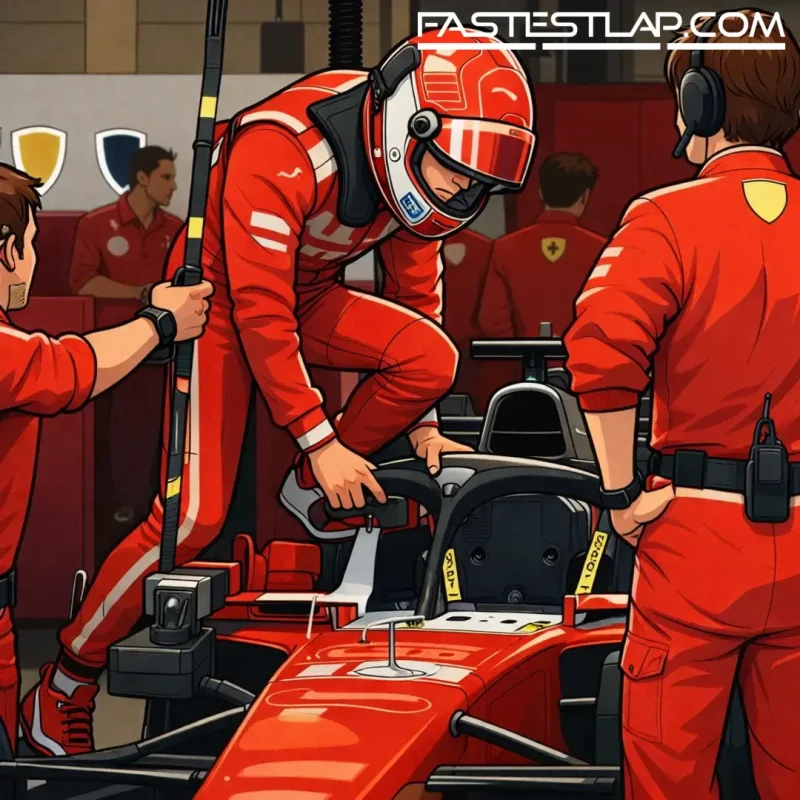
Charles Leclerc isn’t buying the idea that Ferrari has suddenly cracked 2026 and is about to stroll into Spa as the team to beat. Silverstone was a high point, yes — a double podium capped by Leclerc’s first win of the season — but his read is that it was as much a puzzle for Ferrari as it was a statement to the paddock.
The irony is that Ferrari arrived in Britain braced for damage limitation. With the energy demands of these new-generation cars, the team’s own modelling had it losing ground to Mercedes on a circuit like Silverstone. Even Leclerc was expecting a sizeable gap: five to six tenths, minimum, was the number being discussed internally. Instead, Ferrari didn’t just hang on — it won.
That’s why Leclerc’s immediate focus isn’t on whether Spa becomes a repeat performance. It’s on figuring out what, exactly, happened.
“I think it’s too early to say,” he said after the race, pointedly pushing back on the post-race swell of Ferrari optimism. “This weekend was a particularly big surprise for the whole team. Not the win, just the overall performance.
“We were a lot faster than what we thought… and I think as much as we need to analyse when things are going a lot worse than expected, we also need to analyse when things go a lot better than expected.”
It’s a very Leclerc way of framing it: less chest-thumping, more forensic. And it fits Ferrari’s 2026 profile so far. The SF-26 has been talked up as one of the strongest chassis on the grid — especially through slow and medium-speed corners where traction and rotation matter — but the power unit hasn’t consistently looked like the benchmark.
The FIA’s ADUO system has flagged Red Bull’s internal combustion engine as the standard-setter in the new rules era, yet it’s Mercedes that has been piling on the points with a package that works as a whole. The season has had a clear rhythm: Mercedes won the opening six rounds, Lewis Hamilton broke through to P1 in Barcelona, then Mercedes snapped back to the top in Austria. Silverstone, with its reputation as an energy-hungry test, looked like it should have suited that same script.
Hamilton himself had suggested Ferrari might be “twice as big” a deficit away because Ferrari was “power-limited” relative to Mercedes. Instead, Leclerc beat George Russell to win, with Hamilton third as Ferrari secured its first double podium of the campaign.
There was a caveat, though — and it’s one that matters when you start projecting form forward. Leclerc’s victory didn’t come with the comfortable inevitability of a car that’s simply quickest everywhere. Kimi Antonelli was closing in before a broken wheel shield curtailed the Mercedes driver’s challenge, removing what looked like a genuine late-race threat.
So when the calendar flips to Spa for round 10, Leclerc is treating Silverstone as an outlier to be explained rather than a baseline to be assumed.
Ferrari had actually feared Spa could be worse than Silverstone. That’s partly why Leclerc is so wary of the growing narrative that Ferrari has “arrived” and the title fight is about to light up. The team has now taken two wins in the last three Grands Prix and cut Mercedes’ Constructors’ Championship lead to 78 points — real progress, no doubt. But Leclerc’s message is that progress isn’t the same thing as predictability.
“We were expecting a very difficult weekend here in Silverstone,” he said. “Prior to this weekend, we were expecting even more of a difficult weekend in Spa. Considering we obviously won, maybe we are a bit closer than what we initially thought.
“But it’s still to be proven, and for that we also need to understand why was it an outstandingly good weekend compared to our expectations.”
In other words: don’t confuse one weekend where the numbers were wrong in Ferrari’s favour for a permanent rewriting of the pecking order.
Leclerc also batted away the idea that a second straight win would suddenly drag him into a neat, headline-friendly title chase. The drivers’ picture remains a bit awkward for him: Hamilton sits 32 points behind Antonelli, while Leclerc is a further 39 points back from his own team-mate. That doesn’t read like an imminent Leclerc title surge — and he’s not trying to sell it as one.
“I don’t really focus on that,” he said. “Where I’ll be focusing on is just to try and get that feeling again in the car.
“If I have that feeling in the car, I’m confident that I will extract the maximum out of this car. If I don’t, then it might be more tricky.”
It’s a revealing admission, not least because it hints at how narrow the operating window still is in this regulation set. When a driver talks about “feeling” rather than lap time, it’s usually code for confidence in the car’s behaviour at the limit — braking phase stability, balance shifts, the sort of stuff that turns a fast car into a usable one across a weekend. Leclerc’s basically saying Ferrari can’t afford to chase outcomes at Spa; it has to chase understanding.
He summed it up neatly: “Personally, I won’t be focusing on just winning because that will be the wrong approach. I’ll just focus on the process in order to get the best feeling and to maximise this car.”
For Ferrari, that might be the most important part of all. Silverstone delivered a trophy and a points swing, but the bigger win would be turning a “surprise” into something repeatable. Spa will tell us whether Ferrari has found a route to that — or whether Silverstone was simply the weekend when the data lied and the car, briefly, sang.