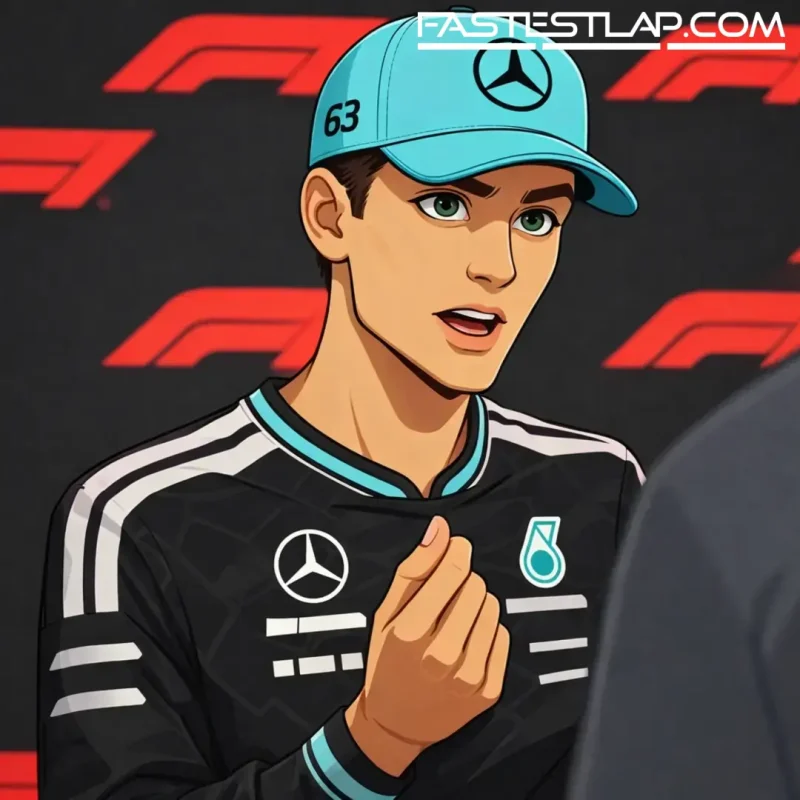
Mercedes spent most of Sunday evening at Spa insisting George Russell’s first-lap exit was an ugly convergence of bad timing and worse luck. The untelevised radio that’s now surfaced doesn’t make that argument any easier to sell.
Because moments before the start, Russell was explicitly told the team was “happy with SOC level” — only for him to find himself effectively defenceless on the run from La Source to Les Combes, then out of the race before the field had even settled into its rhythm.
The sequence is now hard to ignore. Russell launched from third, tucked in behind team-mate Kimi Antonelli and Max Verstappen, and initially did everything you’d expect: tidy first corners, position held, the kind of opening that sets you up to lean on the guys ahead rather than survive the ones behind. Then the car didn’t do its side of the bargain.
On the formation lap, Russell’s engineer Marcus Dudley ran through the usual last-minute housekeeping — clutch feedback, a brief note about a few drivers reporting spots of rain, tyre work, mode calls, burnouts. Then, crucially: “So we are happy with SOC level.” Immediately after, another instruction that in hindsight reads like a cruel footnote: “And just a reminder for that boost press at full power, exit Turn 2.”
Russell got that reminder again as the lights went out: “Reminder: boost press.”
What followed, as the pack fanned out onto the Kemmel straight, was a Mercedes that simply didn’t accelerate like one. Russell was swallowed by Lewis Hamilton’s Ferrari and Charles Leclerc, and suddenly a driver who’d started the lap in clean air was thrown into the sort of compromised fight that Spa punishes brutally.
Trying to re-pass Hamilton around the outside into Les Combes, Russell made contact, spun into the gravel and was done. On the radio, the frustration was instant and volcanic.
“I’m out! What the f**k happened with the SOC down the straight? Had no f**king battery down the straight!” he yelled. “Guys! Unacceptable! Un-f**king-acceptable!”
Afterwards, he sounded less furious than exhausted — the anger still there, but dulled around the edges in a way that tells you it’s not a one-off in his head.
“Numb to the disappointment now,” Russell said in the paddock. “When it happens so often, you just get used to it.”
His explanation was pointed. “For whatever reason, the battery decided not to recharge at Turn 1. I went around the first corner, the battery didn’t charge and I exited the first corner 35 per cent down.
“Because it didn’t charge, I also had a boost problem. The turbo didn’t sort itself out, so I had no power. I got to the top of Eau Rouge with zero per cent on the battery. Quite frankly, it was dangerous.
“I got swamped by three cars. Shouldn’t have been in that position in the first place and that’s why I’m most angry.”
Russell was careful about the collision itself, calling it a “racing incident” and stressing Hamilton “didn’t do anything reckless”. That restraint matters, because it tells you where he thinks the real failure was. Not in the wheel-to-wheel, not in a marginal judgement call at Les Combes — but in the systems that put him into a fight he shouldn’t have been in.
And in 2026, that distinction is everything.
This regulation set has turned energy management from background noise into headline material. If your deployment is wrong — if the car decides it’s not going to harvest, or a boost event doesn’t arrive when the driver expects it — your race can flip in seconds from attacking to surviving. At Spa, the consequence is amplified: you’re exposed for a long time, at high speed, with few places to hide.
The awkward part for Mercedes is that Russell’s Spa failure landed on top of an existing narrative. He’s been complaining for two rounds now about straight-line performance, and the data from qualifying only sharpened the contrast between the two cars. In Q3, Russell was reported to be 10km/h slower than Antonelli through Blanchimont, contributing to a 0.367s loss in the final sector. That’s not a tiny margin hidden in traffic or tyre prep; that’s structural.
The working theory within the team, as described in the paddock, is that Russell’s driving style interacts differently with these 2026 power units and energy demands — using more energy earlier in the lap and paying for it later, with the deficit compounding corner by corner. In other words, what looks like “no straight-line speed” might actually be the bill arriving for choices made half a lap earlier.
Spa, though, wasn’t just a style tax. Russell’s account makes it sound like the car didn’t execute a basic function at Turn 1: recharge. And that’s why the pre-race “happy with SOC level” message stings. Either the team believed the system was in the right window and it wasn’t, or something changed between that reassurance and the moment Russell tried to deploy. Neither is a comfortable explanation.
There’s also a sharp championship edge to all of this. Russell’s third non-score in six races has dropped him to third in the standings, now 50 points behind Antonelli — who, in the other Mercedes, collected his sixth win of the season at the same race Russell didn’t complete a lap.
That split-screen is the kind of thing that warps a season internally. On paper, Mercedes has the fastest package often enough to rack up wins. In reality, one side of the garage is stacking results while the other is talking about numbness, danger, and “unacceptable” failures. It doesn’t take much imagination to see where the pressure concentrates next: on reliability processes, on operational checks, and on whether the team can align car behaviour across both drivers when the margins are this thin.
Russell left Spa insisting he’d been ready to go after the two cars ahead into Turn 5. Instead, he was fighting just to stay alive on the Kemmel straight.
At a track like Spa, that’s not merely frustrating. It’s the sort of problem that forces a team to ask uncomfortable questions — because the radio tells you they thought they had it covered.