Toto Wolff probably didn’t expect a throwaway line in Belgium to become the paddock’s latest stress test of Formula 1’s new power-unit policing. Yet when the Mercedes boss declared his team had “the most powerful power unit”, the remark immediately collided with the sport’s 2026 catch-up framework — and, crucially, with Red Bull’s interests.
What’s made it spicier is Red Bull’s response. No indignation, no public appeal to the FIA, no faux bewilderment. Laurent Mekies simply nodded along. “I think Toto is right,” he said after the Belgian Grand Prix. “I also think they have the most powerful power unit.”
That agreement doesn’t close the story. It underlines the awkward gap between what the ADUO process is designed to measure and what everyone can see with their own eyes on a Sunday.
This year’s engine formula has split the V6 hybrid turbo output 50-50 between internal combustion and battery power. F1 also introduced Additional Development and Upgrade Opportunities (ADUO), effectively a structured mechanism to stop a manufacturer that misses the early development window from being marooned. But ADUO is focused on the ICE side of that equation — and the first set of findings delivered a headline few had anticipated: Red Bull’s internal combustion engine, the first designed by Red Bull Powertrains, was classed as the benchmark. Mercedes sat second, with Ferrari, Audi and Honda placed in the next category.
The practical consequence was politically sensitive straight away. Mercedes was handed one development opportunity, while Ferrari, Audi and Honda received two. On paper, it’s a neat, rules-based calibration. In the paddock, it landed like a contradiction.
Mercedes has started 2026 like a team with a class-leading package, taking five wins from the opening five Grands Prix that comprised the first ADUO period. It’s exactly the sort of early-season performance that tends to shape assumptions about who’s nailed the power unit. So when the FIA’s framework essentially said Red Bull had the best ICE, it didn’t just raise eyebrows — it invited questions about what, exactly, is being captured and what’s being missed.
Red Bull did query the outcome, but the expectation inside the sport was that any challenge wouldn’t lead to a revision. Then Wolff’s comments poured petrol on the embers.
“We had an issue on all Mercedes engines that we lacked power out on the straight… We have the most powerful power unit,” he said in Belgium, framing it as both an admission of a problem and a statement of underlying strength.
On one level, it’s an unremarkable piece of team-principal messaging: reassure, control the narrative, project confidence. On another, it cuts across an FIA system that has already decided Mercedes isn’t the benchmark on the ICE metrics that trigger extra development levers. Former F1 driver Karun Chandhok summed up the political unease neatly, suggesting Red Bull would be straight on the phone to the FIA — because either Red Bull really does have the best engine and has still ended up disadvantaged by the process, or it’s been outplayed in the room while Mercedes gets a path to upgrades.
Mekies’ answer in Belgium was interesting not because he agreed with Wolff, but because he did so while pointing to the evidence the engineers obsess over: speed traces and weekend patterns.
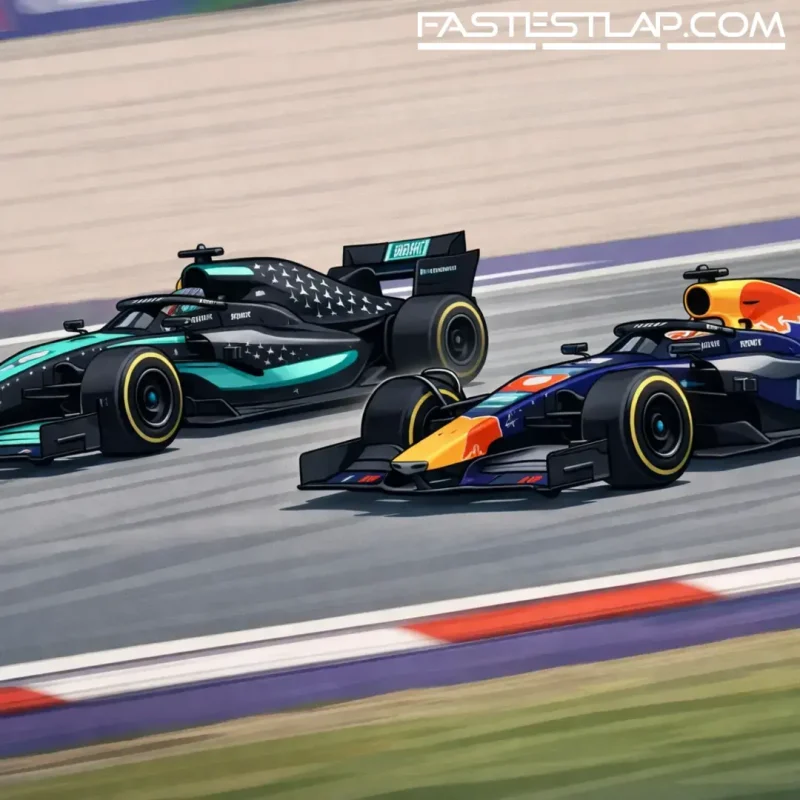
“Certainly they had a sizeable advantage on the straight this weekend again,” Mekies said. “But it’s not the first weekend, they have an advantage on the straight most weekends. This weekend, it was a bit more with the track sensitivity.”
That’s the key nuance. Mekies isn’t necessarily arguing the ADUO numbers are wrong; he’s arguing that the lived reality of performance — the thing teams feel in qualifying and races — keeps pointing to Mercedes as the reference on overall deployment. And in 2026, “power unit” is an intentionally broad term. It’s entirely possible for a manufacturer to have the strongest ICE in the FIA’s defined window and still lose out in the combined picture because another has a better blend of electrical output, harvesting, deployment strategy, or simply a more efficient integration with the chassis.
In other words: Red Bull can top the ICE chart and still find itself chasing on the straights.
Belgium only sharpened the contrast. The race delivered Kimi Antonelli’s sixth win of the season — Mercedes’ eighth overall — while Max Verstappen was Red Bull’s best finisher in third, 11 seconds behind. The championship table has the same tone: Mercedes leads the constructors’ standings on 358 points, 73 clear of Ferrari, with Red Bull a distant fourth, 207 back.
Against that backdrop, Mekies’ calm sounds less like acceptance and more like a marker laid down for the next checkpoint. The second ADUO period closes in Budapest, and he was explicit about what matters next: “We will see what’s happening.”
Because this is where the framework gets properly consequential. ADUO isn’t just an abstract classification — it’s a mechanism that can tilt development trajectories inside a regulation set that’s meant to be tightly managed. If Mercedes is visibly strong on the straights and still gets an upgrade opportunity while Red Bull believes it’s already produced the benchmark ICE, Red Bull will inevitably wonder whether the system is rewarding the right things.
For now, the most telling detail is the lack of theatre. Red Bull isn’t shouting. It’s taking notes, watching the FIA’s process play out, and letting Mercedes’ own words hang in the air. In a season where power-unit performance is being sliced into ever more specific categories, the real battle might not be on the dyno — it might be over which definition of “best” ends up mattering.