Fernando Alonso left Spa with that familiar, tight-lipped look that says he’s done the sums in his head and doesn’t much like the answer. Aston Martin’s weekend in Belgium was never going to be kind to a car already living on the wrong side of the midfield, and Spa – with its brutal demands on energy deployment and efficiency – has a habit of turning “we’ll hang on and see” into “we’re nowhere” in a hurry.
The team’s own trackside chief Mike Krack didn’t dress it up. Aston Martin is “counting the days” until Budapest because the Hungarian Grand Prix is when the AMR26 finally gets the chassis update it has been banking on for weeks. In Krack’s words, the era of running effectively upgrade-less is over. Given where the car has been recently, that’s less a triumphant declaration than simple relief.
Aston Martin has spent much of this season stuck toward the back, and while others have moved the needle with their own developments – Cadillac among them – the green cars have increasingly looked stranded. Spa underlined it in an unflattering way: Alonso circulated a minute behind Valtteri Bottas, who himself wasn’t exactly scrapping at the sharp end of the midfield. It’s the kind of gap that doesn’t just hurt the points column; it drags at the whole operation, because you’re asking drivers and engineers to keep extracting belief from a situation that keeps telling them otherwise.
That’s why Krack keeps coming back to one phrase: “go back racing”. Not “score points”, not even “close the gap” – just get back to being in the fight. It’s a revealing bar to set in public, and it tells you how far the team feels it has slipped from where it expects to operate.
What makes Budapest so loaded is the way Aston Martin has chosen to play its development hand. Rather than drip-feed smaller updates, the team has been working toward one bigger in-season package. There’s upside to that approach: you can re-optimise the car as a complete concept rather than bolting on compromises. But the cost is obvious too – you spend races paying a price for decisions you’ve already made, hoping the eventual payoff is worth the time lost.
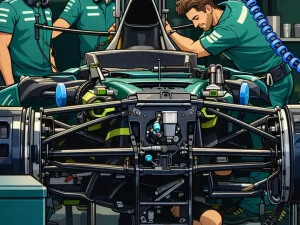
Krack insists the package is “quite extensive”, and he was specific about the themes: aero and weight. That’s code for the two areas that most cleanly translate to lap time under these regulations, and also the two areas that tend to force changes elsewhere. Shaving weight isn’t a paint job; meaningful gains often come from rethinking hardware, layouts, and margins. Aero gains, particularly if they’re tied to a chassis update, can reshape how the whole car behaves: balance windows, ride characteristics, tyre usage, the lot. In other words, it’s the sort of update that can either unlock a direction – or expose that you’ve been walking the wrong one.
There’s also a political undertone to all this, even if nobody in green will say it out loud. Adrian Newey is leading the design effort on these planned changes, and there will be an expectation, inside and outside the team, that the car’s trajectory looks different once his influence starts to show in tangible pieces. That’s not a fair yardstick in pure timescale terms, but Formula 1 is not a fair business. When you attach a name like Newey’s to a project, people stop accepting “we’re working on it” as a long-term answer.
The plan, as outlined, is to have the chassis update available for both Alonso and Lance Stroll at the Hungaroring if possible. That “if possible” matters. Big packages create logistical risk: parts quantity, correlation confidence, the inevitable late-night call on whether you run something in practice or protect it for the race. A split-spec weekend, on a tight circuit where small balance differences matter, can be a headache. But Aston Martin also can’t afford to be conservative forever; it needs data and it needs it now.
Krack, for his part, is careful not to sell fantasies. He openly admits nobody at the team is putting a number on what the update is worth. That’s sensible, because the first question everyone will ask in Budapest is the same one Krack said the team is asking itself: how much does it bring? Yet even without a headline figure, the intent is clear: Aston Martin believes it has hit the goals it set for this package. That’s the internal line you want to hear ahead of a major step, because it suggests the update isn’t a patch – it’s a statement of direction.
There’s another layer still, with Honda also due to introduce a power unit update at Zandvoort after the summer break. That timing matters. Budapest, then, is essentially Aston Martin’s chance to fix the platform – the car’s underlying efficiency and mass – before a separate, later step on the power side. If the chassis update does what the team hopes, it should make it easier to properly exploit whatever Honda brings next. If it doesn’t, Zandvoort risks becoming another weekend of “we need to understand why” rather than “we’re moving forward”.
For Alonso, it’s also about morale as much as lap time. He can tolerate a lot – he always has – but he’s never been a driver who hides when he feels a team is treading water. Spa was a reminder of how exposed Aston Martin has been when the track amplifies the car’s weaknesses. Hungary is a very different circuit, and if there’s any place to feel an aero-and-weight package quickly, it’s a track that rewards grip, consistency, and confidence on entry.
Aston Martin doesn’t need miracles in Budapest. It needs proof of life. And in a season where it’s too often looked like it’s been racing with its hands tied, simply arriving with something new – and the conviction that the stagnant period is done – is the first step back toward being part of the conversation again.