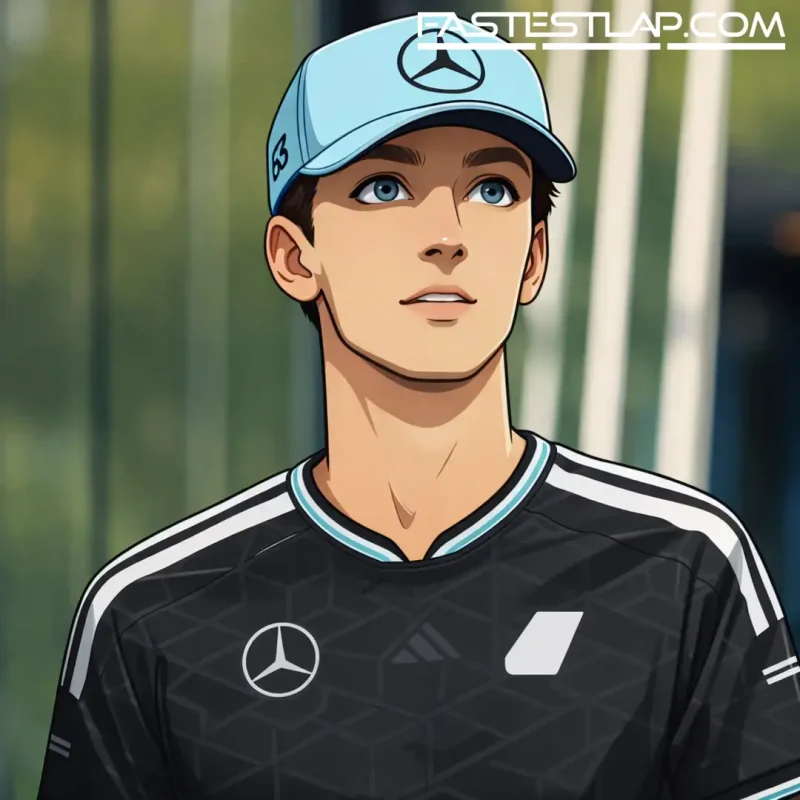
Toto Wolff doesn’t often bristle on live TV, but Spa has a habit of getting under people’s skin — and Mercedes’ Belgian Grand Prix weekend left enough splinters to explain why.
When Sky F1’s Simon Lazenby pressed him on the balance between driver and machinery in George Russell’s latest troubled outing, Wolff cut in quickly. “Simon, you’re pointing your finger at stuff here,” he snapped, before reiterating that Russell has his “100 per cent support”.
It was a sharp exchange, and it spoke to a wider sensitivity inside Mercedes right now: Russell’s problems aren’t presenting as a neat, driver-error storyline, and the team doesn’t want that narrative calcifying in public while it’s still chasing down what, exactly, is going wrong.
From third on the grid Russell was immediately a sitting duck on lap one, haemorrhaging ground on the Kemmel Straight after the blast through Eau Rouge and Raidillon. The visual was ugly — as if the car simply didn’t have the same release of power as those around it. Lazenby likened it to “a handbrake on” exiting La Source, and it wasn’t far off what Russell sounded like over the radio. Untelevised audio captured him launching into an expletive-filled rant as he ran out of battery on that first-lap drag.
Mercedes has since identified “deployment differences” between Russell’s car and Kimi Antonelli’s. The team initially leaned towards driving style as a contributing factor, especially given how the two extract performance differently, but Russell even adapted his approach at Spa and still couldn’t make the issue disappear. That, more than anything, is what has Wolff and Mercedes on edge: when a driver changes what you ask and the symptoms remain, the argument turns from “technique” into “why is this car behaving differently?”
Russell’s afternoon didn’t last long enough for any kind of recovery plan. At Les Combes he went deep, tangled with former team-mate Lewis Hamilton, and was spun into the gravel for a DNF. Hamilton picked up a five-second penalty, though Wolff shrugged off the bigger debate, calling it a racing incident — “These things can happen whether you’re in the front, in the middle, or the back of the pack.”
The more revealing part of Wolff’s post-race debrief was the way he framed responsibility. He suggested an overall 50/50 split between Mercedes and Russell for the Briton’s current struggles, then immediately anchored Spa itself as a team problem. “Probably half of it is to be attributed to the power unit that wasn’t as good as it should have been on his side, and the other side maybe on the driving,” Wolff said. “But we are in this together.”
That’s a classic Wolff line — protective, big-picture, designed to keep a lid on panic — but it also betrays the uncomfortable truth: Mercedes is fighting two fires at once. It’s trying to understand and rectify the “deployment differences” that are leaving Russell exposed in the most punishing acceleration zones on the calendar, while also managing the knock-on effect of a driver being asked to perform with a car he doesn’t fully trust.
Russell’s own words at Spa were telling. He said he felt “numb to the disappointment” after the DNF, which is not the language of a driver who’s simply annoyed about a one-off incident. It’s the sound of someone who’s been chipping away at the same problem for weeks and is running out of emotional runway.
Meanwhile, the intra-team contrast couldn’t be harsher. Antonelli went on to win the Belgian Grand Prix — his sixth victory of the season — while Russell slipped back to third in the standings, now 50 points behind his team-mate. That gap doesn’t just change the mathematics; it changes the politics. When one side of the garage is converting and the other is stuck explaining strange energy shortfalls on the straights, every technical update, every run plan, every “let’s try this” becomes loaded.
It’s why Wolff reacted so quickly to the suggestion that it might be “only his car” because of Russell. Mercedes wants the framing to remain collaborative: a shared issue, not a personal one. And to be fair, Wolff did concede there’s a driving component in play — just not in the accusatory, simplistic way that can take hold in the post-race noise.
“We all do mistakes,” Wolff said. “Today it was a mistake that the team did. Another day is going to be the mistake of the driver, and we just need to minimise it and support each other.”
There’s also an element of man-management here that Wolff is leaning into hard. He said his instinct with a frustrated Russell is to “try to put my arm around him.” It’s a small quote, but it matters: Mercedes knows the next race can’t become a referendum on Russell’s confidence. If a driver feels the car is intermittently “not deploying” when it should, the temptation is to overdrive corner entries to compensate — and Spa, with its long, exposed full-throttle sections feeding heavy braking zones, is exactly the sort of circuit that turns that spiral into contact.
Russell now heads to the Hungarian Grand Prix needing a clean weekend before the summer break, and Mercedes needs something even more basic: a Russell car that accelerates like an Antonelli car. If the “deployment differences” are genuinely understood and fixable quickly, Spa becomes an outlier and this blows over.
If not, Wolff may find himself having to do more of what he did on Sunday: batting away the finger-pointing, keeping the driver’s shoulders square, and trying to stop a title fight — and a relationship — from being defined by a problem that should never exist between two cars in the same team.