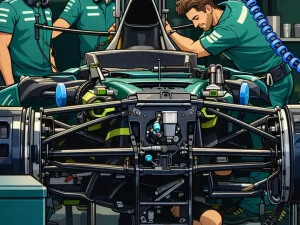
Aston Martin’s long-teased AMR26 B-Spec finally rolled out in the Hungaroring paddock on Thursday and, almost immediately, it had rivals doing that familiar F1 thing: pretending they’re not looking while trying to clock every surface, seam and hurriedly taped-over detail.
Valtteri Bottas, now part of Cadillac’s first Formula 1 campaign, admitted he’s heard one particular whisper that’s hard to ignore — that the updated Aston shares “only the front suspension” with the car that started the season.
“There’s lots of rumours,” Bottas said as the new Aston became the garage-lane talking point. “Most are saying it’s a big step for them. But we’ll see as the car hits the track.
“One rumour I heard is that the only thing that is the same is the front suspension. Everything else is new, so let’s see.”
That’s the sort of paddock line that sounds half like gossip and half like an engineer’s nightmare. If it’s even close to true, it’s not a normal mid-season upgrade; it’s a reset. Aston Martin has effectively bet the first half of 2026 on this moment, choosing to skip the steady drip of smaller packages while others chipped away week by week. Under Adrian Newey’s leadership, the team has piled its resources into one substantial swing — the kind that either changes your season or turns into a very expensive lesson.
It’s also why Bottas’ reaction landed the way it did. Cadillac started the year trading blows with Aston at the back end of the points conversation, the sort of scrap nobody glamourises but everybody in a new project understands. Since then, Cadillac’s more traditional development rhythm has pulled it “clearly ahead”, in Bottas’ words, leaving Aston looking increasingly detached as the rest of the field moved on.
Now, with Aston arriving in Hungary with what appears to be a fundamentally reworked car, Bottas admitted to an emotion you don’t often hear stated so plainly in front of microphones.
“Quite curious about that, but at the same time, a little bit scared in a way that if they make a big step, then we’re at the back,” he said. “But in the end, we need to focus on our job. We shouldn’t waste our energy on that.”
From Cadillac’s perspective, that fear isn’t really about pride. It’s about timing. The first year of a new team is an exercise in picking where to spend finite resource — and when to stop. Cadillac has made steady gains with each piece it has brought, which Bottas sees as a quietly crucial validation in itself.
“Everything we’ve brought to the car has made it quicker, has made it better,” he said. “I think that’s really positive for a new team. It’s not a guarantee in Formula 1 that the parts that you put on the car actually works. I think that’s promising for the future.
“We’ve made steps. We haven’t made huge steps, but we’ve seen progress.”
That last line is doing a lot of heavy lifting. Cadillac’s current trajectory sounds like exactly what you’d want in year one: no miracle leaps, but no dead-end parts either. The problem is that F1’s midfield — and especially the lower end of it — can be brutally sensitive to one team finding something “real” while another is still accumulating marginal gains.
Bottas was pretty candid about the ceiling Cadillac expects from here, hinting that the remainder of 2026 will soon be shaped less by lap time and more by calendar maths and priorities.
“In the second half [of the season], we still have something coming performance-wise, but no magic, nothing huge,” he said. “There is a point that we need to shift our focus 100 per cent for next year, which is coming soon.”
That’s the strategic squeeze Aston is trying to exploit. If the B-Spec genuinely delivers a significant step, it arrives at the exact point when some teams start rationing development and shifting the smart people onto 2027 concepts. The paddock rarely says it out loud, but big mid-year jumps don’t just move you up the order — they force everyone around you to make uncomfortable decisions about whether to respond at all.
For Cadillac, the immediate job in Budapest is more basic: get through a race that has bitten it already this year. The team arrives with new brakes, which Bottas framed less as a performance gain and more as survival kit.
“More cooling, which is needed here,” he said.
Brake fires have already hit Cadillac in Monaco and Austria, and the Hungaroring’s combination of heavy braking zones and likely heat makes it one of the toughest stress tests on the calendar. With air temperatures potentially pushing beyond 30°C on race day, Bottas didn’t dance around what the update was meant to prevent.
“The last two events haven’t been that hard for the brakes, so we could manage,” he explained. “But we know that with the old parts that we had, when we had the issues, it could be a problem here.
“So that’s why we’ve hopefully addressed the issue. It’s a bit like what I said before Austria. If we can survive this race, then we should be okay.”
Pressed on whether Cadillac would have made it through the Hungarian GP on the old brake spec, Bottas was blunt: “I think most likely we would have not with the old parts.”
So while cameras and long lenses inevitably gravitate to Newey’s latest creation, Cadillac’s weekend begins with something less glamorous than aero surfaces and floor edges: keeping the car out of trouble, keeping it cool, and making sure it can even fight the fight if Aston Martin’s gamble pays off.
By Friday evening, the paddock will have more than rumours to work with. Until then, Bottas’ mix of curiosity and apprehension feels like the right read. When a team turns up claiming it’s changed almost everything, you either laugh it off — or you start looking over your shoulder.