Oliver Bearman’s Suzuka shunt wasn’t just another early‑season “getting used to the new rules” moment. It was the kind of incident that snaps the paddock out of its background noise — the arguments about lift-and-coast, awkward energy targets and drivers feeling like passengers to algorithms — and forces everyone to look squarely at the safety consequences of the 2026 power unit era.
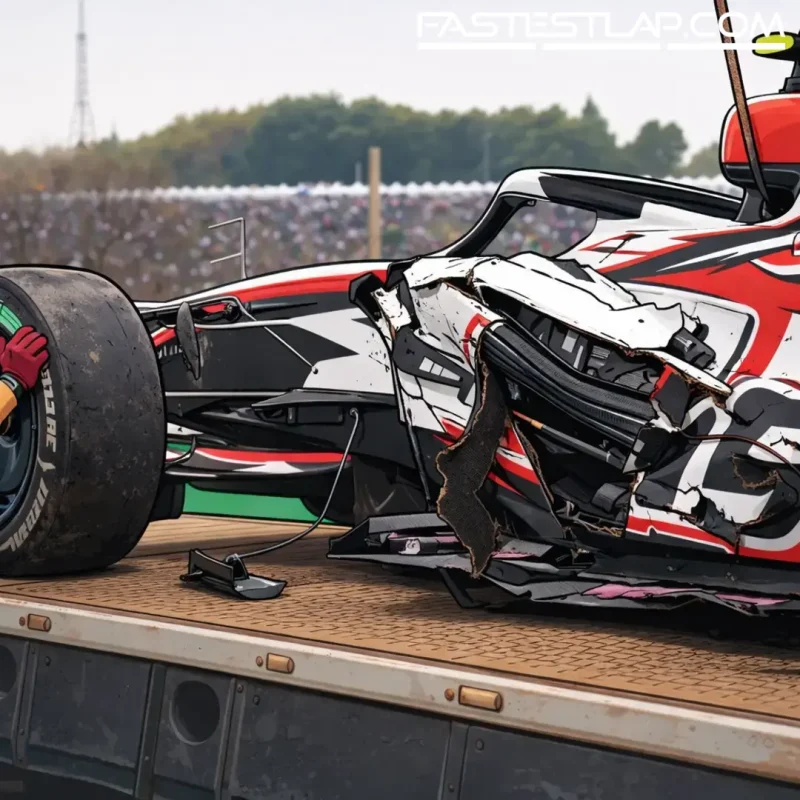
The Haas rookie crashed out midway through the Japanese Grand Prix after arriving on Franco Colapinto’s Alpine with a closing speed that simply didn’t exist in this shape a year ago. Bearman was in an energy deployment phase with his Ferrari power unit and, on the approach to Spoon, rapidly reeled Colapinto in with around a 50km/h advantage. Colapinto’s instinctive move across — described in the paddock as the sort of thing you’d consider “normal” under previous dynamics — left Bearman reacting at the last moment. He took to the grass, lost the car and hit the barriers sideways in a heavy 50G impact.
Bearman climbed out, but he was limping as he walked away from the wreck. Haas sent him for precautionary checks at the medical centre and he was cleared.
The bigger issue is what the accident exposed. 2026’s near 50/50 split between internal combustion and electrification has created a new rhythm to how cars arrive at corners and, crucially, how they close on each other when one car is harvesting and another is deploying. Those deltas can appear quickly and in places where drivers are trained, by muscle memory, to make “standard” defensive movements and corrections.
Haas team principal Ayao Komatsu has been one of the louder voices urging the sport not to thrash around with knee‑jerk regulation changes after only a handful of races. He reiterated that stance again after Suzuka — but with an important caveat: Bearman’s crash is now a real‑world data point the decision‑makers can’t dismiss.
“We’ve done three events. We had one incident,” Komatsu said, stressing that the sport still needs a proper sample size across different circuit types and conditions. Yet he was also blunt about the priority order. “Safety should be obviously paramount… You cannot ignore it.”
That’s the tone you hear when a team boss doesn’t want to be seen pushing for a rules tweak that helps his own package — but also doesn’t want the sport sleepwalking into another incident that was, in hindsight, easy to predict. The paddock has been talking about closing speeds since the start of the season. Suzuka provided the footage.
The calendar also makes the conversation time‑sensitive. The F1 Commission and the Power Unit Advisory Committee are scheduled to meet during the spring break, with a key date on April 9. Komatsu expects Bearman’s accident, and the broader “how are we racing these cars?” debate, to be high on the agenda.
What’s striking is how Komatsu framed the internal politics of it. He’s adamant the discussions so far haven’t been dominated by teams hunting a sporting advantage under the cover of safety — a familiar fear whenever regulations are opened up midstream. “Every time we have a meeting with all the TPs, with the FIA and F1, nobody is really pushing for a sporting advantage,” he said. That matters, because if the grid believes the intent is genuine, it becomes far easier to land small, targeted changes quickly.
And Komatsu is clearly selling the idea of “small” rather than “wholesale”.
“We’re collectively learning so many things,” he said, arguing that relatively minor improvements could “drastically improve the show as well as the safety.”
That’s a loaded line in 2026, because the sport’s early‑season criticism hasn’t been limited to crashes. Drivers have been vocal about the strange, sometimes ponderous approaches to corners that come with harvesting priorities. Lift-and-coast is hardly new in F1, but the current regulation set has made energy management feel like the headline act rather than a subplot, especially in qualifying trim.
Suzuka already produced one tangible response: the FIA reduced the amount of harvestable energy available in qualifying, allowing the permitted 8mJ to be reached via more natural driving techniques. It was a tacit admission that, yes, the spectacle was taking a hit.
Komatsu’s bigger philosophical gripe is about who is actually driving these cars.
“The driver should be in charge of driving, right?” he said. In his view, systems should sit in the background as tools, not dictate the lap. But with deployment largely handled by algorithms rather than direct driver control, he argues drivers are currently “driving to make the system function” — the wrong way round.
That’s also where safety links back in. When drivers are managing constraints rather than attacking corners with consistent behaviour, you get variability: different lift points, different deployment phases, different closing speeds. Variability is fine until it arrives at 300km/h with another car in the way and a decision window that shrinks to nothing.
Komatsu wouldn’t be drawn on a specific fix for the Suzuka scenario — “I don’t know exactly what mechanism we should use for that particular incident” — but he made it clear Haas expects the sport to act thoughtfully and collectively. The subtext is obvious: if 2026’s energy rules are creating speed deltas that catch out even sharp, well‑briefed drivers, then the framework needs refinement, not just better briefings.
For Bearman, the consolation is that he walked away. For Formula 1, the uncomfortable truth is that Suzuka looked like a warning shot — and in a regulation cycle already under scrutiny for the way it’s reshaping racing behaviour, it’s not one the paddock can afford to wave away as bad luck.