
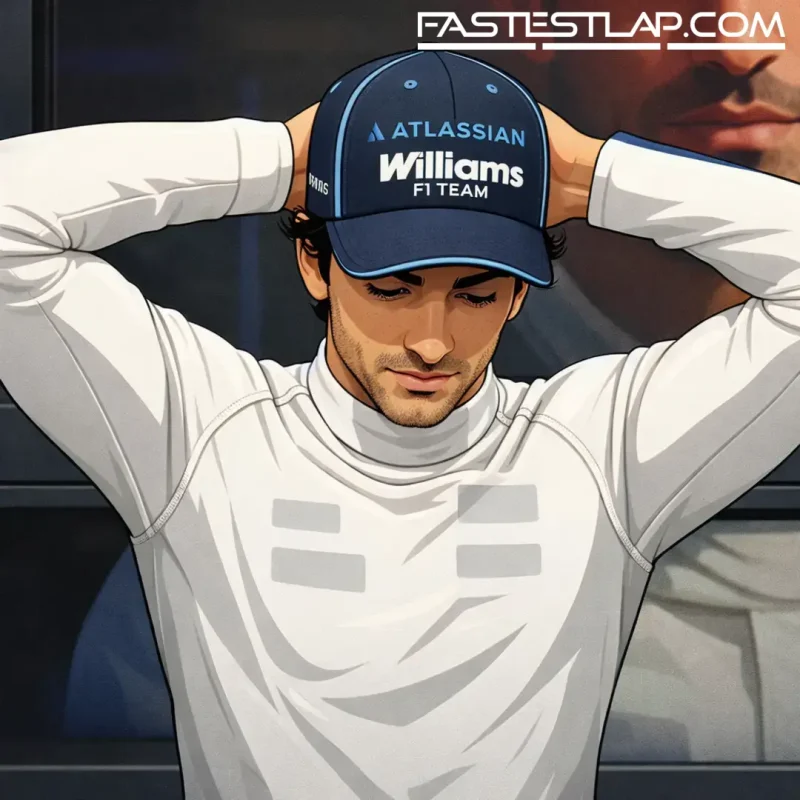
Carlos Sainz didn’t need long to find the soft underbelly of Formula 1’s 2026 racing product. Straight Line Mode might have arrived billed as a new era’s answer to overtaking and energy management, but in Melbourne the Williams driver called it what he thinks it really is: a cosmetic fix papering over a deeper power unit problem.
After the first competitive weekend of the new regulations at Albert Park — an Australian Grand Prix won by George Russell — Sainz’s own Sunday was already compromised. An Energy Recovery System issue kept him out of qualifying, leaving him 21st on the grid, and his race was further derailed by a front wing change that cost him “20-odd seconds”, dropping him to 15th at the flag. Alex Albon finished 12th, leaving Williams outside the points.
But Sainz’s main concern wasn’t the stopwatch. It was the feel of the first lap, when a tightly packed field finally got to stress-test SLM in anger.
“The biggest worry for me about the racing is Lap 1,” Sainz said in Melbourne. “It felt like it was really sketchy with SLM on everyone on the back straight. It felt really dangerous, very difficult to control the car in slipstream and SLM.”
SLM is effectively the new era’s straight-line tool — drivers activating moveable aero to generate extra top speed. The catch is why it’s needed so urgently: with the 2026 power units running a 50/50 split between combustion and electrical power, cars can run out of deployable energy down the straights. That’s where Sainz’s criticism sharpens. In his view, the series has created a system that forces drivers to use an overtaking aid not just to attack, but simply to avoid crawling to the braking zone.
“If it’s straight line, it’s not bad, because it’s like the DRS last year,” he said. “But when there’s a bit of cornering and both cars are using SLM, it becomes like there’s cornering in Turn 7, 8 on that back straight, it feels sketchy also.”
That comment matters in the context of Albert Park specifically, where the fast, slightly curved section around the lake has always blurred the line between “straight” and “not really a straight at all”. It’s also where the governance around SLM already looked indecisive before the race cars even lined up on Sunday.
Following Friday evening’s drivers’ briefing, the FIA announced on Saturday — ahead of FP3 — that a fourth Straight Mode zone on the circuit, running from Turn 6 to Turn 9, would be removed due to safety concerns. It didn’t last: team feedback saw it reinstated shortly after.
Sainz wasn’t subtle when asked whether the FIA’s initial instinct had been the right one. “I think the SLM is the plaster on top of the engine to protect the deployment issues we have,” he said.
“And then when you come to circuits like this that are energy starved, you end up having to use SLM in places where we shouldn’t to protect the deployment. So in the end, you end up having a dangerous situation like we have in Lap 1 and racing in general.”
There’s a revealing nuance in Sainz’s critique. He’s not arguing that SLM itself is inherently wrong — in fact, he all but admits the field is dependent on it. Without it, he suggests, the sport risks a return to the kind of lift-and-coast management that made qualifying and race stints look and sound like energy-saving exercises rather than flat-out performance.
“The issue is not the SLM,” Sainz said. “The SLM we needed if not, we would be… you guys saw we were doing lift and coast like crazy yesterday in quali, all teams. If you now remove SLM, we cannot even race with the deployment we have.
“So we kind of need SLM, but it’s a plaster to a solution to the engine formula that for me just doesn’t seem to work very well right now.”
That’s the uncomfortable bit for the championship’s rule-makers and stakeholders. The system has been designed to promote a certain kind of racing, but the first proper weekend has already surfaced a tension between what looks good in simulations and what feels stable at 300km/h with dirty air, a moving wing and a car that’s changing balance as it toggles between modes.
SLM’s defenders will point out that everyone got through Turn 1 on lap one without incident, even with the field bunched and drivers using the new tool early. But Sainz’s argument isn’t built on crashes avoided; it’s built on the margins drivers are operating within — and how those margins shrink when you combine slipstream, aero shifts and a corner that isn’t quite straight enough to be treated like one.
Melbourne, then, has delivered an immediate litmus test for 2026. Not in who won — though Russell’s victory set the tone — but in how quickly drivers have started pushing back on the mechanisms intended to make the new era raceable.
And if Sainz is right that SLM is compensating for an energy deployment shortfall rather than complementing a balanced package, this won’t stay a one-track talking point. It’ll follow F1 to every “energy-starved” venue on the calendar, and it’ll force the FIA to decide whether it wants to keep adjusting the bandage — or address the wound underneath.







