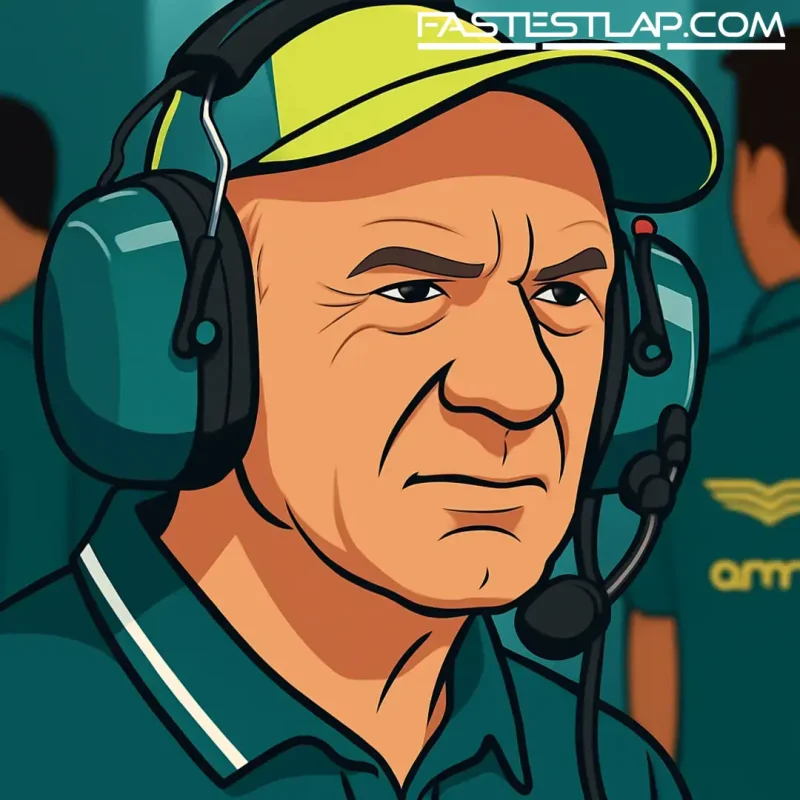
Adrian Newey: In F1’s data deluge, the driver’s feel still decides the direction
Aston Martin’s new managing technical partner hasn’t gone soft for the romance of the past. He’s just convinced the winning edge still comes from the person strapped into the thing.
In a sport drowning in telemetry, Adrian Newey’s message is disarmingly simple: listen to the drivers. The legendary designer — now leading Aston Martin’s 2026 car project after joining in March — believes teams risk getting lost in the numbers if they forget the one sensor that can tell you why a car is behaving a certain way.
People spend too long staring at traces and not long enough interrogating what the driver is actually feeling, he argued during a recent conversation on the James Allen on F1 podcast, then doubled down in an in-house Aston Martin chat. The hardware will show you what the car’s doing; the human can tell you why it’s doing it.
Newey’s built the most devastatingly effective cars of the modern era — title winners at Williams, McLaren and Red Bull — and he’s not just waxing nostalgic about a time before data loggers. He knows exactly what the gigabytes can deliver. But he also knows how quickly top drivers adapt to a car’s quirks without consciously noting those adjustments, masking underlying issues in the process. The art, as he puts it, is dragging those instincts out of them.
That’s where driver-in-the-loop simulators earn their keep. They’re not PlayStations for racecraft. They’re engineering tools that let teams try spring rates, roll bars, aero maps and suspension concepts without burning track time. The catch? No one’s built a synthetic driver model that can feel the car the way a human can. So the human stays in the loop, because the human can still articulate the edges — the vague front, the snap on entry, the non-linear load transfer — that no line of code has quite captured.
And here’s the twist in Newey’s argument: in some ways, the driver’s influence is bigger than ever. The modern pipeline pairs feelings with facts in real time. You get the driver’s language and the data’s language, and when those two line up, development moves fast. That’s the sweet spot. That’s where a car stops being a set of readings and starts being a weapon.
It lands at a fascinating moment for Aston Martin. The team is already pivoting hard toward 2026, when Formula 1 introduces overhauled chassis and power unit regulations. Newey is the point of the spear for that project, not just another senior voice but a managing technical partner and shareholder shaping how the team spends its time and money between now and next March — and beyond. If you’ve watched his career, you know how often his big steps arrive with new rules on the table.
There’s also a culture piece here. The current F1 machine rewards the outfits that can translate a driver’s nuance into aerodynamic and mechanical clarity without ego. The best engineers don’t just confirm what the numbers tell them — they test the theory against what the racer in the seat is describing. When those two disagree, Newey’s instinct is to dive into the disagreement, not dismiss it.
It’s easy to caricature this stance as old school versus new school. It isn’t. Newey’s won in both. He’s telling you where the marginal gains still live: in the handshake between gut and graph, feel and file, telemetry and the person who knows exactly how much curb the car will take before it bites back.
Aston Martin has made it clear that the 2026 car is the big bet. Newey’s philosophy suggests how they’ll place it. Less time trying to reverse-engineer laptimes to a thousandth. More time pulling drivers apart session by session to understand the limits they’re compensating for — and then engineering those limits out of the car.
You can call it romantic if you like. But you’d be arguing with a man who’s had a hand in 26 world championships and arrives in green with the same mantra he’s carried since the March days: data is a compass; the driver points true north.
If he’s right — and history says you’d be brave to bet otherwise — Aston Martin’s next great breakthrough won’t show up first in a spreadsheet. It’ll be heard in the debrief, buried in a sentence that starts with “It feels like…” and ends with a design direction that makes the whole car come alive.