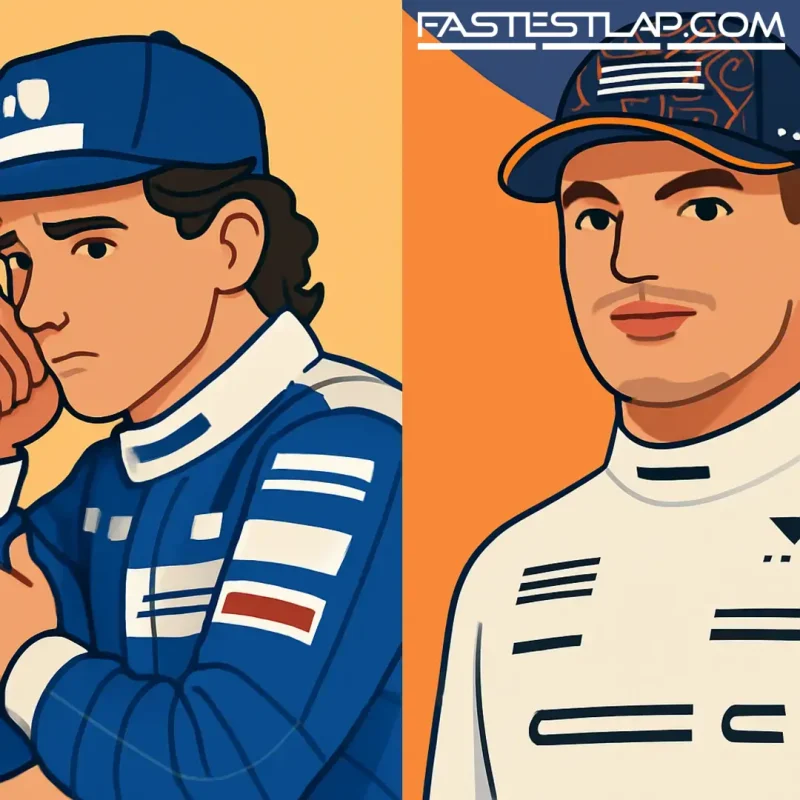
Adrian Newey doesn’t reach for superlatives lightly. When he does, it’s worth tuning in. Asked to pick standouts from a driver roll call that spans Mansell, Hakkinen, Vettel and beyond, the most celebrated designer of his generation singled out two names: Ayrton Senna and Max Verstappen.
Newey, now into a fresh chapter at Aston Martin in 2025 after rewriting chunks of the sport’s record book with Williams, McLaren and Red Bull, recounted the first time he hosted Senna at Grove back in late ’93. It was meant to be a tour. It turned into an interrogation.
“He came to the factory for the first time, and I was given the privilege by Frank and Patrick of showing Ayrton around,” Newey recalled on the James Allen on F1 podcast. “We got to the wind tunnel and straight away he was down on his hands and knees, looking at the rear suspension, spotting that it was different to anything done before, asking all about it. Why this? Why that? What’s the purpose?”
If you’ve spent a career chasing tenths with a pencil and wind tunnel data, that kind of curiosity gets your attention. “I needed to be on my toes,” Newey said. “Ayrton, without doubt, was outstanding.”
The relationship was heartbreakingly short. Senna’s life was cut short at Imola in 1994, just three races into his Williams stint. The impression remained — not just the speed, but the way he processed a car’s secrets in real time. Plenty of greats can drive around flaws. Senna hunted them down and demanded to know why they existed in the first place.
The modern parallel, in Newey’s eyes, is Verstappen. Different era, different toolset, same rare air.
“Max now, I think, is absolutely outstanding as well,” Newey said. “He’s not had the easiest upbringing — that’s no secret — but his maturity is amazing. His ability to handle pressure, soak it up. Whatever’s going on in his life, when he puts the helmet on and gets in the car, all the noise is switched off and he can just go out and race. That’s mightily impressive in a sportsman.”
There’s a clinical quality to Verstappen’s best days that tends to flatten nuance: the lap time is the lap time, the gap is the gap. But those around him often talk about the bit you can’t measure — the way he compartmentalises chaos and lives in the moment when it counts. It’s not romantic, it’s relentless. That’s where Newey draws the line between very good and extraordinary.
It carries a particular weight coming from a man whose fingerprints are on 26 world championship titles, drivers’ and constructors’ combined. Newey arrived at Williams in 1991 and turned the place into a juggernaut by 1992; Nigel Mansell cashed in with his lone drivers’ crown and the team collected the first of many constructors’ trophies from the Newey era. The hits kept coming at McLaren and then at Red Bull, where the RB lineage underpinned a dominance that forced rivals to redraw their maps for a decade.
Now at Aston Martin — he joined in March — Newey is the most coveted new signing in the paddock’s current arms race, paired with a leadership group designed to drag the team from plucky disruptor to permanent threat. It’s a long game and everyone knows it. But Newey’s presence raises the ceiling and the standards overnight.
As for Verstappen, he’s still in the thick of it in 2025, chasing another crown while the field closes around him in fits and starts. The title fight heads into São Paulo with storylines layered all over it and, crucially, without the sense of inevitability that blanketed previous seasons. Verstappen remains the benchmark on Sundays; on Saturdays, he’s often bored holes through the noise — exactly as Newey described.
The thread between Senna and Verstappen isn’t about who’s greatest, or even the raw number of trophies. It’s the way they bend the sport to their will. Senna did it with an almost forensic feel for a car’s soul. Verstappen does it with unshakable focus and a refusal to blink when the stakes go up. Different lenses, same picture: a driver operating a step above the rest.
Newey’s job at Aston Martin, ironically, is to build a machine capable of dethroning the most recent product of his own empire. But if his appraisal of Verstappen sounds admiring rather than possessive, that tracks. Designers build the canvas. Drivers paint the masterpiece. Every so often, one of them uses colours nobody else can see. In Newey’s book, Senna and Verstappen are exactly that.