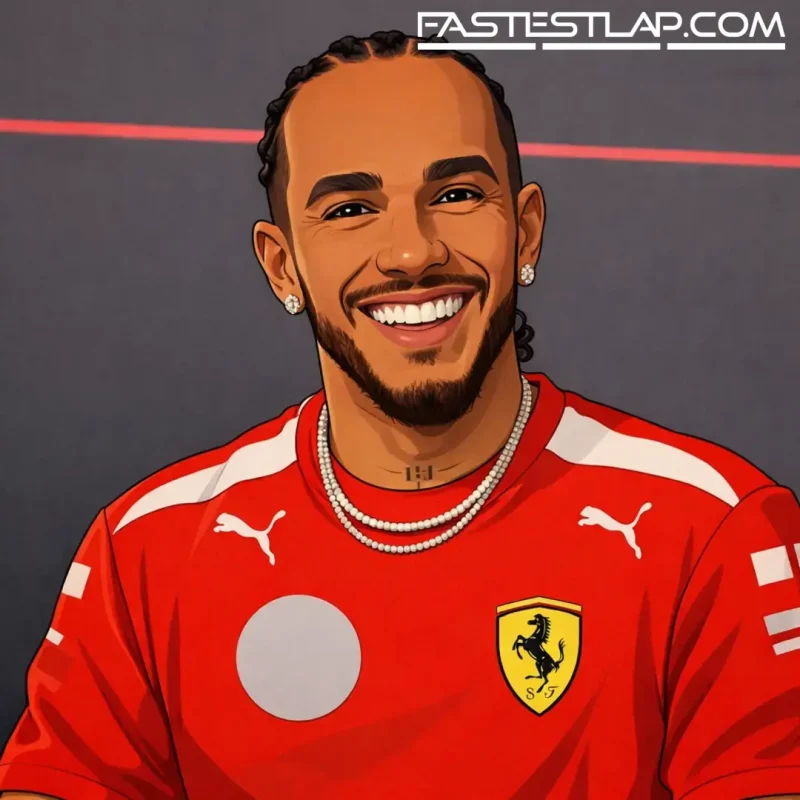
Alex Albon doesn’t usually do grand proclamations, which is why his pick for 2026 landed with a bit more weight than the average pre-season hot take. Asked who he thinks could be the big winner of Formula 1’s reset, the Williams driver didn’t go fishing for safe options. He went straight to Lewis Hamilton.
It’s an interesting call in a paddock that’s spent the past couple of years quietly wondering whether the sport had moved on from Hamilton’s strengths, rather than merely away from Mercedes’. The ground-effect era was, by his standards, a grind: two grand prix wins across four seasons, and last year the statistical gut-punch of a full campaign without a single Sunday podium. Porpoising hurt him, Mercedes’ concept misfired, and the usual Hamilton superpower — making the car do things it shouldn’t — didn’t always translate into results.
His move to Ferrari for 2025 was supposed to change the weather. It didn’t, not in any meaningful championship sense. Hamilton finished sixth in the standings, and for long stretches looked like a driver carrying the weight of expectation rather than shaping it. The vibe was muted. The voice on the radio, too.
Then Bahrain testing for 2026 arrived, and Hamilton sounded like someone who’d found a new starting point. Ferrari’s new overbody aerodynamic car may not have topped the timesheets with him at the wheel — he ended the test seventh-fastest — but his demeanour was the story. He was 1.4s off Charles Leclerc’s best, yet only six-tenths away from the second-fastest overall time in a compressed order, the sort of spread that doesn’t tell you much beyond “it’s close” and “fuel loads exist”.
What did tell you something was Hamilton’s own message afterwards, unusually direct even by his standards.
“I’m reset and refreshed,” he wrote. “I’m not going anywhere, so stick with me.
“For a moment, I forgot who I was, but thanks to you and your support, you’re not going to see that mindset again.
“I know what needs to be done. This is going to be one hell of a season. I’ve given everything to be here today.”
That’s not a man easing towards retirement. That’s someone picking a fight with the narrative.
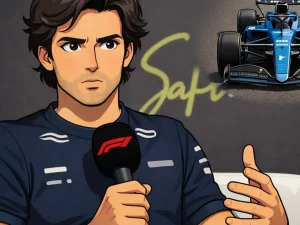
Albon’s reasoning, offered during a Q&A with team-mate Carlos Sainz on Williams’ official YouTube channel, gets to the more technical heart of why Hamilton might be better placed for the new era than the last one. The 2026 cars are smaller and lighter, and they bring in movable front and rear wings — tools that will reshape how drivers attack the lap and how teams balance the trade-offs.
“Weird question, but interesting,” Albon began, initially hesitant to name a driver at all. But with Sainz pushing, he relented: “I think it’s Lewis.”
Albon’s explanation was revealing because it wasn’t framed around legacy, hype, or hero worship. It was about style.
“I think, lighter cars,” he said. “I think that his style suits these cars a bit more. This feeling of, he makes the corners really short and he doesn’t focus on exits. I don’t think that’s the worst thing in these cars.”
Sainz’s reaction said plenty: “Interesting. Bold statement.”
Bold, yes — but not baseless. If you buy Albon’s premise, Hamilton’s knack for compressing the corner, for getting the car rotated and pointed without making a meal of the exit, could be a real asset in a formula where the car’s behaviour is changing again. Movable aero adds another layer: the phases of a lap become more distinct, and the techniques that helped maximise a particular type of corner could come back into fashion.
There’s also a psychological edge to this. Hamilton has spent years being measured against a version of himself from another era — the one who could take a compromised car and still live on the podium. The last few seasons made it easy to forget how quickly he can recalibrate when the rulebook shifts his way. For a driver who feeds off momentum and belief, a clean-sheet regulation set can be as important as any upgrade package.
None of this, of course, guarantees an eighth title. Ferrari still has to build a car that’s not just quick but consistently usable across conditions and circuits, and Hamilton has to beat the one constant in his Ferrari story so far: Leclerc’s raw pace. Being 1.4s down on the same machinery at a test might not mean much in March, but it’s not the sort of detail that disappears when the racing starts.
Still, Albon’s pick cuts through the noise because it frames 2026 as an opportunity for driver craft to reassert itself in a slightly different way. If the new cars reward a sharper, more decisive approach — “short” corners, as Albon put it — Hamilton might finally be stepping into a rule cycle that feels like it’s speaking his language again.
And if he really is, as he says, “reset and refreshed”, then the rest of the grid should probably take him at his word.