Formula 1 didn’t need long to run into the political reality of 2026: the new power-unit era might be locked in on paper, but if the racing feels like it’s being dictated by algorithms rather than instincts, the pressure to intervene becomes irresistible.
That’s exactly where the FIA now finds itself after Melbourne, with single-seater director Nikolas Tombazis confirming the governing body will sit down with teams after the Chinese Grand Prix to reassess how energy management is working in the real world — and, crucially, what can be adjusted without tearing up the rules two races into a new cycle.
The paddock arrived in Australia aware the new chassis and aero package would take time to settle, yet the bigger shock came from how delicate — and at times opaque — the energy picture has become once the lights go out. Lap times, broadly, haven’t fallen off a cliff. The cars are still in the same ballpark as last year, which is a quiet win for the overall regulation shape. But drivers are having to “drive the system” to a degree that’s left even the more adaptable among them sounding exasperated.
The flashpoint is what’s being described around the paddock as “super clipping”: a phase where the car begins harvesting energy in a way that effectively bleeds speed on the straight because electrical energy is being pulled away rather than delivered, even while the driver is still flat-out. In practice, it turns sections that should be about commitment and late bravery into exercises in damage limitation and timing — and it’s happening with minimal agency from the cockpit.
Melbourne’s Turn 9 and 10 sequence became the obvious example. Where those approaches have historically rewarded nerve, drivers found themselves arriving slower than they expected or wanted, because the battery state and the harvesting strategy were doing the louder talking. And once that dynamic exists, it spreads everywhere: why send it deep on the brakes if the smarter play is to brake early, collect more energy, and ensure you’re not the sitting duck on the next straight?
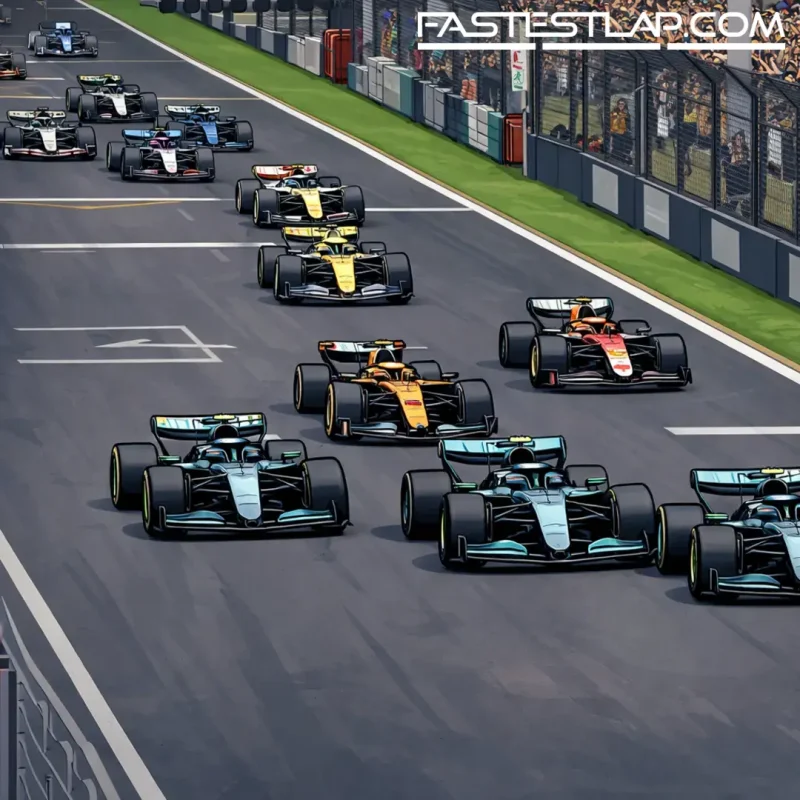
The Australian Grand Prix produced a reported 120 overtakes, an eye-catching headline figure compared with 2025. But the reaction inside the paddock was notably cooler, because a chunk of those moves weren’t born from classic racecraft so much as cars rotating through “rich” and “poor” energy phases. Even the Russell-versus-Leclerc lead fight had moments where the pass-and-repass pattern looked less like two drivers trading punches and more like a boost-button lottery: one car flush with deployment, the other stuck harvesting.
Leclerc was among those to label the racing feel “artificial”, and he wasn’t alone. The concern isn’t simply aesthetic, either. When speed deltas appear and disappear quickly — sometimes without a driver feeling fully in control of why — it can create the sort of closing speeds nobody wants to meet in a braking zone.
That’s the backdrop to Tombazis’ confirmation that the FIA is preparing a formal review after Shanghai.
“We didn’t believe it was realistic to make changes for energy management here,” Tombazis said in Melbourne. “We had a meeting with the teams about 10 days ago, after the Bahrain testing, to review the matter.
“The team’s unanimous position was that we should stick to the current arrangements for the first few races and to review the matter when we have a bit more data.
“Our intention is after China to be reviewing the energy management situation. We have a few aces up our sleeves on that, which we didn’t want to introduce ahead of the first race as a knee-jerk reaction, and which we will review with the teams after China.”
That choice of words matters. “Aces up our sleeves” is FIA-speak for: there are levers available within the framework, but they’re politically sensitive and technically consequential enough that the FIA doesn’t want to be seen panicking. The teams, too, have their own reasons to slow-walk it. Any tweak that changes deployment length, harvesting aggressiveness or peak electrical punch will create winners and losers — and in 2026, nobody wants to volunteer to be the loser in March.
Still, the menu of potential fixes is already being discussed. With the power units homologated, there’s no magic rewrite of peak performance coming. But there may be ways to smooth the worst of the “on/off” feel. One concept doing the rounds is effectively reshaping the electrical delivery: reduce peak output so you get less of a hit out of slow corners, but stretch the deployment so cars don’t feel like they’re running out of electricity halfway down a straight.
Another idea is to raise the ‘super clipping’ harvesting rate from its current 250kW towards 350kW. McLaren even trialled the 350kW concept on the final day of pre-season testing in Bahrain, though Oscar Piastri wasn’t buying the premise that it meaningfully improves the driving experience. His point was simple: a 350kW “super clip” still feels like an enforced lift — except one version leaves the driver in control and the other happens while the throttle is pinned.
“I’m not sure it’s any more optimal,” Piastri said. “I think everyone can see the state of things… there are clearly some fundamental things that won’t be very easy to fix.”
Drivers, typically, have been more candid than teams. Lando Norris, the reigning world champion, was scathing all weekend and didn’t soften after finishing fifth. He described the speed swings as “chaos” and warned that the current dynamic is pushing the sport towards a serious incident.
“There’s gonna be a big accident,” Norris said. “It’s very artificial, depending on just what the power unit decides to do and randomly does at times. You just get overtaken by five cars, and you can do nothing about it sometimes.”
Max Verstappen, who voiced concerns already in testing, doubled down in Melbourne too, saying he’s “not having fun” under these regulations and urging the FIA and F1 to act not for optics, but because the product needs to feel like Formula 1.
The calendar offers a natural decision point. China runs on March 15, followed by a two-week gap before Japan. Beyond that, there’s the possibility of additional downtime if Bahrain and Saudi Arabia are cancelled — a window that could allow procedural changes to be agreed, communicated and implemented without the sport looking like it’s changing the rules between qualifying and the race.
For now, everyone is braced for Shanghai to provide the second data point — and, perhaps more importantly, the second round of driver anger. Because Melbourne made one thing clear: 2026’s energy management isn’t just a technical talking point. It’s become the sport’s first big governance test of the new era.