Fernando Alonso jokes the numbers men have taken over F1 — and contract talks might never be the same
If you’ve been around Formula 1 as long as Fernando Alonso has, you notice the tectonic plates when they shift. And right now, he says, the sport’s leadership culture has moved decisively from the boardroom to the CAD station.
“It is different, no doubt,” Alonso reflected during the Singapore weekend. “The sport is different and the world is different. Everything is more about performance now… the car is run by thousands of simulations. There’s less intuition in what we do on a weekend. Everything is driven by data.”
That data-first mindset is increasingly mirrored at the top of teams. Where once you had flamboyant powerbrokers and larger-than-life dealmakers steering the ship, today’s pit wall is often run by meticulously trained engineers who can talk rake, porpoising and correlation before breakfast.
Alonso’s had the full tour. He came in at Minardi under Paul Stoddart, sparred under Ron Dennis at McLaren, won with Flavio Briatore at Renault and lived the Ferrari era of Luca di Montezemolo and Stefano Domenicali. He knows the old archetypes. And he knows this new one too.
“Maybe it’s tougher to negotiate your contracts now — it’s about numbers and data and things like that!” he grinned, half-joking, half-not.
Across the grid, you can see why the pendulum has swung. Modern F1 isn’t just resource-heavy; it’s algorithm-heavy. Cars are conceived in wind tunnels and supercomputers, the margins are vanishingly small, and the people who speak the language of lap-time are increasingly the ones holding the keys. It’s not a universal template — there are still CEOs and commercial bosses with serious clout — but the trend line is clear.
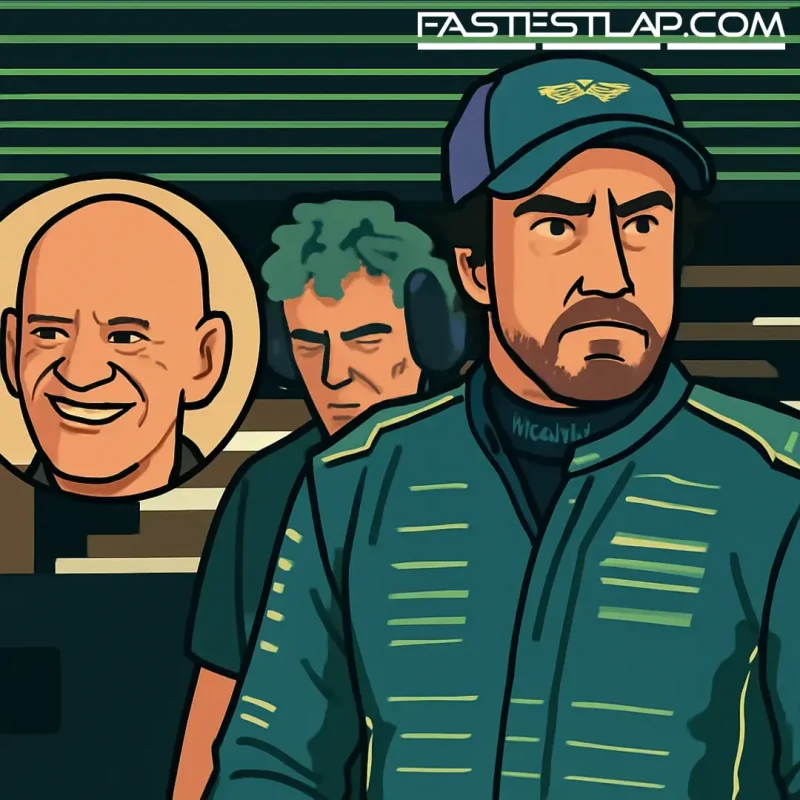
At Aston Martin, Alonso’s current world, that trend has hardened into a statement. The team has loaded up on technical firepower and restructured around it. Adrian Newey, the generational design mind, has taken over as team principal, with Andy Cowell stepping back from the front line after a year in charge to focus his considerable energy on the 2026 Honda power transition. Enrico Cardile has arrived at Silverstone, fresh blood with a reputation for finding aero gains where others don’t. Mike Krack and Bob Bell remain part of the senior picture after a technical reshuffle, while long-serving sporting director Andy Stevenson anchors operations at the track. It’s a lot, and it’s deliberate.
Alonso likes the balance — the blend of engineering rigor and old-school racing instinct — and he gave a nod to the man who signs the cheques and sets the temperature. “We have great technical leaders, but at the same time a very strong commercial team. We have our sponsors, and we have Lawrence [Stroll] on top of that, who is still one of the old characters. The passion of racing is still in his blood. It’s not only data.”
Inside the garage, he insists there’s no shortage of know-how. Between Alonso and Lance Stroll, there’s the better part of 35 years’ experience, and Aston’s track team — engineers, performance gurus, strategy group — has been around enough corners to know what wins look like. The missing piece? The timeless one.
“We just need a fast car next year,” Alonso said, not dressing it up.
That’s where the heavy investment is supposed to pay off. Aston Martin’s new campus is fully online now, the wind tunnel is humming, and the list of marquee hires reads like a technical director draft. On paper, it all points in one direction.
“Factory is completed. Wind tunnel is brand new and completed, and we are using it,” Alonso said. “We have Adrian Newey, Andy Cowell, Enrico Cardile… great people and great talent in the factory. We just need to put everything in place and make sure that all those facilities and people, that are new, are just a few months into the system.”
He’s realistic about the timeline. You don’t click your fingers and turn fresh kit and fresh thinkers into a title-contending machine. Processes need to settle, ideas need to iterate, and the 2026 rules reset looms as both a risk and an opportunity. “Will it be enough, these few months, or do we need one full season to glue everything together? That’s the thing I don’t know. But Aston Martin will succeed. For me, that’s a guarantee. The biggest question is when.”
If the sport truly is run by the data now, Alonso’s bet is that Aston Martin’s numbers will eventually add up. In the meantime, he’s still the same competitor who arrived in 2001: impatient in the best possible way, itching for a car that lets him turn process into podiums.
And for all the talk of simulations and leaders with engineering pedigrees, he’d remind you there’s still room in F1 for a little of the old magic — the gut feel on an out-lap, the brave call in changing conditions, the driver who senses grip where others see risk. The sport hasn’t lost its soul; it’s just learned a new language. Alonso speaks both.