Fernando Alonso has never been one to confuse diplomacy with honesty, and F1’s first proper taste of the 2026 cars hasn’t softened him. In Bahrain testing this week, the Aston Martin driver delivered a withering assessment of where the new regulations have pushed the craft of driving: towards energy choices made before the corner, and away from the kind of high-speed commitment that used to separate the very best.
His headline line was pure Alonso — he said the new cars have the grip of a “rental car” — but the point underneath was more pointed than the punchline. In his view, the performance ceiling in fast corners is being set less by nerve, precision and aero confidence, and more by a deliberate decision to back out early to protect electrical energy for the straight that follows.
The 2026 power unit formula and its 50/50 split between combustion and electrical deployment has been the story of the winter, with the grid split between those enjoying the new challenge and those worried F1 is drifting too close to Formula E’s management-heavy rhythm. In the paddock, “energy management” has become the default explanation for everything from lap time swings to why some runs look oddly pedestrian in places where F1 cars should look spectacular.
Alonso argues that the trade-off is most obvious when the track asks you to hang on through high-speed sequences — the kind of corners where the bravest drivers used to bleed time out of the car by simply refusing to lift.
“You’re always on the limit on the grip,” Alonso said in Bahrain. “But yeah, it is different… you are always at the limit of the grip. Also in a rental car, you are always on the limit of the grip, if you push the limits.
“But in high-speed corners, especially, I think it’s less challenging. We have to say that, there’s nothing wrong to say.”
What he’s describing isn’t a lack of difficulty overall — it’s a shift in where the difficulty lives. Under these rules, drivers are juggling boost modes, overtaking modes and harvesting targets, and that workload doesn’t disappear just because you’re approaching a fast corner. The problem, Alonso suggests, is that the optimal way to be quick often isn’t to drive the corner properly at all.
In other words: you might be capable of taking it flat, but the smart play is to come in slower, spend less energy, then cash it out down the next straight. That changes the feel of the lap, and it changes what “making the difference” actually means.
“Like in 10, 12 here and some other corners, maybe in Barcelona and other places, we will decide to stop the energy, to save it and go through the corner in a slower speed, and then you have more energy for the straight,” Alonso said. “So from a driver point of view, obviously, your skills matter less now, because you can go as fast as the energy decision you choose before that corner.”
That idea — that the lap is increasingly being “decided” ahead of time — is what’s really eating at him. Alonso has always been a driver who prides himself on squeezing the extra few kilometres per hour through the phase of the corner where the car is light, nervous and alive. If the regulation set is effectively telling drivers to bank that time elsewhere, it’s no surprise he’s unimpressed.
He’d already leaned into the same argument earlier in the Bahrain test, using a deliberately exaggerated image to make the point land: that at the reduced speeds now being chosen through certain corners, the act of driving them stops being a differentiator.
“Now in 10/12 we are like 50kph lower because we don’t want to waste energy there, and we want to have it all on the straights,” Alonso said. “So you do 10,12, instead of 260, at 200.
“The chef can drive the car in 10,12 at that speed, but you don’t want to waste energy, because you want to have it on the straight.
“From a driver, you would like to make the difference in the corner, driving those five kilometres faster, but now you are dictated by how much energy your engine will have on the next straight.”
There’s a subtext here that’s worth clocking. F1 has sold 2026 as a reset — new power, new chassis rules, a new era. But drivers are creatures of feel, and the early mood around these cars is that they demand a different kind of discipline: less about the knife-edge of aero grip in the fastest turns, more about restraint and planning. That may well produce good racing, and it may reward the smartest operators as much as the bravest. But it will also change the sport’s aesthetic in ways not everyone is going to enjoy.
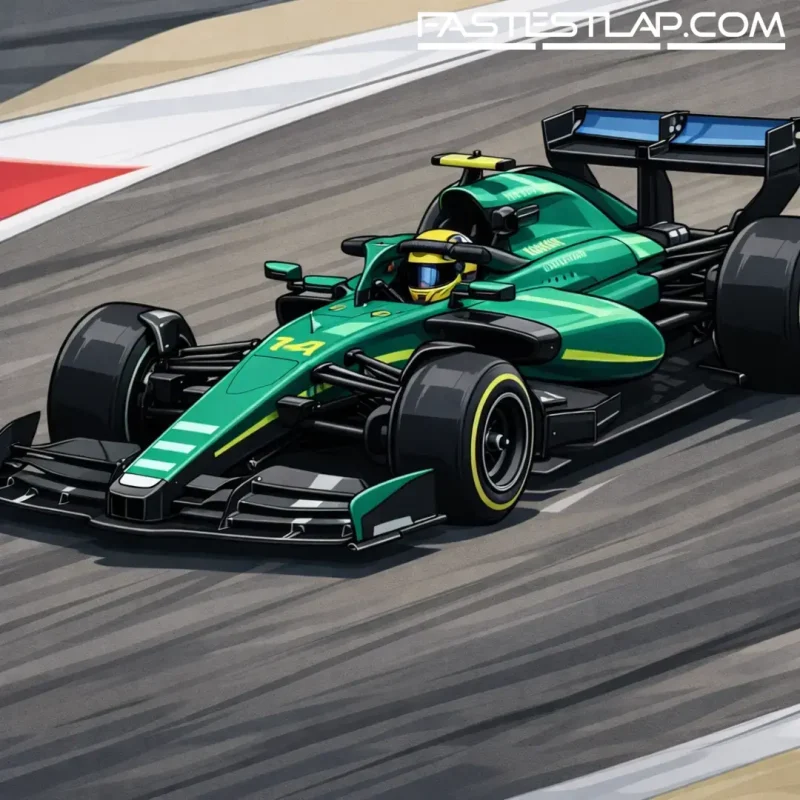
Alonso was back in the AMR26 on Thursday, piling on laps as Aston Martin worked through its programme on the penultimate day of the Bahrain test. Nobody in the pit lane is pretending testing times are the story right now; the real intrigue is how quickly teams and drivers converge on the “right” way to race these cars. If Alonso’s right, the big adaptation won’t just be technical — it’ll be philosophical.
And if F1’s new era really does come down to energy choices made before the corner, don’t expect a two-time world champion to pretend that feels like progress.