
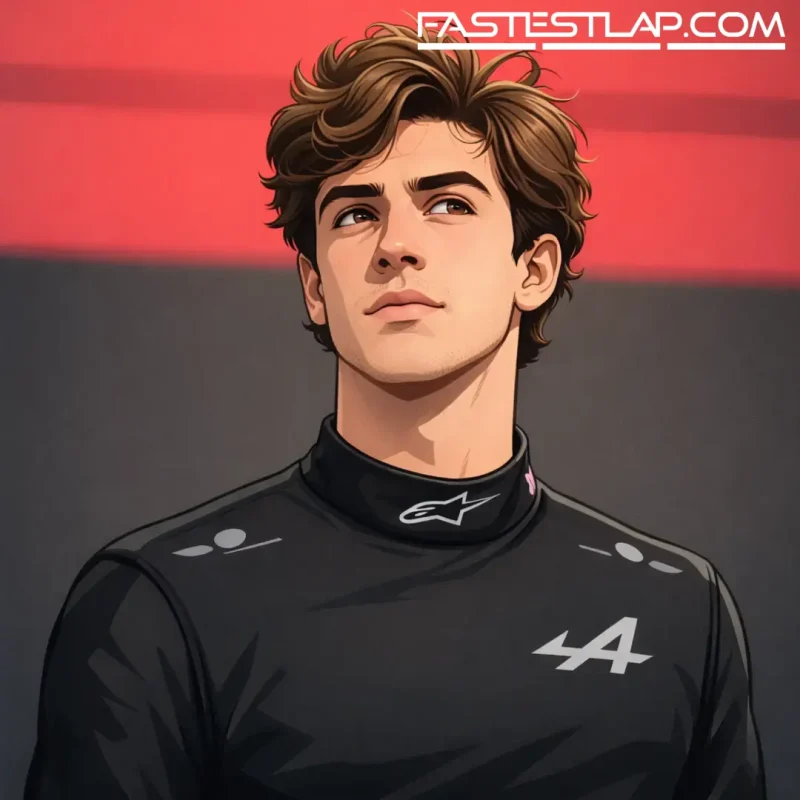
Alpine will tick off another of its 2026 rookie-running obligations in Budapest this weekend, handing Paul Aron the wheel of Franco Colapinto’s car for first practice at the Hungarian Grand Prix.
It’ll be Aron’s third FP1 outing of the season and, while these sessions are often framed as low-stakes admin, they matter a little more in the current climate: the grid’s 2026 rookie quotas are forcing teams to think carefully about when to step off their regular drivers, and Hungary’s tight, low-speed layout is hardly the easiest place to give away an hour of normal preparation.
Aron has been Alpine’s reserve since the start of 2025, but he’s hardly been sitting idle. The 22-year-old Estonian – a former Mercedes junior – has already been in and around F1 weekends regularly, and his recent track time came via last year’s unusual loan arrangement that saw him placed with Audi (then Sauber) for practice appearances. More recently, he logged two FP1 sessions last month in the Audi R26, standing in for Nico Hülkenberg in Barcelona and Gabriel Bortoleto in Austria.
This time it’s back to the “parent” team, and the target is straightforward: meet the rules. Under the current regulations, each team must field a rookie – defined as a driver with no more than two F1 starts – in four practice sessions across the season, split two per car. Alpine has chosen to take Colapinto out of FP1 to get one of those boxes ticked.
For Colapinto, it’s an interruption, but not a calamity. If anything, the timing underlines where his season has moved to: he’s no longer the story because he’s simply there, he’s the story because he’s beginning to look like a points-scoring constant. After a difficult 2025, the Argentine has made clear gains in 2026 and arrives in Hungary 12th in the drivers’ standings, 23 points behind Pierre Gasly, with points scored at six of the first 10 rounds.
Spa was a neat snapshot of the progress. Colapinto came home 10th at the Belgian Grand Prix, one place ahead of Gasly, and sounded quietly confident about how he managed the stint with his team-mate in his mirrors.
“I think it was under control,” Colapinto said afterwards. “It’s just that in the very long straight, you lose seven tenths or six tenths with the tow on energy. So to be behind on a track like this is actually quite good.
“When I was behind, I was catching a lot and I managed to pass three cars. And then when I was in front, it’s tricky to pull away. You also lose in front.
“I was quick in some corners, but I couldn’t really pull away. With how much you’re catching in the straights, it’s very long, like from [Turn] 15 to 18.”
Those comments, more than the single point itself, hinted at a driver who’s starting to read the compromises of modern F1 racing well: where you’re strong, where you’re vulnerable, and how the energy/tow game dictates whether you defend by pace, placement, or simply accepting you’re going to be a sitting duck in the wrong part of the lap.
Hungary, of course, is a different problem altogether, and Colapinto knows it. “I don’t know,” he said of his expectations for the weekend. “It’s a very different track, we’ll try our best.”
Alpine won’t be the only outfit juggling its FP1 line-up in Budapest. McLaren and Haas are also set to run substitutes in first practice, with Leonardo Fornaroli stepping in for Oscar Piastri and Ryo Hirakawa taking Oliver Bearman’s seat.
The subtext across the paddock is obvious: teams are increasingly trying to choose FP1s where the “damage” is manageable – either at circuits where set-up direction is well understood or on weekends where the second practice is likely to carry most of the heavy lifting. Hungary can be unforgiving for that approach, but it’s also a place where confidence in a car’s baseline tends to matter more than chasing a razor-thin top-speed configuration, and that can make it a pragmatic moment to get the rookie mileage done.
For Aron, it’s another meaningful data point in an F1 career that’s currently being built in small but visible steps. For Colapinto, it’s a reminder that, even as his results stabilise, the modern season is a game of compromises — and sometimes that means handing your car over on Friday morning and trusting you’ll be back up to speed when it counts.









