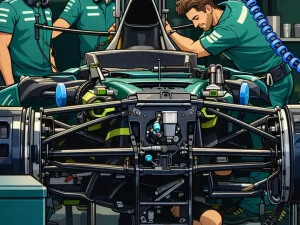
Aston Martin has finally shown its hand in Budapest, rolling a visibly reworked AMR26 into the Hungarian Grand Prix weekend with the sort of “B-spec” label that tends to mean one of two things in modern Formula 1: either a genuine reset, or a last throw of the dice.
Given where this season has gone for the Silverstone team, it can only really be the former. Aston Martin arrives in Hungary propping up the constructors’ table with a single point to its name — Fernando Alonso’s 10th in Monaco — and the sense around the paddock has been that the early AMR26 simply hasn’t had enough in it to fight in the congested midfield, never mind flirt with the sharp end. That makes the timing of this package, and the philosophy behind it, more interesting than the usual “new floor, new wing” churn we’ve seen across the grid.
While several teams have spent the opening run of 2026 peppering their cars with bite-sized updates, Aston Martin has deliberately played the long game: fewer visible changes early on, then a larger, more integrated step aimed squarely at shifting the car’s baseline. Hungary is stage one of a planned two-step push, with Honda power unit improvements pencilled in for the Dutch Grand Prix next month.
What’s on the car this weekend is chiefly Aston Martin’s own doing — and, crucially, it’s not just aero dressing. The brief is weight. The team has been targeting a major reduction through the chassis and gearbox architecture, coupled to a new nose, revised rear suspension, and “substantially revised aerodynamic surfaces”. The language matters: “substantial” isn’t a word teams use lightly when they’re trying to manage expectations.
Adrian Newey, speaking recently via Aston Martin’s own channels, offered a rare bit of candour on what’s changed and what hasn’t. The main structural elements “remain the same”, he said, stressing that the chassis and gearbox architecture don’t “fundamentally” change — but the team has taken weight out of both. That’s not a trivial tweak: it required re-homologation and crash testing of the forward chassis, which tells you this was always going to be a package you aim for a specific date, not something you drip-feed.
Newey also confirmed the front suspension is unchanged, while the rear has been “slightly revised”, a phrase that often hides a lot of geometry work when teams are chasing tyre behaviour and platform control. The headline, though, is the combination of mass and aero: Aston Martin is effectively trying to buy itself performance in two currencies at once — a lighter car that’s easier to place in the operating window, and a bodywork/floor concept intended to generate more consistent load.
“The target is to get very close to the weight limit,” Newey said, which in 2026 is a particularly pointed admission. With the current regulations era, teams that start overweight don’t just suffer in lap time; they suffer in every set-up conversation thereafter. You end up compromising ride, balance, even tyre usage, because the car’s simply carrying more than the engineers designed it to. Shaving kilos is one of the few upgrades that tends to pay you back everywhere, at every circuit, without the “works on paper, not on track” risk that so often comes with aggressive aero.
But Newey was careful not to oversell it. Aston Martin is “predicting a large step”, he said, but wouldn’t attach numbers to it. That caution is understandable, especially given his other point: the team is still climbing out of a hole in its simulation and correlation tools.
There’s a quietly important subtext there. Newey described a historic lack of investment in “core physics tools” and project management systems, and emphasised that you can’t simply rebuild and validate those overnight — and that correlating them properly with the real car takes time. In other words, even if the design direction is right, even if the parts are good, Aston Martin is still in the phase where it’s learning how to trust its own instruments again. That’s the kind of issue that doesn’t always show up in a glossy launch or a neat upgrade list, but it can define a season.
It also explains why this Budapest package feels like a stake in the ground. If the tools are improving but not yet fully paying dividends, then the team needs an on-track reference point — a clear “new baseline” — to accelerate that learning. Hungary, with its emphasis on traction, rhythm and aero efficiency, is a revealing place to do it. If the AMR26 has gained load but become peaky, the Hungaroring will expose that quickly. If the weight reduction genuinely broadens the car’s operating window, both Alonso and Lance Stroll should feel it in a way that doesn’t require a stopwatch to interpret.
None of this, of course, guarantees Aston Martin suddenly launches itself into contention. The midfield this year has been too tight for that sort of fairy tale. But there’s a difference between an upgrade that gives you a couple of tenths on a perfect lap, and an upgrade that changes how often you can access the car’s performance across a weekend. From the outside, this looks aimed at the latter — and for a team that has spent the first half of 2026 scrapping for scraps, that’s the only kind of progress that really matters.
Friday practice will give the first clues, but the real test will come when parc fermé locks and the team has to live with the car it’s built. Aston Martin has been patient in getting here. Now it needs this B-spec AMR26 to be more than just new shapes in the garage.