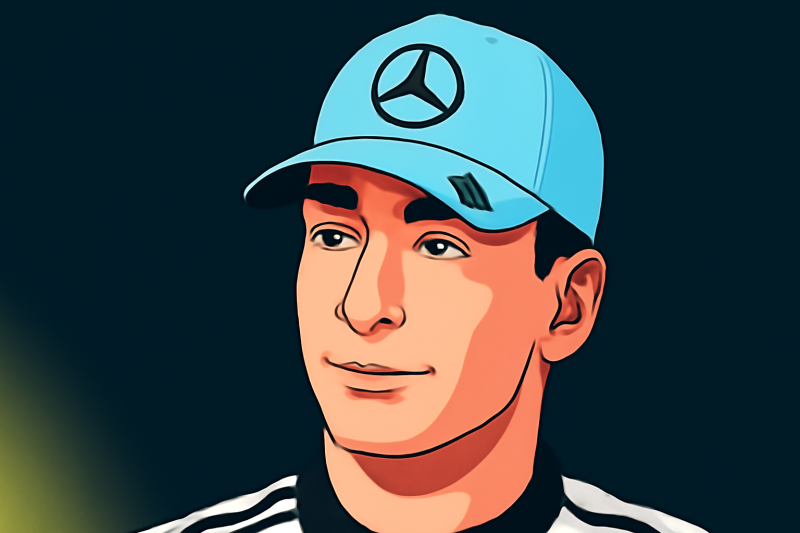
Budapest left Ferrari with a riddle and the paddock with theories. George Russell’s was the loudest — and, according to former technical boss Gary Anderson, the least convincing.
After Charles Leclerc stuck the SF-25 on its first pole of 2025 and controlled the Hungarian Grand Prix early on, his race unraveled in the final stint. From smooth authority to fourth at the flag, his pace fell off a cliff. Russell suggested Ferrari had been forced to hike tyre pressures and wind back the engine to protect a floor skimming perilously close to illegality.
Anderson isn’t buying it. Writing in the Telegraph, the ex-Jordan technical director labelled Russell’s take “a bit wacky and far-fetched,” arguing no top team would kneecap performance that way to save its skid blocks. If you’re genuinely worried about plank wear, he noted, you stiffen the rear, raise the ride height a touch, tweak the mechanical platform — tools that cost lap time, yes, but not seconds. Cranking up rear pressures at a traction-critical track like the Hungaroring? That’s a shortcut to overheating and slidey exits.
Ferrari’s ride-height headaches are well documented this season. The issue first flared in Melbourne and exploded a week later in Shanghai, where Lewis Hamilton was disqualified for excessive skid-block wear a day after blitzing the sprint, and Leclerc was thrown out for an underweight car. Since then, team boss Fred Vasseur has admitted Ferrari has been running with a safety margin on ride height, and at high-load venues the drivers have even been asked to lift and coast at the end of straights. A rear-suspension update landed at Spa to ease the problem.
Hungary seemed the breakthrough — until it wasn’t. Vasseur called the final stint “a disaster,” with a balance shift so dramatic it didn’t resemble the team’s usual mid-race fade. Ferrari typically loses tenths when the tyres turn; this was a gulf measured in seconds. He confirmed an internal investigation is underway to understand whether something on the chassis side broke or fell out of window.
Anderson leans the same way. The scale of Leclerc’s drop-off, he said, points to a car fault rather than a strategic choice or a conservative engine mode. Leclerc himself mentioned an unspecified chassis issue after the race. Those gremlins are rare, but they do happen — and when they do, the stopwatch shouts.
Ferrari’s findings aren’t public yet, which means Zandvoort will bring as many questions as it does orange smoke. Was the Hungary fade a one-off failure or the latest ripple from that stubborn ride-height saga? If the team has truly found the floor with its current setup window, there’s only so much you can mask with lift-and-coast and careful kerb usage.
Russell’s theory made for spicy radio chatter. The engineering reality, as Anderson implies, is usually less dramatic — and far more mechanical.