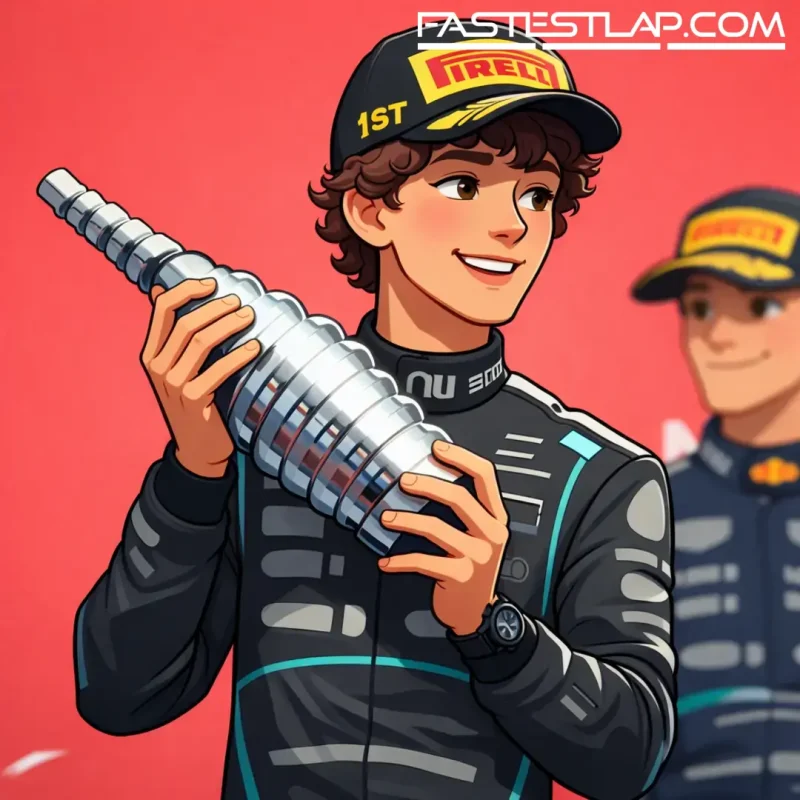
Kimi Antonelli didn’t just leave Spa with a trophy — he left with something more valuable in a title fight: breathing room. Six wins into the 2026 season and now 45 points clear, the Mercedes rookie-turned-championship leader used the Belgian Grand Prix to steady the narrative after a scrappy few rounds and, in the process, offered a pointed glimpse into what’s been nagging at the other side of the garage.
George Russell’s weekend unravelled in familiar fashion, the Briton again talking up an ongoing problem he believes is costing him power. Antonelli, asked directly about it, didn’t dismiss his team-mate’s frustration — but he did frame it in a way that will resonate inside Brackley: these cars can bite if you’re not perfectly in sync with how their systems expect to be driven.
“It can happen,” Antonelli said. “Being honest, with George this weekend there was a slight loss, and sometimes you just don’t understand. I had the same in Australia, for example.
“It can be a little bit down to driving, but sometimes the system just does something a little bit different. It’s very complicated… especially on tracks like this that are very energy-demanding, if you start driving differently, then for the system it’s a bit crazy.”
That’s not a casual line to drop. In a season defined by how teams and drivers are learning to extract performance from complex, tightly managed systems, Antonelli is effectively saying the car can reward one style and punish another — not always predictably, and not always in ways you can spot from the cockpit. He still conceded Russell had “a slight issue” and insisted it would be fixed for Budapest, but the subtext is hard to miss: Mercedes’ benchmark right now is the kid making it look straightforward.
Russell, by contrast, has watched early-season momentum evaporate. In Belgium it became worse than a bad qualifying or a compromised strategy call; his race ended early, and his complaints about power came with the added drama of a moment that put him on a collision course with Lewis Hamilton. The DNF didn’t just hurt his points haul — it amplified the sense of a driver trying to wrestle answers out of a car that isn’t responding consistently to him.
Antonelli’s own weekend was a reminder that momentum in F1 is rarely linear. He arrived at Spa having gone three grands prix without a win after rattling off five on the bounce earlier in the year, and with recent results blotted by misfortune — including a DNF and a 15th-place finish in two of the previous three races. Mercedes needed a clean, authoritative Sunday. Antonelli delivered one, even if it didn’t come without a wobble.
He started from pole but was beaten off the line, first by Max Verstappen and then by Charles Leclerc, in a messy opening where Spa’s long run to Les Combes often reshuffles the order regardless of who begins P1. Over a stint, though, the Mercedes pace asserted itself and Antonelli hauled his way back to the front.
The race’s key twist came after his pit stop, when a Virtual Safety Car for debris handed Leclerc what every strategist dreams of: a cheap stop and track position. For a moment it looked like the kind of break that can flip a result — and, potentially, a championship swing after Antonelli’s recent bad luck.
Instead, Antonelli responded like someone who knows exactly where his season is going. He re-overtook Leclerc and then controlled the remainder, keeping the Ferrari at arm’s length in a win that was more about composure than fireworks.
“It’s great to be back on the top step after obviously a few difficult rounds,” Antonelli said. “It was a hard fought race. We lost the first place with a virtual safety car, but then we managed to make our way back… it was a tough win because Charles was quick, and we had to hold on to that.”
What makes Spa such a useful data point for Mercedes is that it’s a circuit that punishes inefficiency — not just in aero drag but in how the car manages its energy and deployment over the lap. Antonelli’s comment about an “energy-demanding” track making the system “a bit crazy” if you drive differently reads like an accidental technical debrief. It also explains why one driver can feel like the car is “missing” something while the other is stacking trophies.
And that’s the championship story right now. Antonelli’s lead looks healthy not only because he’s fast, but because he’s maximising weekends even when variables swing against him. He admitted the bigger picture benefited from Russell’s misfortune, but he also sounded like a driver who understands how quickly that can reverse.
“I think the momentum was always there, it was just about getting the result,” he said. “Today we were a bit lucky with what happened in terms of the championship. But that’s why you’ve got to try to take every opportunity because we saw that it can really swing very easily the situation.”
Budapest is up next, and Mercedes will be desperate to arrive with fewer questions than they left in Belgium. For Antonelli, it’s about keeping the machine rolling. For Russell, it’s about proving this “slight issue” really is just that — and not the start of a wider gap opening up inside his own team.