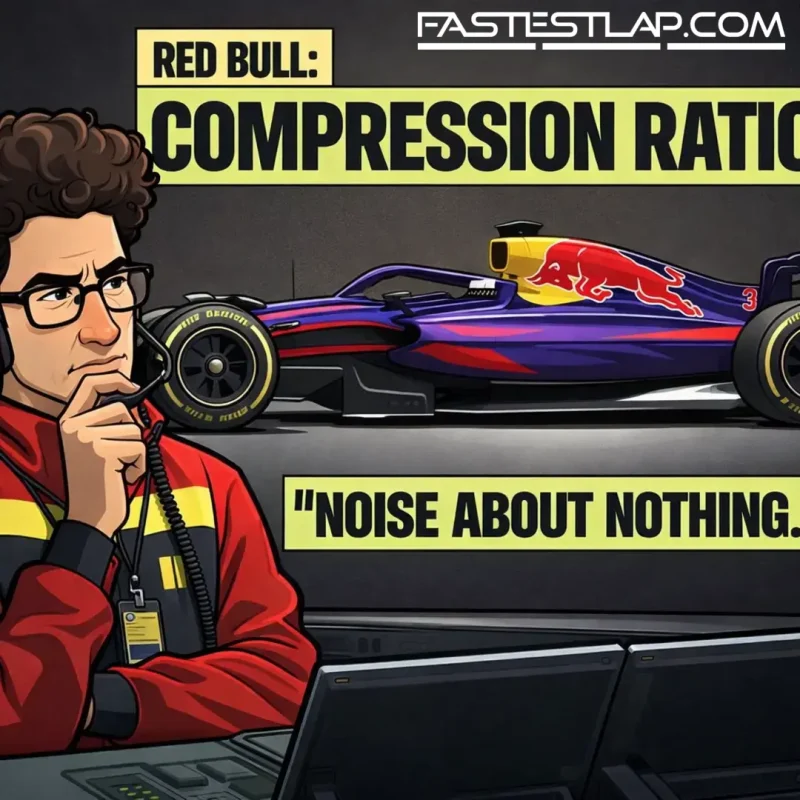
‘A lot of noise about nothing’: Red Bull Powertrains brushes off 2026 compression ratio chatter ahead of FIA summit
Ben Hodgkinson isn’t losing sleep over the paddock’s latest ghost story.
With 2026’s hybrid era overhaul looming and a crucial FIA technical meeting set for January 22, Red Bull Powertrains’ technical director has dismissed talk of compression ratio trickery as the usual winter murmur. The claim doing the rounds? That at least one manufacturer has found a way to show a compliant 16.0:1 compression ratio at ambient checks, but run a higher figure when the engine is hot and busy on track.
“I’ve been doing this a very long time,” Hodgkinson said ahead of Red Bull’s RB22 livery reveal in Detroit. “I’m confident what we’re doing is legal. Of course we’re right on the limit of what the rules allow — I’d be surprised if everyone isn’t. My honest feeling? It’s a lot of noise about nothing. I expect everyone will be sitting at 16.”
For 2026, Article C5.4.3 caps the geometric compression ratio at 16.0:1 and, crucially, requires each power unit manufacturer to propose a measurement procedure at ambient temperature for FIA sign-off as part of its homologation dossier. Homologation lands on March 1. That wording — “ambient temperature,” and the fact the makers define the measurement process — is the gap some believe could be exploited.
Inevitably, the rumour mill has pointed at the big guns. Mercedes High Performance Powertrains — supplying the works team plus three customers this year — is said to be one of the names in the frame, with Red Bull Powertrains another. The perceived gain? A modest but meaningful uptick in thermal efficiency for the internal combustion engine. With the FIA able to tune the electrical side of the 2026 package (harvest and deployment limits) track by track, a small ICE advantage could swing a weekend.
The FIA, for its part, says the January 22 sit-down is routine. As new regulations bed in, the governing body’s technical department gathers the manufacturers to make sure everyone’s reading the same music sheet — and playing to it.
The bigger philosophical gripe from engineers is that 16.0:1 may be too conservative for where combustion technology is now. Hodgkinson didn’t hide his view.
“From a purely technical point of view, the limit is too low,” he said. “We have the technology to make combustion fast enough that a higher ratio would work. We could make 18:1 work with the speed of combustion we’ve got. There’s performance in every tenth of a point — so every manufacturer will be aiming at 15.999 as far as they dare when it’s measured.”
That’s the game: find the cliff edge, then live on it. The suggestion that someone’s found a way to be under 16:1 in the garage and over it on the out-lap is exactly the sort of thing that spooks rivals in January and is either closed by a technical directive — or winds up being perfectly legal after all.
Strip away the intrigue and the key storyline is simpler. Four years after Red Bull committed to building its own power unit, the first RBPT engine destined for racing will finally get air in its lungs. Red Bull and sister team Racing Bulls will run the hardware at pre-season testing in Barcelona and Bahrain next month, with this being the sixth complete PU iteration to come out of Milton Keynes as the organisation worked through development steps toward the 2026 spec.
How much is still on the table? Hodgkinson, who’s been designing racing engines for 27 years, won’t pretend there’s a finish line.
“In the last cycle that started in 2014 and went to the end of last year, there was a big step every year,” he said. “There’s no such thing as ‘optimum and done’ in this business. Given more time, I’ll always make it better.”
So, does the compression ratio story matter? Potentially. Even if the FIA nudges the electrical balance during 2026 to manage speeds and energy flow, eking out a tiny efficiency edge from the ICE will pay back over a race distance. That’s why the whispers travel fast, and why the meeting on the 22nd matters: alignment now avoids arguments later.
But if Hodgkinson’s read of the room is right, expect this one to settle into the usual pre-season rhythm: rivals push the wording, the FIA clarifies the boundaries, and everyone converges around the same numbers. The stopwatch, as ever, will do the real talking in a few weeks.