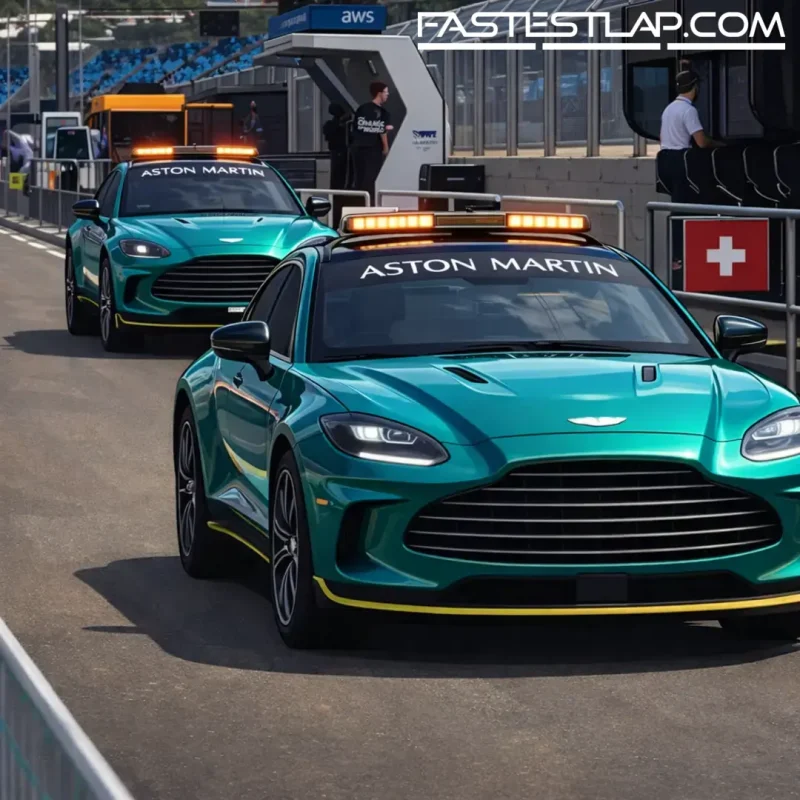
Aston Martin’s green Safety Car era in Formula 1 is over.
The British marque has confirmed its agreement with F1 to supply the Official FIA Safety and Medical Car wasn’t extended beyond the end of 2025, closing a five-year run that began in 2021 when Aston Martin and Mercedes split course-car duties. From the 2026 season onward, Mercedes will stand alone as the championship’s Safety Car and Medical Car supplier.
On paper it’s a small change — the race still gets neutralised the same way, the Medical Car still launches on lap one — but it’s also the end of a very visible branding platform that Aston Martin leaned on heavily as it re-established itself in the modern F1 ecosystem. When the first Vantage Safety Car arrived in 2021, it came with 535bhp and the kind of camera time sponsors dream of. By the time the deal concluded, the car had been upgraded substantially: Aston Martin increased output to 656bhp for 2024 and then added another 14bhp for 2025.
That ramp-up wasn’t subtle. It was a response to a real paddock grumble that had become difficult to ignore.
The sharpest complaint came from Max Verstappen during the 2022 Austrian Grand Prix, when the reigning champion at the time was stuck circulating behind the Safety Car and didn’t hide his frustration at the pace being set.
“It’s just that there’s so little grip because the safety car was driving so slowly,” Verstappen said then. “It was like a turtle. Unbelievable.
“With that car, to drive 140km/h on the back straight where that was not a damaged car anymore, I don’t understand why we have to drive so slowly.”
The Verstappen comments landed because other drivers had been making similar noises, if sometimes in more diplomatic language. George Russell, for one, estimated the Aston Martin was roughly five seconds per lap slower than the Mercedes-AMG GT Black Series in comparable conditions — the sort of delta that matters when you’re trying to keep tyre temperatures alive and brakes in the window.
The FIA’s public response at the time was essentially a reminder of first principles: the Safety Car isn’t there to set purple sectors, it’s there to control a hazard and protect drivers, marshals and officials. That’s true, of course, and always has been. But drivers weren’t asking for qualifying laps; they were asking for a pace that doesn’t create a different kind of risk through cold tyres and unpredictable grip levels.
Aston Martin’s subsequent power increases read like a company that heard the message and wanted to take the talking point away — whether or not the headline horsepower number was ever the real limitation in how the car could be driven in certain scenarios.
Alongside the Vantage, Aston Martin also provided a DBX707 SUV as the Medical Car, another highly visible role given the way the broadcast follows it down to Turn 1 on lap one. That, too, now disappears from the grid’s pre-race ritual.
“Aston Martin’s agreement with Formula 1 to provide the Official FIA Safety and Medical Car concluded at the end of the 2025 season,” a spokesperson said. “Having amplified the brand’s return to F1, we are grateful for the association and success of holding this critical role on the grid for the past five years.”
What’s left is a cleaner arrangement for 2026: one manufacturer, one set of course cars. That’s not necessarily more exciting, but it is simpler, and F1 has never been shy about tidying up the presentation when a commercial cycle ends.
For Aston Martin, it also subtly shifts where the brand’s exposure comes from. The Safety Car programme was a guaranteed presence regardless of results — a kind of insurance policy for visibility on weekends when the racing team wasn’t on camera for the right reasons. From 2026, the attention is more directly earned, and in an F1 landscape that’s only getting noisier, that’s a different pressure.
As for Mercedes, it’s now the single face of the sport’s course cars again. And while the Safety Car’s job description hasn’t changed, the paddock will still notice the details — especially the first time a late-race neutralisation bunches the field up and everyone starts doing tyre-temperature maths on the fly.