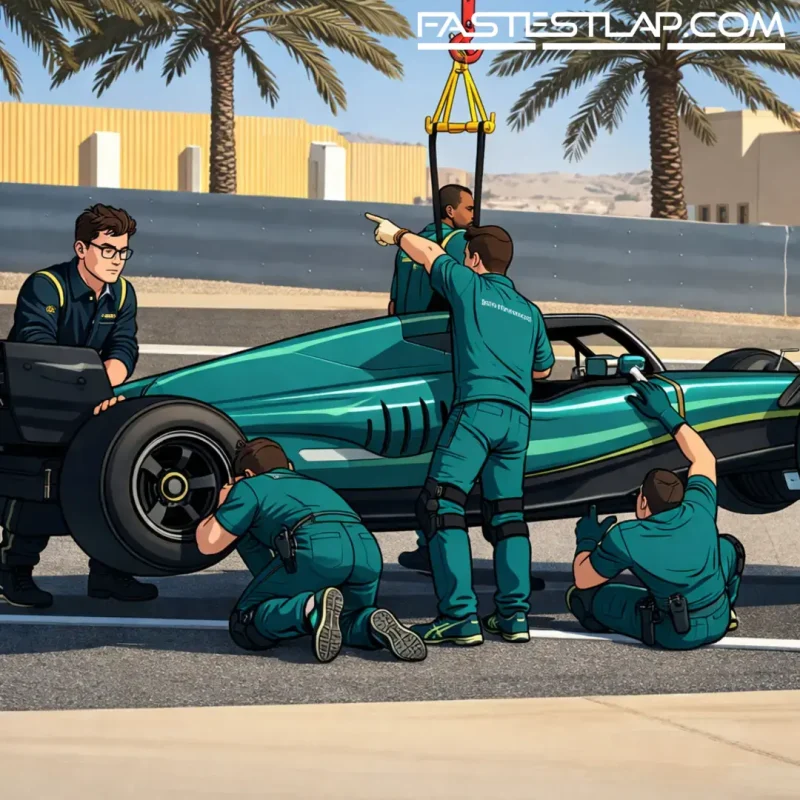
Aston Martin’s Bahrain test has turned into one of those pre-season stories nobody in green will be enjoying, and Friday morning only sharpened the mood. The AMR26 was brought to life in the garage, but Lance Stroll didn’t log a single lap in the opening two hours of the final day as the team wrestled with a battery-related problem that has now forced Honda and Aston Martin into damage-limitation mode.
Honda confirmed the issue first appeared during Fernando Alonso’s running on Thursday, when his programme was cut short despite a comparatively productive 68-lap tally earlier in the day. Overnight work has been split between trackside troubleshooting and deeper investigation back in Japan, with Honda Racing Corporation’s Sakura facility running test-bench simulations in an attempt to pin down the fault.
“Our last run with Fernando Alonso yesterday showed a battery-related issue that impacted our test plan with the Aston Martin Aramco Formula One Team,” Honda said. “Since then, we have been carrying out simulations on the test bench in HRC Sakura. Due to this and a shortage of power unit parts, we have adapted today’s run plan to be very limited and consist only of short stints.”
That last line is doing a lot of heavy lifting. Limited running is one thing; limited running because you’re trying not to consume a finite stock of parts is another. In the modern testing landscape—already squeezed by tight limits—teams normally spend the final day building confidence: system checks that look mundane on timing screens but matter hugely when you’re trying to arrive in Melbourne with a car that starts, charges, deploys and cools in all conditions. Aston Martin, instead, is being pushed into the uncomfortable territory of choosing what not to learn.
This was always going to be an intense winter for Aston Martin: a brand-new car concept credited to Adrian Newey’s influence and a fresh works relationship with Honda. Either change on its own can reshape a team’s early-season trajectory. Both at once is the sort of reset that needs clean mileage, repeatable runs and the quiet accumulation of data. So far, it hasn’t been that.
The lap count tells its own story. Aston Martin has completed fewer than 400 laps across the test, and neither Stroll nor Alonso has managed what you’d call a trouble-free day. That’s not just a dent in performance work; it’s a hit to the basic process of correlation—understanding whether what you’re seeing on track matches what you expected in simulation. When the car is stopping on circuit and the run plan becomes “short stints only”, the priority shifts away from set-up nuance and towards simply making the machine dependable.
Battery issues are also the kind of problem that can become a time sink because you can’t always brute-force them with trackside guesswork. Energy store behaviour sits at the intersection of software, hardware, thermal management and the wider power unit architecture. Even when you find the culprit, you still need to prove the fix doesn’t introduce a new limitation elsewhere. That’s why Honda’s mention of bench simulations matters: it suggests they’re trying to replicate the failure mode properly rather than swapping components blindly and hoping it goes away.
For Stroll, losing the first chunk of the final morning is particularly awkward. Pre-season testing isn’t just about the engineers ticking boxes; it’s when drivers build the baseline references they rely on when the calendar starts. Every lap you don’t do in Bahrain is a lap you’re trying to make up when parc fermé is looming and the weekends come thick and fast. And in 2026, with major regulations bedding in and new power unit partnerships settling, the early races are exactly where the “unknown unknowns” have a habit of biting.
Alonso, at least publicly, has been trying to keep the temperature down. Speaking earlier in the week, he insisted Aston Martin’s problems weren’t terminal, framing them as solvable issues rather than structural flaws in the project.
“I think everything can be fixed, for sure, short and medium term,” Alonso said. “I don’t think there is anything that is impossible to fix, but we need to wait and see. We will try to fix everything that we can before Australia and, after that, try to fix as many things as possible in the first couple of races before it’s too late in the championship. But no, I’m optimistic. I think there is a solution in place.”
That’s vintage Alonso: calm in tone, but with a subtle edge in the timeline. “Before Australia” is the obvious target; “first couple of races before it’s too late” is the part that will resonate inside the factory. When a team starts a season on the back foot, the danger isn’t only the points lost early on. It’s the knock-on effect: development plans delayed, correlation questions unanswered, and a car that requires fixing rather than improving.
The final day in Bahrain was supposed to be where Aston Martin stitched its story together. Instead, it has become a controlled retreat—short runs, constrained parts usage, and a battery issue serious enough to travel from Alonso’s Thursday into Stroll’s Friday without being cleared in time. If they do get back on track later, every lap will feel like triage.
No-one in the paddock writes teams off on the basis of a messy test, particularly in a new era. But Aston Martin and Honda don’t just need pace from the AMR26—they need normality. And right now, even that is proving hard to come by.