Lance Stroll didn’t sugar-coat it in Bahrain, and it was hard to blame him. Aston Martin’s first steps into the 2026 season have been less about chasing lap time and more about working out how to simply run the car without it trying to shake itself — and its drivers — to pieces.
“Some seasons you get in the car and it’s magic, and some seasons you get in the car and it’s shit,” Stroll said, with the sort of blunt acceptance that only lands when it’s backed by a week of miserable test mileage. “Go with it and work with what you have.”
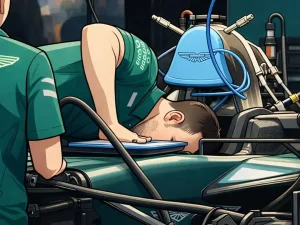
The immediate problem is vibration from the Honda power unit, severe enough that Aston Martin is planning to restrict race stints to protect its drivers. Adrian Newey, now overseeing the technical direction at the team, has laid out the situation in stark terms: the vibration has been “significantly reduced” since testing, but not enough to remove concerns about what it’s doing to the people holding the steering wheel.
“The much more significant problem with that is that that vibration is transmitted ultimately into the driver’s fingers,” Newey explained ahead of Melbourne. Fernando Alonso believes he can manage no more than 25 consecutive laps before risking permanent nerve damage in his hands; Stroll’s threshold is even shorter, at 15 laps.
That’s an extraordinary thing to be discussing on the eve of a grand prix, and it turns the Australian weekend into an exercise in compromise before the lights even go out. Over a 58-lap race distance, neither driver can get anywhere near halfway without stopping — and this isn’t strategy, it’s medical risk management.
Stroll confirmed the issue isn’t just an unpleasant sensation; it’s compromising the car’s integrity as well.
“A lot of vibration,” he said. “In Bahrain, it was limiting us, not just from the physical driver side, but also the whole car just falling apart with that level of vibration. It’s not good for the engine. It’s not good for anything in the car, human included.”
Aston Martin insists work has been done in the time between Bahrain and Melbourne to improve matters. If it has, the team might at least be able to put together a semblance of a normal race. If it hasn’t, the prospect is grim: a grand prix shaped around artificially short stints, heavy restrictions on race distance, and the looming possibility that the only sensible option is to park one or both cars.
What makes this sting is the broader context. Honda is back as a full works engine manufacturer in 2026, a formal return after stepping away following 2021, with Red Bull having run the Honda power unit operation through to the end of 2025. Aston Martin’s new-era partnership was meant to be a statement: a factory-style alliance to go toe-to-toe with the sport’s best as the regulations reset. Instead, the first public storyline is about vibrations so intense that hands go numb and components start to give up.
The team’s pre-season was already compromised before the vibration story became public. Newey admitted Aston Martin was “on the back foot by about four months” because a model didn’t reach the wind tunnel until mid-April, and the car only came together at the “last minute”. It also missed almost two days of pre-season shakedown running — exactly the sort of lost time that turns early-season weekends into damage limitation exercises rather than performance showcases.
And beneath all the vibration talk sits an unglamorous truth Stroll was happy to point out: even if the car ran smoothly, it still isn’t quick enough.
“My wrists are okay,” he said, when asked whether the issue aggravated old injuries. That’s a small mercy for Stroll, who broke both wrists and a toe in a cycling accident before the 2023 season, then underwent further surgery in 2025 that forced him to miss the Spanish Grand Prix as the problem started to “bug” him again.
But the real diagnosis, in his words, is simpler. “We’re not fast enough, that’s the main issue. We need to find performance on the engine side, on the chassis side, and then we just had a lot of reliability issues that have cost us running time.”
There was also a notable tone shift when he spoke about what comes next. Stroll didn’t sound defeated — more like someone bracing himself for a rough opening phase and trying to keep the bigger picture in frame.
“Right now, times are tough, but like I said, I believe the future is very bright,” he said. “So myself included, the whole team, I think we’re all just accept where we are now, and it’s just full attack.”
That line will be tested quickly. Melbourne is rarely forgiving at the best of times, and this version of Aston Martin is walking into the first race with a car that needs protecting from itself and drivers who may be forced into stints dictated by nerve endings rather than tyres. In a season where everyone is still learning the new rules, plenty of teams will arrive with problems. Few, though, will arrive wondering how many laps their drivers can physically survive in one go.