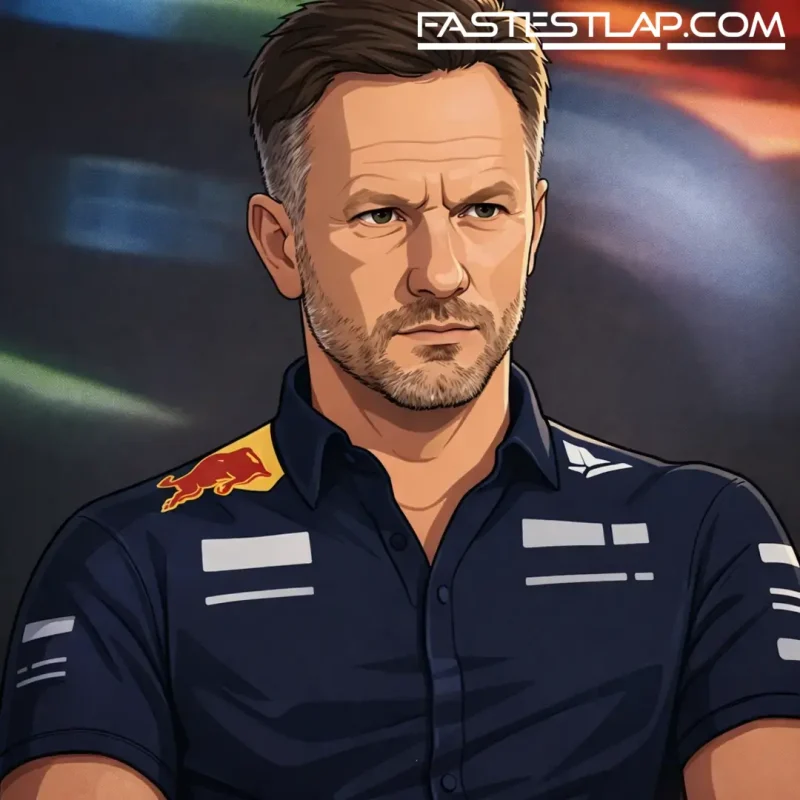
Audi’s first weeks in Formula 1 have been noisy in the way a new factory programme can’t really avoid: flashes of promise, a few brutal reality checks, and now a senior management-shaped hole left by Jonathan Wheatley’s sudden exit. In the middle of that churn, one name keeps being thrown into the paddock blender as a neat solution — Christian Horner.
Juan Pablo Montoya did the most Montoya thing imaginable by saying the quiet part out loud: Audi “needs somebody like” Horner. It’s not hard to see why the idea has legs. Audi has Mattia Binotto back in a team principal-style role, but it’s one thing to architect a long-term project and another to run the weekly knife-fight of modern F1 while trying to build a culture that can survive the first proper crisis. Montoya reckons Binotto’s facing an uphill battle. He won’t be alone in that view.
Wheatley’s departure matters because it removes exactly the kind of day-to-day operator you want when a new team is still learning where the sharp edges are. Audi has already shown it can score points — it did so immediately in Australia — but early points can flatter. The power unit has been flagged as an area needing improvement after the opening races, and those are the moments when an organisation either tightens up or starts springing leaks. A leader with Horner’s ruthless instinct for putting out fires before they become bonfires is, on paper, an obvious temptation.
The snag is that “perfect fit” is easy to say and hard to manufacture. Audi isn’t shopping for a mascot. It needs a structure that can handle the scale of the job, and the politics that come with being a major manufacturer trying to win quickly in a regulation reset. If Binotto is indeed being asked to carry the weight of the programme while also fronting the operation, that’s a heavy load — especially with the scrutiny that comes when the power unit isn’t yet where it needs to be. Horner speculation, then, isn’t really about one individual as much as it is about whether Audi has enough senior ballast to keep its debut season from becoming a rolling reorganisation.
Elsewhere, Williams has its own familiar headache reappearing under the 2026 rules. Carlos Sainz has confirmed the team is investigating a long-standing issue that’s “flared up again”, after it had been managed previously. Alex Albon had already alluded to the car “three-wheeling” through some corners — the inside-front lifting and taking front-end bite with it — and Sainz admitted he was surprised by it in his first test with the team back in late 2024.
It’s the kind of problem that’s deceptively expensive in lap time because it doesn’t just rob grip; it robs confidence. Drivers will live with a car that slides if it does it consistently. What they hate is something that unpredictably changes how the front axle behaves mid-corner. Williams managed it through last season, but regulation changes have a habit of dragging old weaknesses back into the light. Sainz being so candid so early in the year hints it’s not just a mild quirk — it’s something that can compromise a whole weekend if they don’t understand why it’s returned and where the new cars have shifted the sensitivity.
The broader 2026 picture is also being shaped away from grand prix weekends, with Mercedes and McLaren heading to the Nürburgring for a two-day Pirelli tyre test on April 14-15. It’s a small but telling reminder of how much development work now happens in these controlled windows — and how the 2026 reset is still settling. F1 hasn’t raced at the Nürburgring since the one-off Eifel Grand Prix in 2020, and it hasn’t been a permanent calendar fixture since 2013, so seeing current machinery back there will feel like a throwback even if it’s strictly business.
And then there’s the title fight that’s arrived early at Mercedes — not with rivals, but in-house. Kimi Antonelli’s won two of the opening three races and holds a nine-point lead over George Russell, and Toto Wolff has essentially said he’s prepared to let them race without heavy-handed control if they’re both still in the hunt late in the season.
“Absolutely off the leash” is a phrase that sounds liberating until you remember the unspoken bit: there’s always a leash when it matters. Wolff’s caveat is that it lasts “as long as there is margin between the cars” on track — which is his way of saying Mercedes won’t tolerate a repeat of the kind of self-inflicted damage that can turn a championship campaign into a post-mortem by midsummer.
What’s interesting is that Mercedes is even willing to have that conversation publicly this early. It suggests two things: first, the team believes it has a car capable of keeping both drivers in the championship picture; and second, it sees value in letting the fight breathe, rather than squeezing it into something artificial that only builds pressure. Russell’s in the phase of his career where he can’t afford to be polite about opportunity, and Antonelli clearly isn’t waiting around for permission. The next time they arrive at a track where passing is tricky and strategy compresses the field, we’ll learn how “off the leash” works when two fast cars share the same patch of asphalt.
So yes, the headlines bounce around — Horner-to-Audi chatter, Williams chasing an old gremlin, tyres being tested at a circuit F1’s forgotten, Mercedes letting its drivers have at it. But the connective tissue is stability. In 2026, with a new ruleset and a grid full of projects at different stages of maturity, the teams that look calm are gaining an advantage before they even find lap time. The ones that aren’t — or can’t be — will spend their season reacting to problems they hoped they’d already solved.