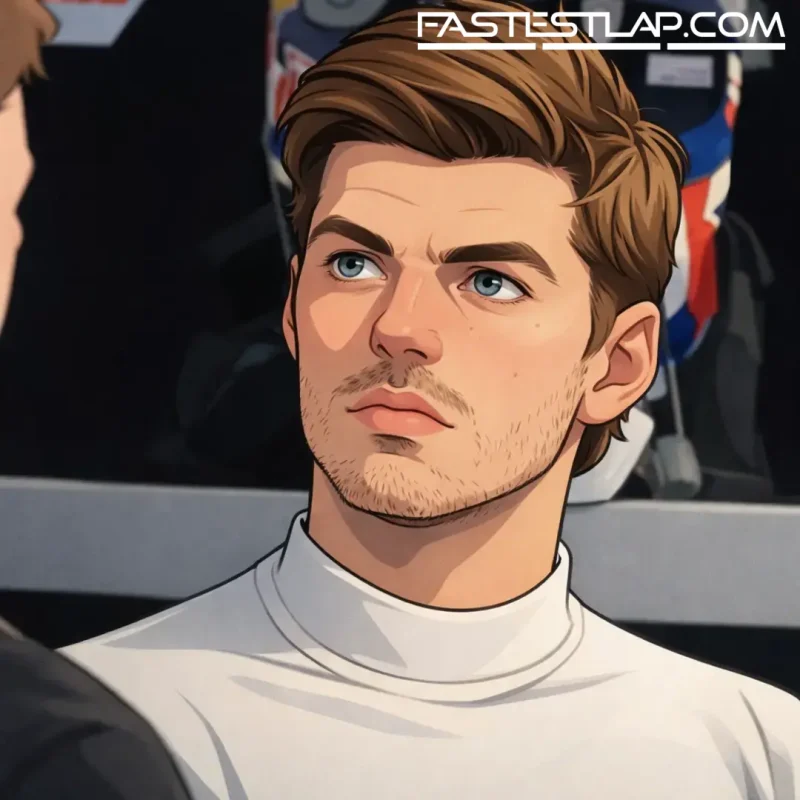
Max Verstappen has rowed back on the tone, not the substance, of his “Formula E on steroids” quip — and in doing so he’s put his finger on the real political fault-line of F1’s 2026 reset.
The Dutchman isn’t taking a cheap shot at Formula E, he insists. What he’s uneasy about is the direction of travel inside Formula 1 itself: a ruleset built around a near-50/50 split between electrical deployment and internal combustion, underpinned by fully sustainable fuel. In other words, a championship that’s historically sold itself on flat-out performance now asking its drivers to live on the edge of an energy spreadsheet.
That’s the nub of it. Not whether Formula E is “cool” (Verstappen actually sounds fairly complimentary), not whether its drivers could cope with F1, but whether F1 should be leaning even further into the kind of energy management that defines an electric series.
Asked in Bahrain, on the opening day of the second pre-season test, whether battery management in F1 could open the door for Formula E drivers to cross over, Verstappen’s response was telling. He didn’t dismiss the talent pool — if anything he went out of his way to avoid that fight — but he drew a bright line between categories.
“Well, let’s hope not,” he said. “Not about the drivers, because there are a lot of good drivers that would be able to perform really well here, but I don’t want us to be close to Formula E.
“I want us to actually stay away from that and be Formula 1.”
In Verstappen’s view, F1 shouldn’t be “increasing the battery” at all. His preference is simple: keep Formula E as the place where energy saving and electric performance sit at the heart of the show, and keep Formula 1 as the place where the engine — and the sensation of it — remains central.
“Let Formula E be Formula E,” he said. “We should stay Formula 1 and let’s try not to mix that.”
It’s a striking stance to take in 2026, because the sport has already made its choice. F1 has moved a long way from the last V12 era in 1995, and even from the V8s that were still around as recently as 2013. The hybrid V6 turbo era that began in 2014 leaned heavily on the combustion side — roughly an 80/20 split in favour of the internal combustion engine, with the MGU-K contributing a smaller portion of peak power alongside the now-removed MGU-H concept.
This year, that balance has shifted dramatically. Electrical energy is far more prominent, and with it comes a different kind of workload in the cockpit: more emphasis on when to deploy, when to harvest, and how to avoid arriving at the wrong part of the lap with the battery in the wrong state.
Verstappen is hardly alone in clocking that the driving experience is changing. Liam Lawson, for one, has already sought advice from fellow New Zealander Nick Cassidy — a Formula E race winner — as teams and drivers start to map what matters in this new era. That’s not a sign F1 is suddenly becoming FE, but it is a hint that some instincts and habits from energy-limited racing may suddenly be more valuable than they were.
Where Verstappen’s comments land awkwardly is in what they reveal about the sport’s identity debate. The 2026 rules are designed to sell a narrative: relevance, sustainability, cutting-edge electrification. F1 wants to look forward, not backward. But it also still needs to feel like F1, and for a lot of drivers — and fans — that means the cars should reward aggression and commitment more than conservation.
Verstappen, typically, doesn’t bother dressing that up. When he was challenged on whether he’d received pushback for the remark, he shrugged it off as a simple case of saying what he thinks.
“I’m just sharing my opinion,” he said. “So I think we live in a free world, free speech, and that’s what I felt.
“Not everyone needs to feel like that, but that’s how I felt… I got a question and I shared my opinion.”
What makes the episode more interesting is that, despite the philosophical grumbling, Verstappen’s practical mood around Red Bull’s own 2026 project sounds upbeat.
Red Bull has taken on the daunting job of bringing its Red Bull Powertrains programme to the grid in a new regulatory cycle, and Verstappen sounded genuinely impressed by what he’s seen internally — even if the test hasn’t been flawless.
“I think in general, for us, it has been a very positive start to the year,” he said. “Building a whole new, fresh power unit from the ground up, it’s been really impressive to see.
“It’s been really enjoyable working with everyone. And it’s, of course, a very proud moment for all of us.”
There have been some bumps — a messy start to one day in Bahrain, and another day the previous week that he described as “a bit more difficult” — but Verstappen framed that as normal turbulence rather than anything more ominous. The bigger point, as he sees it, is that the car’s behaving and the team isn’t fighting constant fires.
“Overall, I’m very happy… We don’t have too many problems,” he said.
And in a paddock that’s always sniffing for early tells, Red Bull’s rivals have already started talking them up. Mercedes and McLaren have both tipped Red Bull as the team to beat heading into the first race of the season in Melbourne on 6-8 March — praise that sometimes doubles as a warning shot.
For Verstappen, though, the coming months will be a test of two things at once: whether Red Bull has nailed the technical brief, and whether the sport he’s dominating still feels like the one he signed up to race in. His “Formula E on steroids” line might have been a little too neat for its own good, but the question underneath it isn’t going away. In 2026, managing energy isn’t a niche skill anymore — it’s the centre of the job.