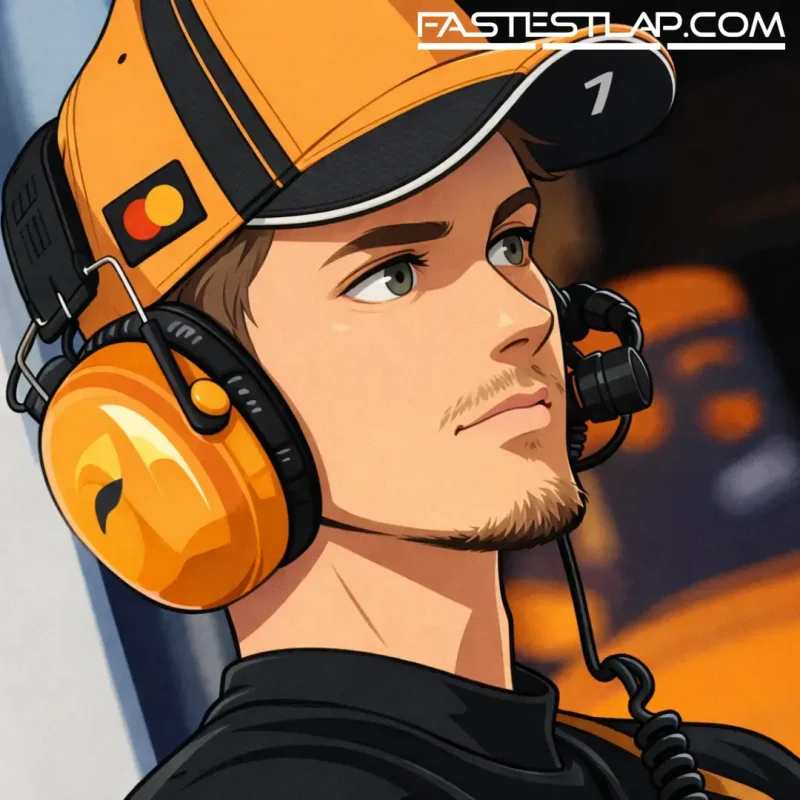
Lando Norris didn’t bother sugar-coating it in Melbourne. Formula 1’s much-vaunted 2026 power unit reset has only just made its competitive debut, and the reigning world champion is already sounding like a man who’s had his fill of it.
“The fact it’s a 50/50 split just doesn’t work,” Norris said after qualifying sixth for Sunday’s Australian Grand Prix, taking aim at the new balance between electrical deployment and internal combustion. In theory, it’s the sort of roadmap that keeps manufacturers happy and sells a neat sustainability story. In the cockpit, Norris painted it as something else entirely: a constant compromise that drags the driver’s attention away from driving and into battery arithmetic.
He wasn’t talking in abstracts either. Qualifying provided a tidy little case study of what he thinks F1 has created. Norris clipped debris that came off Kimi Antonelli’s Mercedes — a cooling fan, as it was described — and McLaren ended up applying tape to the front wing before his final run. The endplate then failed on that last attempt.
Norris’ explanation for not seeing the debris was brutally revealing: he was too busy checking his steering wheel displays to manage the new energy demands.
“I’m looking at my steering wheel… it’s why I don’t see the debris,” he said. “Because I have to look at what the speed I’m going to get at the end of the straight and know if I need a brake 30 metres earlier, 10 metres later.
“You have to look at the steering wheel every three seconds to see what’s going to happen otherwise you’re going to end up off the track.”
That, really, is the nub of his frustration. The 2026 cars have been sold as a bold new era. Norris, one of the grid’s most naturally fluent drivers, is basically telling you the experience has become more like managing a live dashboard than feeling for the limit. He talked about how the cars “decelerate so much before corners” and how drivers are forced to lift in places that, in recent seasons, have been about commitment and precision.
It’s not just that the driving feels different; it’s that the incentives have moved. Norris’ line about pushing harder and sometimes going slower landed with a thud in the mixed zone because it’s the kind of inversion F1 has always resisted. The sport’s DNA is built around the idea that bravery and execution are rewarded. What Norris described is a world where you can nail a corner, but if you’ve spent the wrong chunk of battery doing it, you’ve effectively harmed your lap.
“We’ve come from the best cars ever made in Formula One, and the nicest to drive to probably the worst,” he said. “And it sucks, but you have to live with it… and just maximise what you get given.”
There was a sting in the tail, too, because Norris didn’t have to name names to make his point. George Russell put his Mercedes on pole, with Norris almost a second back — a gap big enough to feel less like early-season noise and more like a systems advantage. Norris even joked that Russell would be “smiling”, before conceding McLaren simply has to get on top of it.
Sometimes these complaints can read like a front-running driver annoyed the sport has taken away a familiar comfort blanket. But Norris was careful to frame it as something wider: a question of what Formula 1 wants to be. When he was asked directly whether this is what the sport is “meant to be”, he didn’t hesitate.
“Not really, no.”
He also referenced a “quite opinionated” driver meeting on Friday. The subtext was clear: this isn’t one disgruntled champion having a moan because he’s not on pole. Norris suggested the pushback is broad, and that drivers aren’t lobbying purely for an easier life, but for a better show — faster-looking cars, more watchable racing, fewer moments where the cockpit becomes a management sim.
“The rules have been changed because that’s what manufacturers want,” Norris said. “But if you have probably 18 other drivers complaining, actually it’s 20, I don’t know what’s better for the sport or not.”
That’s the political tension F1 has walked straight into with 2026. The regulations were designed to bring manufacturers in and keep them there. Yet if the first impression for the audience is drivers lifting more, staring at displays more, and talking openly about cars being unpleasant, the sport is going to have a messaging problem on its hands — and not the kind a slick pre-season launch video can smooth over.
For now, Norris is doing what he always does when something isn’t to his taste: he’s being blunt about it, then getting on with it. Sixth on the grid isn’t a catastrophe, but in an era where energy deployment can define your lap — and, increasingly, your whole weekend — it does underline the bigger point he was making.
Mercedes, Norris admitted, has “obviously understood that” side of 2026 quicker than McLaren. Whether that’s because it’s “their own engine”, because the team has simply executed better, or because the new rules naturally flatter their approach, is the kind of question that’ll shape the early season. McLaren believes it’ll “get there”. Norris insists it’ll just take time.
What he’s less convinced about is whether, once everyone does “get there”, the sport will like what it’s found.