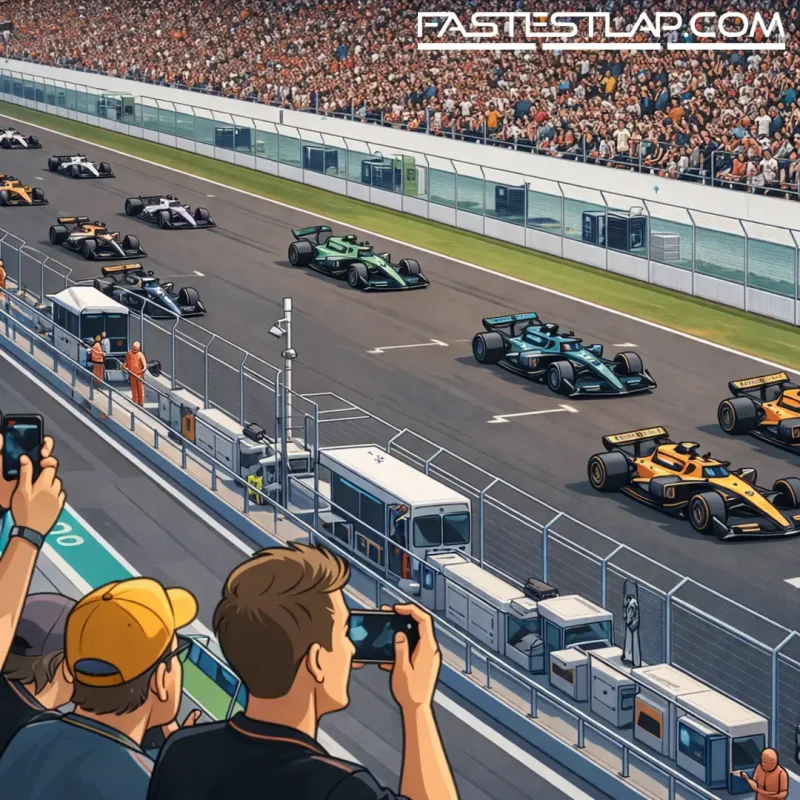
Budapest always turns Formula 1 inward. The Hungaroring has a habit of stripping away the bravado you can hide behind in Spa’s slipstream festival and asking harder questions: how good is your car in the slow, loaded corners, how clean is your deployment, and how much faith do you really have in your package when track position is king and passing is more theory than reality.
That’s why this weekend feels like more than just the last stop before the mandatory summer shutdown. The 2026 title picture lurched again in Belgium, where George Russell’s race was over on the opening lap, and Kimi Antonelli did what championship leaders do: took the opportunity and walked away with another win. Six victories into the season and arriving in Hungary with a points cushion, Antonelli isn’t just leading — he’s setting the pace of the fight. For Russell, Budapest is less about a “response” and more about damage control. When your teammate keeps cashing in and you’re the one watching from the garage, the momentum becomes a living thing.
Mercedes’ Spa stumble was traced to a lap-one battery issue, and while nobody in the paddock needs reminding that reliability can be a fickle companion under new regulations, it’s still a problem that changes how you go racing. If you’re even slightly unsure about the robustness of your system, you find yourself compromising: managing harder, being conservative where you’d usually attack, protecting rather than exploiting. That’s not a comfortable way to arrive at a circuit where qualifying can decide your Sunday before the first pit stop window even opens.
Hungary also lands as one of the more revealing tests of the current pecking order because the track demands a particular kind of performance. Straight-line speed and drag efficiency matter less here than who can generate consistent downforce, rotate cleanly through medium-speed sequences and keep the rear tyres underneath them as the circuit tightens around you. It’s the closest thing the calendar has to a slow-speed referendum — “Monaco without walls” is a lazy shorthand, but the point holds: once you’re out of position, you can spend 70 laps staring at a gearbox.
That’s where Ferrari will quietly fancy its chances. The SF-26’s high-downforce, medium-speed cornering profile fits what the Hungaroring asks for, and the team arrives with two drivers who know how to win here. Lewis Hamilton has made a habit of turning this place into his own, and if Ferrari can put him or Charles Leclerc on the front two rows, suddenly Mercedes’ lead looks a little less comfortable — not necessarily because of outright pace across the weekend, but because Hungary rewards the first clean hit of the weekend more than almost anywhere else. Nail Saturday, manage Sunday, bank points.
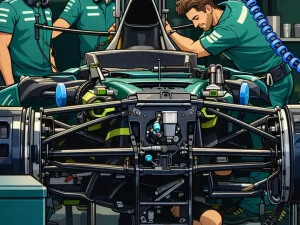
The subplot that could turn this into a spicier weekend than the circuit’s reputation suggests is the upgrade race. McLaren and Aston Martin are both arriving with meaningful changes, and in 2026 that’s always a big deal. Teams are still mapping the edges of the regulations; gains aren’t just about polishing, they’re often about correcting fundamental behaviours in the car.
McLaren’s package is being framed as targeted — an attempt to address the MCL40’s low-speed balance. That’s basically the whole exam paper in Budapest. If the car has been hesitant in rotation or inconsistent on entry in the slower stuff, you feel it here in every sector, and your drivers end up having to “drive around” the problem. For Lando Norris and Oscar Piastri, a step in that area doesn’t just mean lap time; it means the kind of confidence that lets you commit in qualifying without leaving a margin. And in Hungary, margin is where lap time goes to die.
Aston Martin’s changes are even more sweeping: a major single-package update designed by Adrian Newey, featuring a re-homologated lighter chassis, a new nose and reworked aero. That’s not a tweak; that’s a statement — and also a risk. Big packages can transform a season, but they can just as easily create a fortnight of correlation headaches if the numbers don’t match the track. Still, if you’re trying to rescue a troubled start to a new rules era, this is the kind of swing you have to take. A lighter chassis and a refreshed aero concept should, in theory, be exactly the sort of thing that pays off on a circuit where efficiency comes from stability and traction rather than raw power.
Red Bull, meanwhile, rolls into a layout that traditionally rewards a strong chassis, and it arrives with momentum and a reasonable expectation that the Hungaroring’s slower nature could flatter its strengths. It may not be the loudest storyline, but don’t be surprised if their weekend looks more comfortable than the last couple of high-speed blasts have suggested.
The weather should keep everyone honest. Conditions are expected to stay warm through practice and qualifying — enough to keep tyre management relevant without turning it into a survival exercise — but the chance of rain rises for Sunday. In Hungary, that’s where the script can get ripped up in a hurry. A wet race on a track where overtaking is hard in the dry tends to create the kind of strategic tension teams pretend they love and engineers actually hate: when track position is priceless but so is the timing of every call.
As ever, the weekend rhythm matters. Friday’s running will be about understanding tyre behaviour and how the upgrades behave in heat; Saturday is the main event. If you’re quick over one lap here, you can control your race with cleaner air and calmer strategy. If you miss it, you’re left trying to improvise on a circuit that doesn’t hand out gifts.
The schedule follows the traditional format at the Hungaroring. Practice begins on Friday 24 July with FP1 (13:30 local) and FP2 (17:00). Saturday 25 July brings FP3 (12:30) and qualifying at 16:00. The race starts on Sunday 26 July at 16:00 local time.
By Sunday evening, the championship may not look fundamentally different — Hungary rarely delivers the kind of high-drama collisions you get on faster, wider circuits — but it can still shift the psychological weight of the season. Another Antonelli win, especially if Russell is again compromised, would harden Mercedes’ internal dynamic and the wider paddock narrative: this is the year the young leader doesn’t blink. A Ferrari resurgence, on the other hand, would send everyone into the shutdown with a different kind of unease — the sense that the chasing pack has finally found a track that exposes the leader’s weak points.
And if one of those big upgrade packages lands properly? Then the second half of 2026 might start before the first half even ends.