Brad Pitt’s fictional comeback story has done something very real: it’s barged its way into the Oscars conversation.
‘F1’, the big-budget Formula 1 film headlined by Pitt and Damson Idris, has landed four Academy Award nominations, including the one the industry still treats as the ultimate stamp of approval — Best Picture. It’s also in the running for Best Film Editing, Best Sound and Best Visual Effects, a trio that speaks to where this film has always been most ambitious: making motorsport feel physical, loud, and immediate on a cinema screen.
It’s hard to overstate how rare that is for a sports movie, let alone one built around a world as technical and obsessively policed as F1. Plenty of films have borrowed the aesthetics of racing; far fewer have been given the kind of access ‘F1’ enjoyed, shooting on location across multiple Grand Prix weekends and weaving its cameras and crew into the live event without losing the plot — literally or logistically.
That access shows up in the nominations. Sound is an obvious battleground when you’re trying to convince an audience that 200mph is happening inches from their face, and editing is where motorsport films traditionally fall apart: the moment where Hollywood rhythm clashes with the reality that racing rarely obeys screenplay timing. The Academy nods suggest ‘F1’ didn’t just look the part, it held together in the places most likely to expose it.
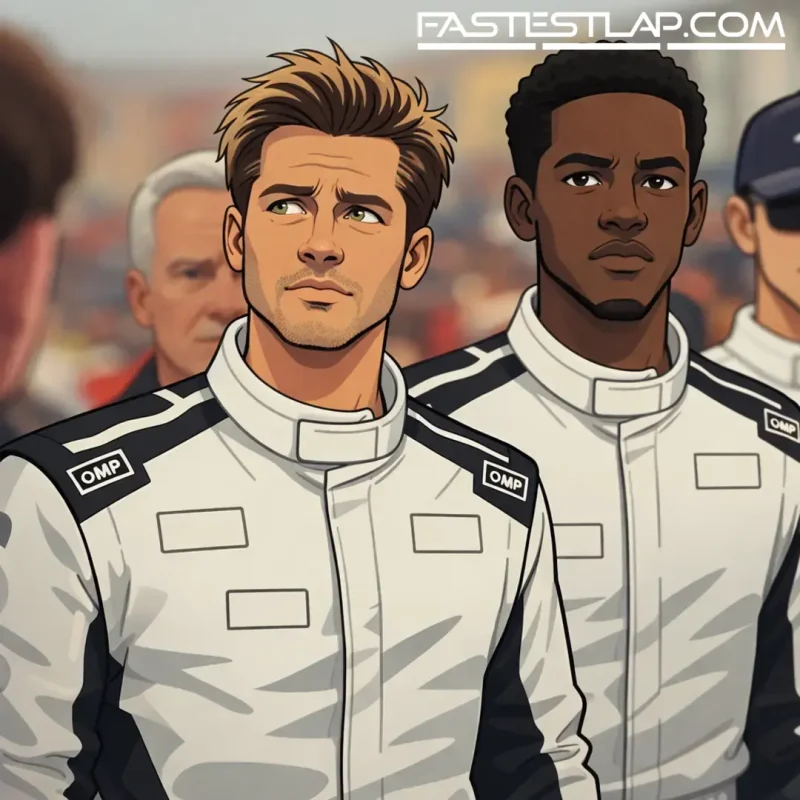
The story, of course, is classic movie scaffolding. Pitt plays ‘Sonny Hayes’, a driver dragged back into the sport decades after failing to fulfil his promise, paired with Idris’s ambitious rookie ‘Joshua Pearce’ at a fledgling fictional team, APXGP. It’s built for a wide audience — ageing hero, hungry kid, underdog team — but it’s the F1-specific execution that’s pushed it beyond being “a racing film” and into the kind of cultural moment the Academy can’t ignore.
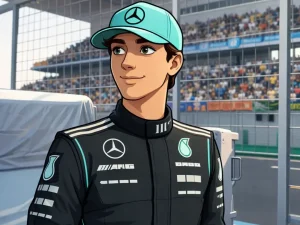
Lewis Hamilton’s involvement sits right at the centre of that credibility. Now at Ferrari, Hamilton was part of the production team and has been clear that his job was to keep it honest — to flag when a scene drifted too far from how the sport actually functions and to steer it back toward something that would pass the paddock’s sniff test. When you’re making a film around a championship where the smallest procedural detail gets dissected on Monday morning, that matters.
The same goes for the broadcast flavour. Sky F1’s David Croft has credited Hamilton for helping bring him and Martin Brundle into the project, a smart move that anchors the film in the voices fans associate with real race weekends. It’s an easy trick to get wrong — fan service can feel like fan service — but in this case it’s part of the wider point: ‘F1’ wanted to feel like it belonged to the sport, not like it was borrowing it for two hours.
Commercially, the film has already cleared every bar put in front of it. It’s now credited as the highest-grossing sports movie of all time, pulling in $630 million globally against a budget reported as up to $300 million. However you want to slice those numbers, it’s a statement: there’s a market for F1 beyond the core audience, and there’s a way to package the sport that travels.
Awards momentum has been building for a while. ‘F1’ has already won two Critics’ Choice Awards, picked up two Golden Globe nominations, and earned three Grammy nominations for its music — a spread that hints at what the Academy has now formalised: this isn’t a one-lane technical showcase, it’s being treated as a fully-fledged major release.
The Best Picture nomination places it in a heavyweight field: Bugonia, Frankenstein, Hamnet, Marty Supreme, One Battle After Another, The Secret Agent, Sentimental Value, Sinners, and Train Dreams are all on the list. Whether ‘F1’ can go the distance against that kind of competition is the next question — and the Academy has never been shy about making sports films fight for oxygen — but being in the room is already a win that will ripple well beyond Hollywood.
For Formula 1 itself, the significance is obvious without needing to get too misty-eyed about it. The sport has spent the last decade refining how it sells its world — the personalities, the noise, the scale — and ‘F1’ is the most expensive, most mainstream proof yet that the pitch is landing. The film’s director Joseph Kosinski has delivered something glossy enough for a global cinema audience, while still leaning hard on the elements that make the paddock such a strange, intoxicating ecosystem.
The 98th Academy Awards take place on 15 March at the Dolby Theatre in Los Angeles, with Conan O’Brien hosting. If ‘F1’ walks away with trophies, it’ll be a landmark moment for a sport that already thinks in terms of spectacle. If it doesn’t, the nomination haul still confirms what the box office already did: Formula 1 has cracked the film industry’s mainstream ceiling — and, for once, it’s done it without having to dilute what makes it F1.