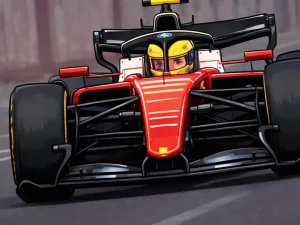
Charles Leclerc doesn’t usually need much of an excuse to smile about a clean launch, but in Melbourne he had one ready: the person in charge of the start lights.
Ferrari arrived at the 2026 Australian Grand Prix with a reputation from testing for getting the SF-26 off the line sharply, yet even Leclerc sounded like he couldn’t quite believe how perfectly the first getaway of Formula 1’s new era fell into place. From fourth on the grid, he was first by Turn 1 — and he reckons the timing of lights-out played right into Ferrari’s hands.
“I think the person that is switching off the lights has been quite cheeky,” Leclerc said, grinning. “Because for the first start of the season, with these cars, to go so quick lights off, was, I think, it took everybody by surprise, and we’re always very much on the limit with the power units. So, I think that played a little bit in our hands.”
It was a line delivered with a laugh, but it carried a point that matters in 2026: starts are different now. With the new power units, drivers need to have the turbo primed and everything balanced for the initial hit, and the procedure has been tweaked accordingly — including a blue flashing light to warn the field that the sequence is about to begin. When the five red lights go out earlier than expected, you’re asking 20 drivers to hit a narrow window they’re still learning. Some will nail it. Some won’t. Ferrari, on this evidence, absolutely did.
Leclerc wasn’t the only one to benefit. Lewis Hamilton, starting seventh, also made serious progress in the opening metres, which will only add fuel to the early-season chatter that Ferrari has found something in that first phase of acceleration.
And for a brief stretch, it looked like Ferrari might be turning Mercedes’ qualifying authority into a proper fight.
Mercedes had owned Saturday. George Russell took pole and led a front-row lockout with rookie team-mate Kimi Antonelli alongside him. But Melbourne on Sunday was always going to reset the story. Everyone had been watching how these cars race, how they deploy energy, how they defend — and crucially, how much any one team can control the chaos once the lights go out.
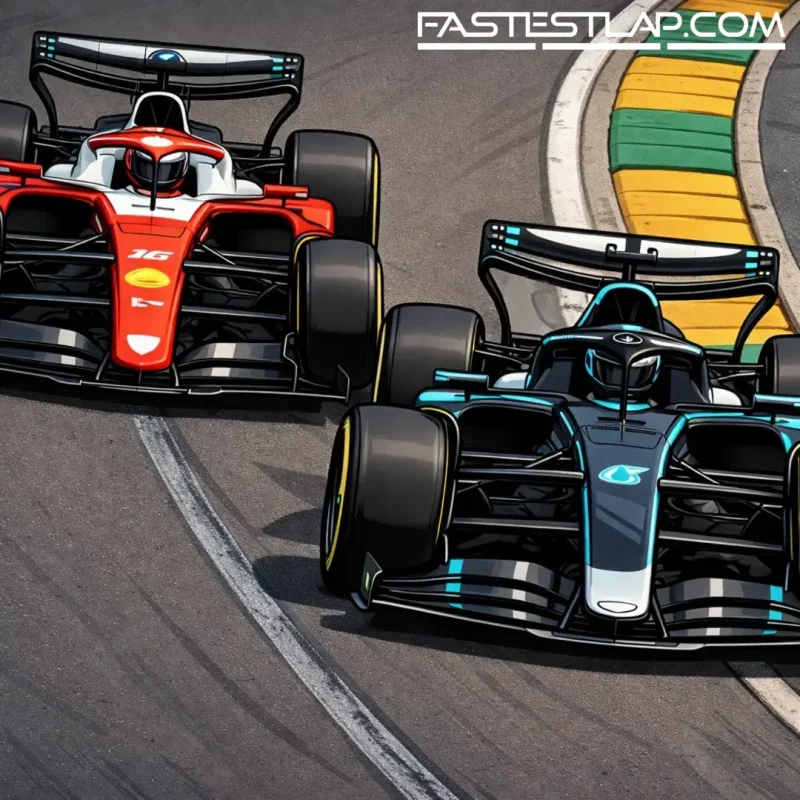
Leclerc’s getaway created the scrap the grandstands wanted: he and Russell trading track position in the opening phase, the kind of elastic, energy-management chess match that already feels like the defining rhythm of this regulation set.
“It was a very, very tricky race,” Leclerc said afterwards. “Honestly, at the start, I don’t think anybody of us knew what to expect with the fights, with the energy. And then it’s even more tricky for the overtakes to defend. You don’t really know when your battery is going to cut in the straight, so while defending there’s massive speed differences.”
That’s the 2026 learning curve in a nutshell. The speed delta doesn’t always look “earned” in the old-fashioned sense — sometimes it’s simply whose deployment arrives at the right moment on the straight, and whose doesn’t. For drivers, that turns defence into educated guesswork, and for spectators it creates those sudden bursts where a car looks like it’s been fired out of a sling.
Leclerc admitted he enjoyed that opening brawl, even if it didn’t translate into the result he wanted. “I was happy to get out of this battle in first,” he said. “Unfortunately, that didn’t help us for the rest of the race, but it was a fun first part of the race. Then P3 is the best we could do today.”
The race turned, as these things often do, on a decision that looked brave in the moment and painful once the chequered flag fell. During a Virtual Safety Car for Isack Hadjar’s stricken Red Bull, Ferrari kept both Leclerc and Hamilton out. Mercedes didn’t hesitate: Russell and Antonelli pitted.
Hamilton’s reaction over the radio was immediate and pointed. “At least one of us should have come in,” he told Ferrari — the sort of message that lands with extra weight when it’s still race one of a new partnership and everyone is feeling out where the authority sits on the pit wall.
Ferrari’s logic wasn’t hard to see: keep track position, bank on tyre life later, and hope the race opens up. They did end up with fresher rubber for the final stint. The problem was the one that tends to ruin clever plans — Mercedes simply had enough pace to make the undercut stick and enough control thereafter to keep Ferrari at arm’s length.
Russell converted victory, Antonelli backed him up for the one-two, and Leclerc was left reflecting on what might have been without the VSC gamble. He didn’t sound convinced it would’ve changed the winner.
“I don’t think so,” Leclerc said when asked if he could have fought Russell for the win with a different call. “But maybe I’m wrong. It looked like Mercedes maybe had a bit more pace than us today, but maybe not as much as what we saw yesterday. So that’s a good thing, but I don’t think we could have won.”
That’s probably the most revealing takeaway from Ferrari’s afternoon. The start was spectacular, the early laps were punchy, and the SF-26 again looked sharp in that initial launch phase — but over a race distance, Mercedes had the cleaner hand. Even with Ferrari’s tyre offset late on, Russell and Antonelli had enough in reserve to keep the red cars where they belonged.
So yes, Leclerc can joke about a “cheeky” lights operator, but Ferrari will leave Albert Park knowing two things can be true at once: they’ve got a weapon at the start, and Mercedes still looks like the team with the bigger picture under control. In 2026, that’s the difference between leading Turn 1 and leading the championship.