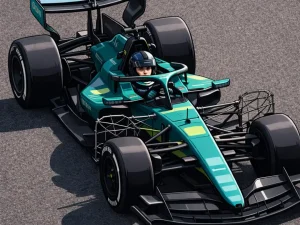
Cadillac may have put a tidy, corporate-sounding benchmark on Colton Herta’s first European single-seater campaign — top 10 in the 2026 Formula 2 standings — but the driver they’ve signed doesn’t really do “tidy”.
Asked about that target, Herta didn’t bristle at it, nor did he hide behind the usual rookie caveats. Instead, he framed it the way racers tend to when they’re being honest: anything short of trying to win feels like missing the point.
“Everything that I hop into, I want to be competitive, and I want to be strong,” Herta said. “If the goal isn’t to win, then I don’t really see why you would do it. That’s my mindset.”
It’s a revealing tension at the heart of this project. Cadillac’s leadership, with CEO Dan Towriss setting the bar, is being pragmatic: Herta is 25, he’s switching disciplines, he’s joining a grid full of specialists who’ve built their whole careers around the quirks of F2. A top-10 championship is a sensible, defensible KPI for a driver who’s also juggling a parallel role as a Cadillac F1 test driver.
But Herta isn’t arriving in Europe to tick a box. He’s arriving because he’s gone all-in on an F1 ambition, and you don’t make that kind of pivot with a “let’s see how it goes” mindset. He talked about wanting to lead sessions, take pole, win races — not as a soundbite, but as an operating principle.
“Either how unrealistic it is or how realistic it is, I don’t know. I guess time will have to tell,” he said. “I think if you go into the mindset of, ‘Well, let’s try to work off and start inside the top 15, and then move forward from there,’ I just don’t think it’s the right approach.”
The early testing numbers at Barcelona gave that confidence some shape. Herta opened the test inside the top 10, nudged forward to ninth on day two, and ended the running fourth quickest. Testing times are slippery things — fuel loads, programmes, tyres, and the usual fog of pre-season misdirection — but the simple point stands: he didn’t look like a driver drowning in the transition.
That matters, because Herta’s move is not being sold as a vanity exercise. Cadillac has placed him in Hitech for 2026 with a clear intention: accelerate his readiness for Formula 1 while also evaluating him in an environment that strips away the comfort of his American résumé.
That résumé, of course, is not small. Nine IndyCar wins and time in IMSA means he’s already lived through pressure, strategy chaos, and the sort of racecraft that can’t be learned from sim runs and Instagram clips. Yet Herta was quick to downplay the idea that being older and more experienced automatically translates into an F2 advantage.
“I don’t think it’s as much of an advantage as people might think,” he cautioned. “At this stage in your career, whether you’re 18 or 25, you’re pretty much fully developed there… as far as outright pace, you’re pretty much close to what your maximum will be.”
It’s a smart bit of expectation management — and, frankly, it’s also true that F2 has a way of humiliating anyone who believes their previous category guarantees instant authority. The tyres behave differently, the weekends are compressed, track knowledge is specialised, and the margins are brutal. If Herta is going to do more than just “meet the target”, he’ll need to land the essentials quickly: qualifying execution, tyre preparation, and the rhythm of feature-race degradation.
One thing working in his favour at Hitech is the presence of Ritomo Miyata. The Japanese driver is 26 and heading into his third season in F2 — the kind of teammate who can be invaluable when you’re trying to work out whether you’re missing lap time because of your driving or because you’re chasing the wrong solution entirely.
“I think what’s very helpful is having Ritomo as a teammate also, with a lot of F2 experience,” Herta said. “I think it’s going to be very helpful for me this year.”
Still, Herta’s F2 results won’t be the only data Cadillac is collecting. His 2026 calendar is designed as a dual-track assessment: learn the European ladder in public, and learn the Cadillac F1 environment behind the scenes. That includes simulator work and planned FP1 outings during Cadillac’s first season on the Formula 1 grid.
And when Herta talks about those Fridays, his priorities are unmistakable.
“Seat time in an F1 car is probably going to be the most important thing to get me ready for Formula 1!” he said. “Obviously, it’s a big task and big job that they have on, so I don’t know exactly when those FP1s are going to come. It’s pretty far down on the priority list at the moment.”
That last line, delivered with the kind of realism you hear from drivers who’ve already been around big programmes, is worth underlining. Cadillac is new to the grid, meaning everything is urgent — car development, personnel, processes, reliability, correlation. There will be a natural temptation to treat FP1 outings as a “nice-to-have” until the operation has its feet under it. Herta, though, is clearly viewing them as a central part of the audition.
For now, the first proper measure arrives quickly. Formula 2’s 2026 season starts alongside Formula 1 at Albert Park, with the sprint race on 7 March and the feature race on 8 March. Herta will arrive with a corporate target hanging over him, a driver’s ego pushing higher, and the sort of scrutiny reserved for anyone trying to break into F1 through an unconventional route.
A top-10 championship is the ask. Herta is speaking like he’s aiming to make that look modest. The sport will decide how much of that is swagger — and how much is signal.