Ferrari’s Barcelona shakedown has been conducted behind closed doors, but that hasn’t stopped the paddock from doing what it always does in winter: scrutinising grainy images for clues that matter.
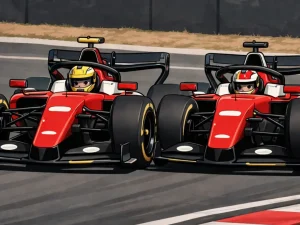
One detail that’s already prompted a round of knowing nods up and down the pitlane is what Charles Leclerc and Lewis Hamilton were seen running once the rain arrived on Day 2 at the Circuit de Barcelona-Catalunya. With the SF-26 circulating on a wet track, Ferrari appeared to trial a configuration where only the front wing’s active element was “open”, while the rear wing stayed “closed”.
In other words: a potential answer to one of the first awkward questions thrown up by Formula 1’s 2026 move to active aerodynamics on both wings. Everyone understands why moveable aero exists in the new rulebook — it’s baked into how the cars are meant to hit efficiency targets and reshape racing — but the moment you introduce adjustability, you also introduce a safety and sporting headache the first time the weather turns. Barcelona simply got there early.
The parallel with the previous era is obvious. DRS was routinely disabled when conditions were deemed wet, on the grounds that a driver pressing a button at the wrong moment could easily find the rear stepping out. Active aero for 2026 isn’t a bolt-on overtaking gimmick; it’s a core part of the aerodynamic concept. So the question has never been “will it be used in the wet?” so much as “how do you stop it becoming a liability?”
The FIA’s single-seater director Nikolas Tombazis all but admitted late last season that the governing body was still juggling options. Speaking in Las Vegas, he said there had been “a lot of discussion” and “a few different options” on the table, adding that final talks had continued at a technical meeting a few weeks earlier — and that he wasn’t up to speed on the “very last change” on that specific point.
That context matters, because what Ferrari showed — if the images reflect an intentional test rather than a one-off run plan — looks like a pragmatic compromise. Keep the rear wing stable and predictable in low-grip conditions, while allowing front-end aero to shift. It’s the sort of solution that makes sense on paper: rear instability is what bites hardest in the wet, and the consequences of reducing rear load at the wrong time are far more dramatic than trimming the front.
Leclerc was pictured with the SF-26 in that front-open, rear-closed state during the rain, and Hamilton also sampled the same approach when he took over the car in the afternoon. That in itself is telling. If you’re only ticking off installation mileage, you don’t need both drivers cycling through a particular operating mode. If you’re mapping behaviour — especially on a day when conditions allow you to explore edge cases without manufacturing them — you do.
It’s also a reminder of how quickly teams are having to build an operational playbook for 2026. This isn’t just “new car, new tyres, crack on”. The entire choreography of a lap changes when the aero state is no longer static, and that has knock-on consequences for how drivers approach corners, how engineers define safe deployment windows, and how race control frames the rules around what’s permitted when grip drops away.
Barcelona’s shakedown format only heightens the intrigue. The five-day event allows each team to run on three of those five days, and the media isn’t present in the traditional sense. That vacuum tends to amplify whatever does leak out, because any small detail feels like a rare clean data point. When the track went wet by mid-morning on Day 2 — earlier than expected — it effectively forced the issue. If you’re Ferrari, why waste a gift-wrapped scenario to validate a wet-mode philosophy?
All of this sits alongside the bigger promise of the 2026 overhaul. The cars are smaller and lighter, with power units running a 50-50 split between electric power and biofuel, and the aero package is intended to produce a better wake profile than the late-stage ground-effect cars. Tombazis has said the FIA expects cars to be able to follow “much closer than now”, even if the early season may bring a wider spread as teams interpret the new rules.
That’s the selling point. But the devil is in the operational details, and wet running is where good intentions get stress-tested. If active aero becomes overly restricted whenever it rains, you risk awkward inconsistencies: cars behaving like a different formula depending on the weather, and teams having to carry two performance philosophies in parallel. If it’s too permissive, you risk creating precisely the sort of unpredictable, driver-triggered instability that led to DRS being shelved in the first place.
Ferrari’s apparent front-only opening in the wet looks like the kind of middle path that could satisfy both camps — and, crucially, one that can be policed. A rule that locks the rear wing state in declared wet conditions while still allowing controlled front adjustment is simpler to enforce than a free-for-all, and it aligns with the fundamental priority of keeping the rear end planted when visibility is poor and grip is inconsistent.
It’s early, and nobody outside the garages has the full picture of what Ferrari was running and why. But winter testing is rarely about lap times. It’s about finding the problems that will embarrass you in April — and solving them in January when the only people watching are the ones who know what to look for.
If the first proper rain of the 2026 era has already prompted teams to experiment with “wet active aero” operating modes, that’s not a curiosity. It’s the sport quietly admitting that the new toys come with new rules of survival.