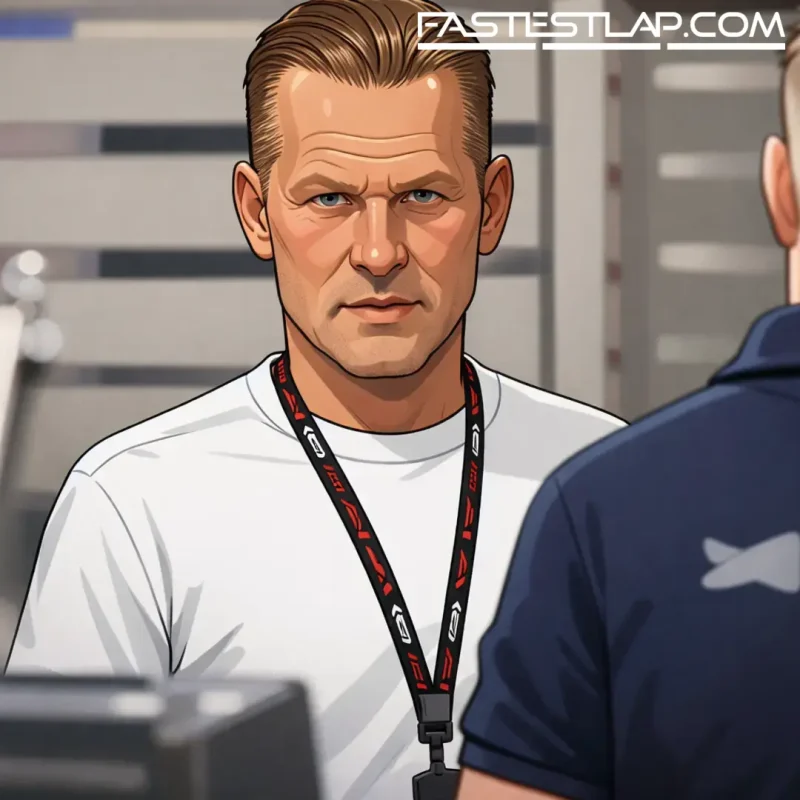
McLaren’s decision to bring Gianpiero Lambiase into its senior structure might be dressed up as a straight hire — another experienced operator moving across the pitlane chessboard — but nobody in the paddock is pretending it’s that simple. When you take Max Verstappen’s long-time voice from Red Bull’s radio and install him in Woking’s leadership group, you’re not just buying expertise. You’re buying optionality.
Lambiase is heading to McLaren as chief racing officer, with the move set to happen “no later” than 2028. Even with that timeframe, the ripples were immediate because the name is so tightly bound to Verstappen’s modern era: the calm, corrective tone under pressure; the shared shorthand in chaotic races; the relationship that’s been treated, at least externally, as one of Red Bull’s irreplaceable competitive edges.
And yet the most telling response on Friday didn’t come from either team principal. It came from Jos Verstappen.
He revealed he’d known “for a while” that Lambiase was McLaren-bound and said Verstappen’s camp encouraged him to “grab it with both hands.” That alone punctures the idea this was an ambush. More importantly, it frames the move as something Verstappen’s inner circle has made its peace with — perhaps even something it understands strategically.
Jos also played down the knock-on effect for Max, insisting the four-time world champion should “just carry on” without him, despite Max having previously suggested he’d retire if he ever split from Lambiase. In other words: the rhetoric of loyalty is one thing; the reality of modern F1 is another. People move. Titles don’t wait.
It’s not hard to see why McLaren wanted Lambiase badly enough to carve out a top-level role. He’s not simply a race engineer; he’s someone who’s lived inside a team that has had to win while being hunted, internally and externally, and he’s had a front-row seat for the evolving demands of racing with today’s energy management and systems-heavy decision-making. McLaren will tell you it’s about process, leadership and performance. All true. But in F1, intent is often multi-layered.
Zak Brown didn’t hide his satisfaction, saying he’s “excited about what we can achieve together.” That quote reads like standard executive messaging — until you put it alongside McLaren’s recent appetite for Red Bull talent. Rob Marshall. Will Courtenay. Now Lambiase. There’s a pattern here that isn’t subtle: Woking is trying to compress the gap between being quick and being relentless. The latter is where championships live.
And there’s a second pattern, too. Lambiase had been approached for a senior job at Aston Martin before McLaren got the deal done. That matters because it speaks to how the paddock values him — and how aggressively teams are fighting to strengthen the race team layer, not just the headline aerodynamic or power-unit departments. If 2026 has underlined anything early on, it’s that marginal gains are increasingly being extracted in how you operate, not only what you design.
Away from the political undertow, there was real track work as well. Lewis Hamilton was back in a Ferrari, completing a private Pirelli tyre test at Fiorano in the SF-26. Ferrari’s programme included artificial wet running, part of Pirelli’s ongoing development work, and it came in the wake of Red Bull and Racing Bulls staying on at Suzuka for similar testing after the Japanese Grand Prix.
There’s a quiet but significant subtext to all of these tyre days: the 2026 cars and the way they manage energy and deployment have put a premium on predictability at the limit, especially in low-grip conditions where the usual “driver feel” is heavily mediated by systems behaviour. Teams are hoovering up data anywhere they can — and if that means private mileage in controlled conditions, so be it.
Next week, Mercedes and McLaren head to the Nürburgring for another Pirelli test, notable for being the first time since the 2020 Eifel Grand Prix that current F1 machinery will run at the German venue. It’s a reminder that even as teams posture about development pathways and long-term rules interpretation, they’re also chasing basic answers: how the rubber behaves, how temperature windows look, and what that does to strategy under the newer constraints.
Meanwhile, Lance Stroll offered one of the day’s more intriguing side notes by revealing he consulted Verstappen before deciding to make his GT3 debut. Stroll is set for the opening round of the GT World Challenge Europe at Paul Ricard this weekend, sharing an Aston Martin Vantage with former F1 driver Roberto Merhi and Mari Boya. The timing is no accident: Verstappen has been making noise with his own GT3 outings, and it’s become fashionable in F1 circles again to dip into GT racing as both a skills exercise and, frankly, a fun pressure release in an environment with fewer microphones.
Stroll’s admission also hints at something else: Verstappen’s influence in the wider driver community. Even with everything swirling around Red Bull’s staffing and its future competitive picture, he remains a reference point for peers weighing decisions that sit outside the strict F1 conveyor belt.
Finally, the FIA issued an update after the first round of talks over potential refinements to the 2026 regulations. The governing body described “constructive dialogue on difficult topics,” and flagged energy management as an area where there’s appetite for tweaks — not because the racing has been poor, but because the sport is aware of where the sharp edges are.
There are three further meetings scheduled before the season resumes in Miami next month, and it’s worth reading between the lines: nobody wants to admit the formula needs rescue, but everyone wants to avoid a future where the same handful of operational scenarios keep dictating the show. If teams are already converging on similar solutions, the pressure to refine the framework only grows.
Put it all together and Friday had a theme, whether the paddock said it out loud or not: 2026 is becoming a season where the battle isn’t just fought with lap time. It’s being fought with people, process, and how quickly organisations adapt when the sport’s moving targets — tyres, energy management, leadership structures — refuse to sit still. McLaren’s Lambiase play is the clearest example. It’s a hire for performance today, and a hedge for possibilities tomorrow.