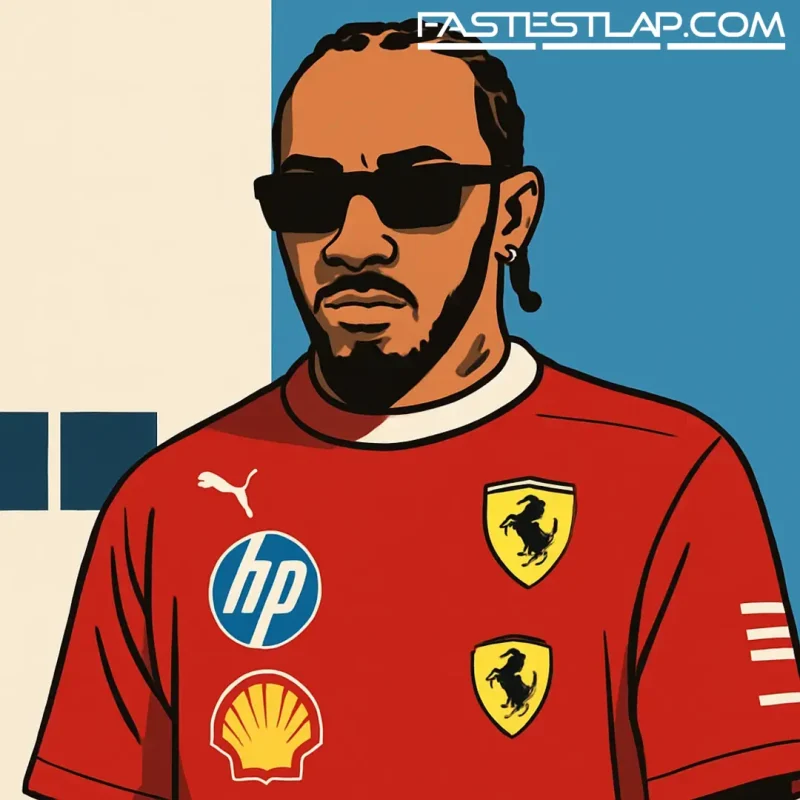
Brazilian GP: Hamilton escapes grid drop for double-yellow breach, handed reprimand after Leclerc spin
Lewis Hamilton dodged a grid penalty in São Paulo after the stewards ruled a reprimand was sufficient for failing to slow adequately under double waved yellows during Sprint qualifying at Interlagos.
The incident unfolded late in SQ2 when Charles Leclerc looped his Ferrari at the exit of Turn 10, triggering the double yellows. Hamilton, also in a Ferrari this year, arrived moments later while hustling to beat the clock after missing the cut-off to start a final lap. He didn’t back off enough through the yellow zone and was summoned.
The stewards dug into telemetry and onboard and concluded the seven-time champion “did not reduce speed as required.” But there was nuance. The double-yellow light panel on the left side of the track illuminated just as Hamilton was turning in, and for only a split second. With his vision keyed to the right, toward the apex, they accepted his explanation that he likely didn’t register the panel in time.
That wasn’t the end of it. Hamilton acknowledged he’d seen Leclerc’s Ferrari stationary off-line and a green signal beyond the incident. In the stewards’ view, that meant he knew he was in at least a yellow sector, and the obligation to slow “discernibly” still applied. The data showed only a brief hesitation on the throttle rather than a clear reduction in speed.
Ordinarily, failure to respect double yellows points toward a five-place grid drop. The panel instead leaned on precedent, saying similar cases had previously resulted in reprimands when visibility or timing of signals was a factor. On “consistency” grounds, Hamilton got the same.
It’s a judgment call that’ll divide opinion. Double waved yellows are among the sport’s non-negotiables: slow down, be prepared to stop. But the light-panel timing, the driver’s sightline at turn-in, and the quick change to a green beyond the scene muddied the picture enough to sway the room. Right call or a fortunate break? Depends which garage you’re in.
For Ferrari, it capped a scrappy session. The team never looked truly comfortable, and Hamilton’s SQ2 exit underlined it. He’ll line up 11th for the Sprint, work to do if he’s to salvage points from a grid that has pace scattered in unusual places. Leclerc, for his part, paid for the spin that set off the whole sequence.
Up front, Lando Norris planted the McLaren on Sprint pole with Oscar Piastri third, while Max Verstappen spent more time airing frustrations than celebrating performance after a scruffy afternoon for Red Bull. It all sets the Sprint up nicely: quick cars out of position, a Ferrari with ground to recover, and a champion who’s avoided a costly penalty but still has to slice through traffic on one of the trickiest short dashes of the year.
Key points from the stewards’ decision:
– Double yellows were triggered for Leclerc’s spin at Turn 10 in SQ2.
– The light panel on Hamilton’s approach illuminated very late and briefly; the stewards accepted he likely didn’t perceive it at turn-in.
– Hamilton saw the stationary Ferrari and a green light beyond the scene, which meant he should have slowed significantly.
– Telemetry showed only a momentary lift rather than a clear reduction in speed.
– Based on previous comparable rulings, the stewards issued a reprimand instead of the guideline five-place penalty.
– Hamilton starts P11 for the Sprint.
Expect Ferrari to spend the evening rebalancing the car and resetting the plan. Expect Hamilton to come out swinging. Interlagos usually rewards commitment — and after this brush with the rulebook, he’ll need plenty of it.