Formula 1 is barely three races into its 2026 era and already doing what it always ends up doing when a new rulebook meets the real world: getting everyone in a room to argue about what the sport has become.
Over the next couple of weeks, three formal meetings are scheduled between now and the Miami Grand Prix to review how the new regulations are behaving — not in theory, but in traffic, in qualifying, and under the kind of pressure that only a live championship provides. The first, on Thursday April 9, is essentially a technical stocktake: senior technical staff from the teams alongside FIA and FOM personnel, positioned as a Technical Advisory Committee-style session rather than a political summit. Team principals won’t be in that room. Yet.
The very existence of a meeting cycle this early isn’t, in itself, extraordinary. The sport always sands down the sharp edges of a new ruleset once the first data arrives. What’s different in 2026 is the tone around it — and the widening gap between what drivers are warning about and what teams privately seem content to live with.
At the heart of the unease is the new power unit landscape: 1.6-litre V6s delivering a near 50/50 split between internal combustion power and electrical energy from a 4mJ battery. With the combustion engine no longer the dominant part of the equation, lap time is increasingly an exercise in managing when and how the car charges and deploys. And because topping up the battery is largely achieved while running on track — primarily through braking — drivers have found themselves forced into behaviours that look, and often feel, engineered rather than instinctive.
The paddock’s shorthand for it has become familiar quickly: longer lift-and-coast phases, exaggerated corner approaches to maximise harvesting, and “super-clipping” — the mapping trick that lets a driver keep the throttle pinned while the car bleeds speed as the system harvests up to 250kW from the ICE. It can be fast. It can also be odd to watch, and even stranger to race against when every car’s deployment profile is being governed as much by algorithm as by the driver’s right foot.
That’s why the next fortnight matters. These meetings aren’t about tearing up 2026 and starting again — nobody credible in the system thinks that’s even remotely on the table. The manufacturers have locked in designs after years of development, and homologation alone blocks hardware changes until 2027 at the earliest. Any fantasy of rebalancing the power split towards the ICE — say, pushing it to 60/40 — is just that. Not viable, not quick, and, crucially, not what these discussions are for.
Instead, the focus is on refinements that can change the feel of the racing without detonating the foundations. That sounds modest, but “minor” in modern F1 can still reshape how a weekend is run: set-up direction, energy targets, even how drivers are instructed to attack or defend.
The clearest precedent arrived at Suzuka, where the energy harvesting limit was reduced from 9mJ to 8mJ. That was an agreement reached with all power unit manufacturers, aimed at easing the strain that 9mJ placed on driving technique. The logic was simple: at 8mJ, drivers can recover most of the required energy through more natural braking and partial load phases; at 9mJ, the system all but forces the more extreme lift-and-coast and super-clipping routines.
One of the more intriguing implications is that the harvest limit could become circuit-dependent, which would require careful rewording rather than a brute-force rewrite. The technical regulations already contain the scaffolding for it. Article C.5.2.10 allows reductions to 8mJ where the FIA determines that’s the maximum realistically harvestable per lap through braking and partial load — and even leaves room to go as low as 5mJ in qualifying at tracks where the required driving dynamics are deemed excessively unnatural. In other words: the levers exist. The sport is now debating how often to pull them.
Beyond that, options being kicked around include altering super-clipping harvesting limits (one idea being an increase to 350kW), allowing more energy recovery on the formation lap, and revisiting how movable aero is used — the last of those straddling performance and safety considerations in a way that tends to slow any decision-making to a crawl.
The calendar, oddly, has helped. With Bahrain and Saudi Arabia cancelled, F1 has been handed an unexpected gap — time that has allowed discussions that would normally happen in corridors and debrief rooms to be formalised into a proper process. Thursday’s meeting is expected to be a review exercise based on the first three weekends, with a second meeting pencilled in for the same day next week to refine proposals. The key date is April 20, when the final meeting includes team principals and the full F1 Commission stakeholder set — the point at which anything concrete could be agreed.
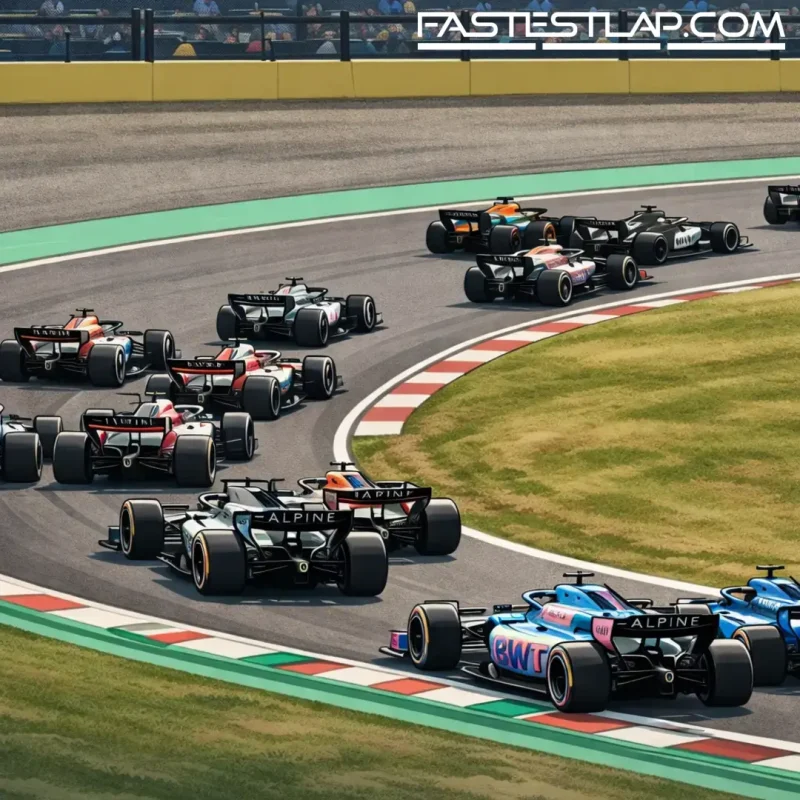
If all of this sounds bureaucratic, that’s because it is. But the urgency has been injected by what happened at Suzuka, where Oliver Bearman’s 50G crash became a stark demonstration of the new world’s closing-speed problem. Bearman was caught out by a large speed differential to Franco Colapinto’s Alpine — around 50km/h with Bearman in full deployment — and when Colapinto defended, Bearman took avoiding action and hit the barriers. The move itself wasn’t exotic by old standards; the mismatch in deployment patterns was.
That’s the scenario the drivers say they’ve been warning about. GPDA director Carlos Sainz didn’t dress it up after Suzuka, pointing out how quickly the same type of incident could become uglier on street circuits like Baku, Singapore or Las Vegas, where there isn’t always an escape road waiting.
Not every driver has sung from the same hymn sheet. Lewis Hamilton arrived at Suzuka calling harvesting the “least enjoyable” aspect of the new rules, yet argued the racing had improved because cars can follow more closely at high speed and battles are less dependent on a DRS-style patch. By the end of the weekend, though, his optimism had cooled. He said he wasn’t expecting much from the coming talks and voiced a familiar frustration: drivers can shout, but they don’t get a vote.
That’s the crux of the political tension heading into these meetings. Drivers want change — not just for lap-time aesthetics, but because they believe the current system bakes in unpredictable speed differentials. Teams, according to paddock sources, are generally happier with the “product” than the noise suggests, and some in senior circles insist fans are enjoying the racing more than in previous cycles, even if hard data hasn’t yet been put on the table to prove it.
What happens next is likely to be incremental rather than revolutionary. But in 2026, incremental changes to energy rules aren’t cosmetic. They decide whether drivers can race on instinct again — or whether the sport is prepared to accept that the fastest way around an F1 lap now comes with a layer of calculation that will always look a little artificial, no matter how good the wheel-to-wheel show becomes.