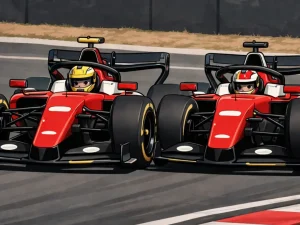
F1 Academy is tweaking its weekend shape for 2026, introducing a three-race format at selected rounds — a move that reads as both an ambition play and a practical response to a calendar that’s suddenly less stable than anyone expected.
The change lands in the wake of the cancelled F1 Academy races that were originally scheduled for Saudi Arabia. Those cancellations came as part of the broader removal of the Bahrain and Saudi Arabian grands prix from the Formula 1 calendar, which inevitably dragged the relevant support categories with them. In other words, the series has lost track time, lost visibility, and lost an important chunk of its rhythm — and it’s now moving to claw some of that back where it can.
The first outing for the new format will be in Montreal alongside the Canadian Grand Prix at Circuit Gilles Villeneuve, with the three-race weekend also set to return later in the year at Circuit of The Americas in Austin.
The key wrinkle is what F1 Academy is calling the “Opening Race”, which effectively becomes race one of three. Rather than setting that grid from the usual headline lap, the starting order will be determined by each driver’s second-fastest qualifying time — a tweak that puts a premium on consistency and judgement, not just a single peak effort.
There’s no points bonus for pole position under the new structure, but there will be a bonus point available for fastest lap. Full points will be on offer for the Opening Race, and everything scored counts toward both the Drivers’ and Teams’ standings.
It’s a subtle but significant set of incentives. Using second-fastest times takes some of the edge off the “all-in” qualifying moment and nudges drivers toward building a bankable weekend, which is no bad thing in a category where the whole point is development under pressure. It may also change how teams approach traffic management and tyre preparation in qualifying: the second lap can’t just be an afterthought if it decides a race grid.
F1 Academy managing director Susie Wolff framed it as part of the championship’s push to grow and to maximise meaningful running.
“Introducing the Opening Race at select rounds underscores our commitment to building a platform where the most talented can thrive by maximising competitive track time,” Wolff said. “As F1 Academy continues to grow on and off the track, I am continually looking for ways to elevate our race weekends.
“I’d like to thank our promoters for their support and enthusiasm for this dynamic new format, which will deliver additional on track action in Montreal and Austin and provide a compelling schedule for fans and drivers alike.”
The timing is hardly accidental. With two Middle East F1 rounds cut from the schedule — and support categories forced to reshuffle accordingly — every series in the F1 ecosystem is having to re-balance its year. F2 had been slated to race in both Bahrain and Saudi Arabia, while F3 was also due to run in Bahrain. Now, revisions are expected, with Miami and Montreal understood to be among the options being considered as replacements.
F2 and F3 have at least already got going: their 2026 campaigns began in Melbourne on Formula 1’s season-opening weekend. But the larger point stands: the junior ladder calendar is being reworked on the fly, and series organisers are looking for ways to protect sporting value while keeping the weekends attractive for promoters and spectators.
For F1 Academy, adding a third race at selected events is a neat way of turning a problem — less available real estate on the calendar — into a statement of intent. Montreal and Austin aren’t just convenient blanks to fill; they’re high-profile, high-attendance weekends that can offer the series the kind of stage it wants, particularly with a format designed to generate more action without resorting to gimmicks.
There will, inevitably, be questions about knock-on effects. More racing means more incident exposure, more pressure on budgets, and less margin for error across a weekend. But that’s also the point: if the goal is to prepare drivers for the next step up, giving them a denser programme — and a qualifying format that rewards repeatability — is a fairly honest way of doing it.
The first real tell will come in Canada. If the second-fastest-lap grid produces cleaner, more meritocratic openings, it’ll look inspired. If it turns into a game of managing gaps and manufacturing clear track at all costs, teams will adapt quickly — and the category will have learned something about itself just as quickly, too.
Either way, F1 Academy has made its move: fewer lost weekends, more racing where it matters, and a format that asks a slightly harder question than “who can nail one lap?” In 2026’s constantly shifting landscape, that kind of clarity is valuable.